


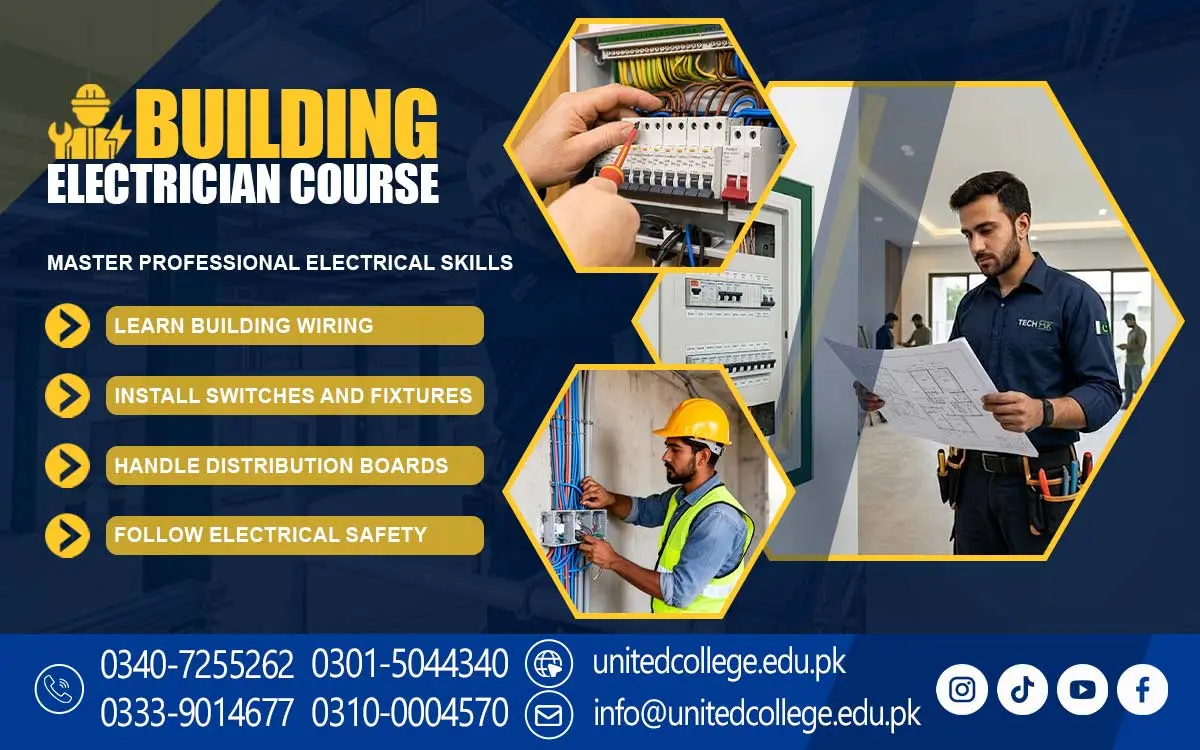

Building Electrician Course in Khurram Agency: Learn Practical Skills
When Electrical Problems Put a Building’s Safety at Risk
Imagine a family moving into a newly constructed house, only to discover that some lights are not working, a socket becomes unusually hot, and the circuit breaker keeps switching off. These problems may seem small at first, but they can indicate incorrect wiring, overloaded circuits, damaged cables, or other electrical faults that need professional attention. This is why trained building electricians play an important role in making homes and commercial properties safe and functional. They help install electrical systems, identify faults, maintain equipment, and ensure that electrical work follows appropriate safety requirements. For students and beginners in Khurram Agency, learning these skills can be a practical step toward understanding the electrical systems used in modern buildings.
The Building Electrician Course in Khurram Agency, offered by United College of Technology (UCT), is relevant to learners who want to explore electrical installation and maintenance as a technical skill. Building electrician training introduces learners to the work involved in residential electrical wiring, lighting systems, switches, sockets, and other electrical components. It also helps them understand why careful planning and correct installation matter in every project. Instead of guessing when an electrical problem occurs, a trained person learns to recognize possible causes and follow suitable procedures. Developing this knowledge can help beginners appreciate the responsibilities of an electrician and understand why technical ability, attention to detail, and electrical safety must always go together.
Develop Practical Electrical Skills Through Professional Training
Learning electrical work requires more than memorizing the names of wires and electrical components. A person must understand how different parts of an electrical system work together and how to handle them safely. Through a structured electrical installation course, beginners can develop an understanding of wiring methods, electrical symbols, basic circuit concepts, and the purpose of common electrical devices. The Building Electrician Course in Khurram Agency is a relevant training option for people who want to explore this technical field and build a foundation for further learning. Building electrician training in Khurram Agency can be especially useful for students who prefer practical skills alongside theoretical knowledge.
Similarly, learning about switches and sockets becomes easier when learners can connect these components with their everyday use in homes and offices. Beginners can also develop useful habits such as following instructions, checking their work carefully, keeping tools organized, and recognizing when a task requires experienced supervision. United College of Technology (UCT) offers the course for learners interested in building electrician skills. Before enrolling, prospective students should confirm the current course outline, practical training arrangements, admission requirements, and available facilities directly with the institution. Choosing suitable training helps learners understand the subject step by step rather than attempting complicated electrical tasks without the necessary knowledge or preparation.
Understand House Wiring, Lighting, Switches, and Sockets
A building may look complete from the outside, but its electrical system must be installed correctly before the property can function safely and conveniently. Lights, switches, sockets, fans, and other electrical fittings all depend on a properly planned wiring system. House wiring training helps learners understand how electricity is distributed throughout a residential property and why different components must be installed according to suitable electrical standards. During an electrical wiring course, beginners can learn about common wiring arrangements, cable types, basic electrical diagrams, and the purpose of different fittings. For example, a bedroom may require lighting points, switches near convenient locations, and sockets for everyday appliances.
Understanding these differences helps learners appreciate why electricians should assess the intended use of each area before installing electrical equipment. The Building Electrician Course in Khurram Agency can introduce learners to the concepts associated with residential electrical wiring and other building installation tasks. Learners can also explore how electrical drawings communicate the positions of lights, switches, sockets, and distribution equipment. These drawings help electricians understand the planned arrangement before work begins. Correct cable selection, secure connections, suitable circuit protection, and proper testing are essential parts of responsible electrical installation.
Learn to Identify Electrical Tools and Installation Equipment
Imagine arriving at an electrical workshop and seeing a multimeter, wire stripper, insulated screwdriver, cable cutter, and several types of electrical cable arranged on a workbench. A beginner may recognize some of these items but still be unsure about their correct uses. Learning to identify electrical tools and equipment is an important part of building electrician training because each tool serves a specific purpose. A wire stripper, for instance, is designed to remove insulation from a conductor without unnecessarily damaging the metal underneath. Insulated screwdrivers are made for electrical work, although their insulation does not make working on energized equipment safe. A multimeter is an instrument used to measure electrical quantities such as voltage, resistance, and, where appropriate, current.
A distribution board contains protective devices that distribute electrical power to different circuits within a building. Understanding these components helps learners recognize their functions during installation and maintenance activities. Through the Building Electrician Course in Khurram Agency, beginners can explore the role of electrical tools and equipment in professional work and develop an appreciation for using the correct tool for each task. Practical learning should also include checking tools for damage, keeping equipment clean, and storing it properly after use. Electrical testing instruments must be suitable for the task and used according to their instructions.
Build Skills in Electrical Fault Finding and Maintenance
A homeowner may notice that a circuit breaker trips repeatedly whenever several appliances are operating at the same time. Another person may find that a light flickers or that a particular electrical outlet has stopped working. These situations require more than replacing a component without understanding the cause. Electrical fault finding involves identifying the source of a problem through a systematic and safety-conscious process. A trained electrician considers possible causes such as damaged wiring, loose connections, overloaded circuits, faulty equipment, or an unsuitable protective device. Electrical maintenance skills are equally important because regular inspections and appropriate repairs can help identify developing problems before they cause equipment failure or interrupt normal activities.
For example, if a breaker trips repeatedly, it should not simply be reset again and again without investigating the underlying problem. A qualified electrician must determine why the protection is operating and arrange suitable corrective action. The Building Electrician Course in Khurram Agency can help interested learners explore the knowledge associated with electrical maintenance, fault identification, and responsible repair practices. Beginners should understand that diagnosing a fault does not mean immediately opening equipment or touching electrical conductors. Electrical supplies must be isolated before suitable work begins, and the absence of voltage must be verified using appropriate equipment and procedures.
Make Electrical Safety a Priority During Every Task
Electrical work can become dangerous when safety precautions are ignored. A damaged cable, wet working surface, exposed conductor, or incorrectly selected protective device may create a risk of electric shock, burns, fire, or equipment damage. This is why electrical safety training must be an essential part of learning to become a building electrician. Beginners need to understand the importance of isolating electrical supplies, preventing accidental reconnection, and verifying that circuits are de-energized before appropriate work begins. They should also learn why electrical systems must be protected against relevant faults through suitable circuit breakers, residual-current protection where required, and correctly installed earthing arrangements.
Earthing provides a protective connection intended to help reduce the danger associated with certain electrical faults. Personal protective equipment (PPE), such as suitable eye protection, protective footwear, and other task-specific equipment, can also support workplace safety, although PPE cannot replace proper isolation or safe working procedures. The Building Electrician Course in Khurram Agency provides a relevant learning pathway for people who want to understand the responsibilities involved in electrical installation and maintenance. Safety knowledge is particularly important on construction sites, where electricians may work around ladders, scaffolding, power tools, other tradespeople, and unfinished building structures. Learners should be taught to recognize hazards, keep work areas organized, use suitable equipment, and report unsafe conditions.
Gain Confidence Through Supervised Practical Learning
Reading about electrical components can help beginners understand their purpose, but practical activities are important for connecting that knowledge with real tasks. Consider a learner who understands the purpose of a switch in theory but has never examined how switches, conductors, and lighting components fit into a planned circuit. Supervised practice can make these relationships easier to understand. Practical electrician training may involve identifying tools, interpreting basic electrical diagrams, recognizing cable types, arranging components on training boards, and studying how simple circuits operate. Where suitable facilities and qualified supervision are available, learners can also practise approved installation exercises using de-energized training equipment.
These activities encourage careful work and help students become familiar with the sequence of an electrical task. For instance, learners may study how an electrical drawing indicates the intended position of lighting points and switches before examining how the arrangement is represented on a training board. They can also learn to check their work against instructions rather than assuming that a connection is correct simply because it looks neat. The Building Electrician Course in Khurram Agency, offered by United College of Technology (UCT), is relevant to beginners who want to develop an understanding of building electrical work. Prospective learners should verify which practical activities are included in the current course before enrolling.
Apply Building Electrician Skills in Homes and Commercial Properties
A small house may need lighting circuits, sockets, ceiling fans, and connections for everyday appliances, while a shop or office may require more extensive lighting, additional circuits, and electrical arrangements for computers, cooling equipment, and other devices. Larger commercial properties may contain more complex distribution systems and require coordination between several technical professionals. Building electricians help install, inspect, maintain, and repair electrical systems according to their training, authorization, and the requirements of each project. The Building Electrician Course in Khurram Agency can help learners explore the skills associated with residential wiring, commercial building electrical installation, and routine electrical maintenance.
For example, a new office fit-out may require electrical drawings to be reviewed, lighting points to be positioned correctly, and circuits to be installed and tested before the premises are used. On a construction site, electricians may also need to coordinate their work with builders, plumbers, and other tradespeople so that cables and electrical fittings are installed in the appropriate locations. Local businesses and property owners may require qualified technicians to investigate faults or maintain electrical equipment. However, the tasks a person can undertake depend on practical competence, experience, supervision, and applicable regulations. Training provides a foundation, but it does not automatically qualify someone for every electrical project.
Prepare for Technical Work Through Continued Learning and Responsible Practice
Developing electrical skills is a process that continues beyond the classroom. A learner may understand basic wiring concepts but still need more practice before handling unfamiliar installations or diagnosing complicated faults. Employers and customers generally need electricians who can follow instructions, communicate clearly, arrive prepared, keep records when required, and complete tasks carefully. These professional habits are just as important as knowing how electrical components work. Someone who notices damaged equipment, explains a problem honestly, and refuses to carry out unsafe work demonstrates responsibility that can build trust over time.
The Building Electrician Course in Khurram Agency, offered by United College of Technology (UCT), is an option for students and job seekers who want to begin exploring building electrical installation and maintenance. Before joining, learners should ask UCT about the current syllabus, practical facilities, course duration, assessment methods, and the qualification awarded on successful completion. After training, suitable next steps may include supervised workplace experience, additional technical courses, and further study of electrical standards and installation practices. Career possibilities may include assisting qualified electricians, working toward more advanced electrical responsibilities, or applying for relevant technical roles when the person meets the employer's requirements.
Frequently Asked Questions (FAQs)
The Building Electrician Course in Khurram Agency is a technical training option for learners who want to understand electrical wiring, building installations, maintenance, and electrical safety.
You can learn about house wiring, switches, sockets, lighting systems, electrical tools, circuit breakers, fault finding, and safe electrical working practices.
Students, beginners, fresh learners, and job seekers interested in developing electrical installation and maintenance skills can explore this course. Contact United College of Technology (UCT) to confirm the current admission requirements.
Yes, practical training helps learners understand electrical components, follow wiring diagrams, use tools correctly, and develop technical skills under qualified supervision.
United College of Technology (UCT) offers the Building Electrician Course in Khurram Agency. Contact the institution for details about the current syllabus, training facilities, duration, and admission process.
Admission Open: Start Your Professional Journey Today!
Join United College of Technology and build a career with practical training, recognized certifications, and Gulf job support. Seats are limited.
Apply Now via WhatsAppContact Information
- Address: Rawalpindi: F-272 Main New Katarian Stop, Old IJP Road | Lahore Campus: Lahore, Pakistan
- Phone/WhatsApp: 0340-7255262 / 0333-9014677 / 0301-5044340 / 0310-0004570 / 051-8770756
- Website: unitedcollege.edu.pk
















Leave a Comment