


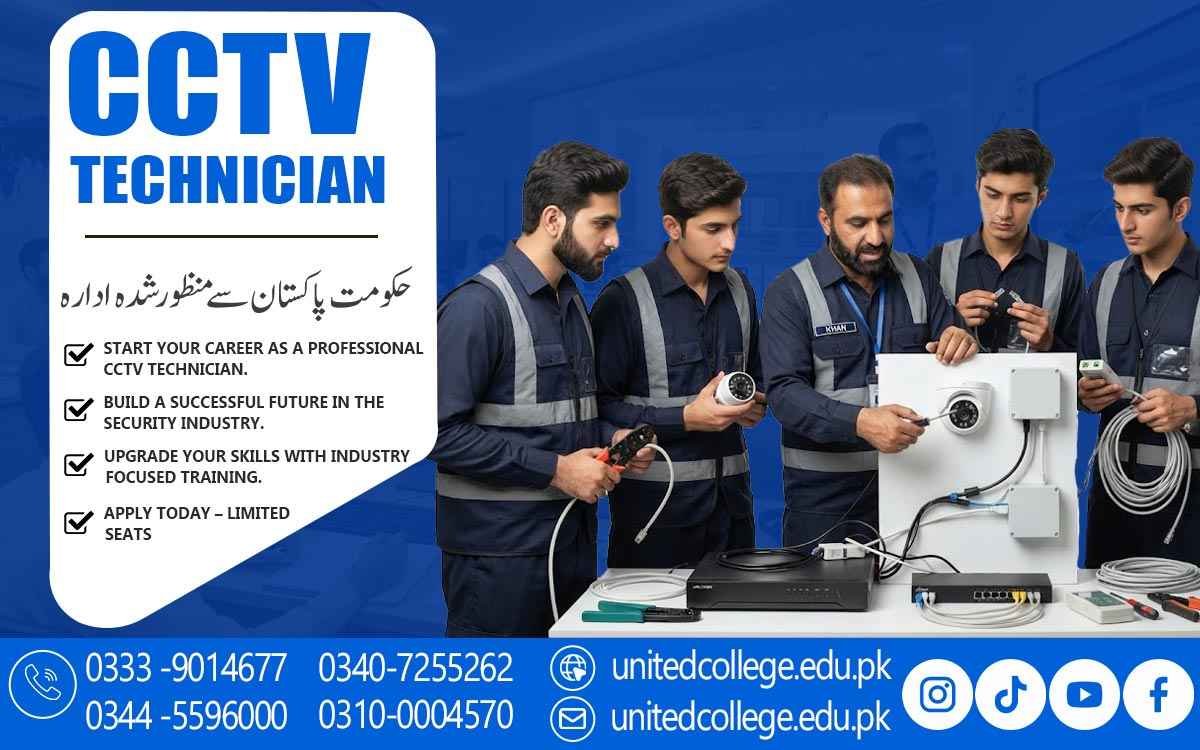

CCTV Technician Course in Jhang: Learn CCTV Systems Through Practice
Turn Security Technology Into a Valuable Practical Skill
A security camera can watch an entrance, protect a shop floor, monitor a school corridor, or help keep an office under observation—but only when the system is installed and configured correctly. From homes and shops to warehouses, offices, schools, and commercial buildings, CCTV has become a common part of modern security setups.
This creates a need for people who understand more than simply placing a camera on a wall. A trained technician needs to know about cameras, wiring, recording devices, positioning, networking, testing, and maintenance. The CCTV Technician Course in Jhang, offered by United College of Technology, gives beginners and fresh learners an opportunity to explore these practical skills and understand how different parts of a surveillance system work together.
When a Camera Becomes More Than Just a Security Device
CCTV work starts with understanding the purpose of a surveillance system. Different properties have different security requirements, so a technician must think about entrances, important rooms, outdoor areas, storage spaces, and other locations that may require monitoring. During a CCTV Technician Course in Jhang, learners can become familiar with the basic parts of a system, including cameras, cables, connectors, recording units, monitors, power components, and networking equipment.
Understanding the role of each part makes it easier to follow the complete path from capturing video to viewing or storing it. This foundation is important for beginners because CCTV installation is not based on one single skill. It combines equipment handling, basic technical knowledge, careful observation, and practical problem-solving.
The Right Camera Starts With the Right Location
Not every CCTV camera is designed for the same situation. Learners can explore common options such as analog cameras and IP cameras and understand how their features may suit different installation environments. Camera positioning is another important part of CCTV camera installation. A camera placed too high, too low, or at an unsuitable angle may fail to provide useful coverage.
The surrounding area, viewing direction, lighting, and purpose of the camera all need attention before final placement. For example, an entrance camera may need to focus on people approaching a doorway, while a camera inside a warehouse may need to cover a wider working area. Learning to connect camera choice with location helps students approach security camera installation more carefully.
DVR, NVR and Storage Create the System's Memory
A camera captures video, but another part of the system usually handles recording and storage. This is where learners begin to understand devices such as DVR and NVR and their role in video surveillance. A DVR is commonly associated with compatible analog camera systems, while an NVR is generally used with network-based cameras. The exact setup depends on the equipment being used, but the basic idea is simple: recorded video needs a suitable system that can receive, manage, and store camera footage.
Students can also learn how monitors connect with surveillance systems for viewing. Understanding the relationship between cameras, recording devices, storage, and displays gives learners a clearer picture of how a complete security system operates.
Clean Wiring Makes Technical Work Easier to Control
CCTV wiring may look like a small part of an installation, but poor cable management can create unnecessary problems. A technician needs to understand suitable cable types, connectors, connection points, and organized cable routing. During CCTV installation training, learners can practice connecting compatible components and keeping wiring neat. Proper organization also makes future inspection and maintenance easier because connections are easier to identify.
Power is another area that requires attention. CCTV cameras and related equipment need appropriate power arrangements. Beginners can learn the basic role of power connections without moving into unsafe electrical work. Careful handling and following proper safety practices should remain part of every installation task.
Networking Opens the Door to IP-Based Surveillance
Modern CCTV systems can also work through computer networks. IP cameras send video over a network, so students taking a CCTV Technician Course in Jhang can benefit from learning basic networking along with traditional camera installation skills. CCTV networking includes understanding how to connect compatible devices and how cameras communicate with other parts of the surveillance system.
Remote camera viewing is another important concept. With the right setup, authorized users can view camera feeds on devices such as smartphones or computers. Learning about remote viewing helps students understand how modern surveillance systems can be monitored from different locations instead of only through a local monitor.
Good Coverage Depends on More Than Mounting a Camera
A camera may be working perfectly and still fail to provide useful footage if its position is poorly planned. This is why learners need to look at the complete viewing area rather than focusing only on the physical installation. Practical camera positioning involves considering the direction of the lens, the area being monitored, possible obstacles, and the purpose of the camera.
Learners can also explore basic camera configuration so that connected equipment works according to the intended setup. After installation, the system needs to be checked. A technician may review the live view, confirm that cameras are communicating with the recording system, inspect connections, and verify that the required areas are visible. These checks help separate a properly configured system from an installation based on guesswork.
Troubleshooting Turns a Working Setup Into Real Technical Experience
Technical problems are part of learning CCTV work. A camera may show no picture, a connection may be loose, a cable may have an issue, or a display may fail to show the expected feed. Learning how to approach such situations develops practical troubleshooting ability. CCTV troubleshooting is easier when the technician checks the system step by step instead of changing everything at once.
Learners can develop a habit of examining connections, power, cables, device settings, and communication between components. Maintenance is also important after installation. Keeping equipment, connections, and system settings under observation can help identify issues that need attention. These skills are useful across different surveillance environments because technical systems require regular checking rather than one-time installation alone.
Practice Creates Confidence That Theory Cannot Provide
Reading about CCTV components can explain how a system works, but practical activities allow learners to understand how those components behave when connected together. This is why hands-on learning is an important part of developing practical CCTV skills. At United College of Technology, learners studying the CCTV Technician Course in Jhang can focus on practical aspects of CCTV installation and security systems.
Working through installation-related tasks can help beginners become more comfortable with cameras, cables, recording equipment, monitoring, configuration, and basic fault identification. Repeated practice also helps learners become more careful with small details. A properly connected cable, suitable camera position, organized installation, and careful system check can all contribute to better technical work.
Build One Technical Skill Today and Keep Learning Tomorrow
CCTV technology continues to develop, giving learners reasons to keep improving their knowledge after learning the basics. Newer cameras, network-based systems, monitoring features, and connected security equipment can introduce additional areas for future study. The skills developed through CCTV installation can also provide a starting point for related technical learning, such as basic networking, electronic equipment handling, security system maintenance, and other surveillance technologies.
The CCTV Technician Course in Jhang at United College of Technology can help learners begin that process by focusing on the practical side of surveillance systems. With regular practice, careful learning, and a willingness to understand new equipment, a beginner can gradually build a stronger foundation in CCTV technical skills.
Frequently Asked Questions (FAQs)
The technician should first understand the property's requirements, identify important monitoring areas, and consider how the complete system will be arranged.
Clear labeling can make different cables and connections easier to identify, which can save time when checking, servicing, or modifying the system later.
Yes. Learners can explore how camera locations and equipment arrangements may change according to the size, structure, and security requirements of a property.
The technician can follow the connection path and examine relevant power, cable, device, and configuration points to identify where the problem may have started.
Basic records of camera locations, connections, and system details can make future maintenance easier and help technicians understand the installation more quickly.
Yes. CCTV work can introduce learners to areas such as networking, electronic devices, system maintenance, and other technologies used in modern security setups.
Admission Open: Start Your Professional Journey Today!
Join United College of Technology and build a career with practical training, recognized certifications, and Gulf job support. Seats are limited.
Apply Now via WhatsAppContact Information
- Address: Rawalpindi: F-272 Main New Katarian Stop, Old IJP Road | Lahore Campus: Lahore, Pakistan
- Phone/WhatsApp: 0333-9014677 / 0344-5596000 / 0310-0004570 / 0301-5044340 / 0340-7255262
- Website: unitedcollege.edu.pk
















Leave a Comment