


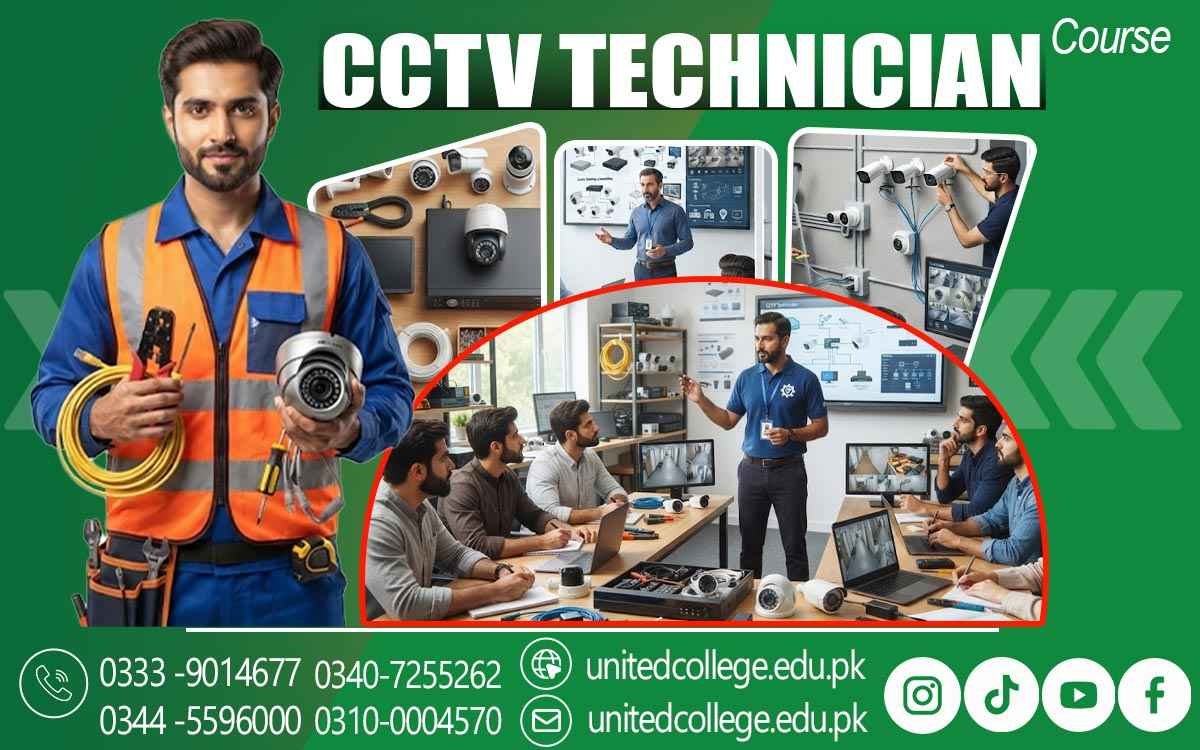

CCTV Technician Course in Narowal – Master Modern Security Systems
When a Camera Becomes More Than Just a Camera
What would happen if a shop owner wanted to see what was happening near the entrance after closing time, or a school administrator needed to monitor important areas of a building without being physically present everywhere? This is where CCTV systems become useful. Modern surveillance is no longer limited to large organizations; cameras can be found in homes, shops, offices, schools, warehouses, workshops, factories, and commercial buildings. However, installing a camera properly requires more than fixing it to a wall and switching it on. The technician needs to understand camera selection, positioning, wiring, power connections, recording equipment, networking, and troubleshooting.
A CCTV Technician Course in Narowal can introduce beginners to these practical areas and help them understand how complete security camera systems are installed and maintained. Learners can explore CCTV camera installation, surveillance equipment, video recording, monitoring, and basic networking while developing technical skills through practical learning. For students, fresh learners, school and college graduates, and people interested in security technology, learning how CCTV systems actually work can be a useful way to develop a hands-on technical foundation.
Understanding the Different Cameras Used for Different Security Needs
Why does one building use small dome cameras while another uses long bullet-shaped cameras? The answer often depends on the location, viewing requirements, lighting conditions, installation environment, and type of surveillance needed. During a CCTV technician Course, learners can become familiar with commonly used camera types, including analog cameras, IP cameras, dome cameras, and bullet cameras. Analog cameras generally transmit video through traditional cabling to compatible recording equipment, while IP cameras use network connections to send digital video data.
Dome cameras are often designed in a compact shape that can be useful for indoor installations, while bullet cameras can be suitable for situations where a more directional view is required. Understanding these differences helps beginners avoid treating every camera as the same device. A technician needs to consider where the camera will be installed, what area needs to be covered, and what type of system the customer requires. Through a CCTV installation course, learners can explore these choices in simple terms and understand how camera selection connects with the overall design of a security camera system.
Proper Camera Installation Starts With the Right Position and Wiring
A camera may have good specifications, but what happens if it is installed in the wrong place? Even a capable surveillance camera may provide limited useful footage if its view is blocked, the angle is poor, or the wiring is not installed correctly. Practical CCTV camera installation therefore involves several steps, including selecting an appropriate mounting position, fixing the camera securely, routing cables carefully, attaching connectors, and checking power connections. Learners can study how camera positioning affects the area visible in the footage and why important entrances, pathways, counters, gates, and other relevant locations need to be considered during installation.
They can also become familiar with camera wiring, cable management, connectors, and basic installation tools. A technician should keep cables organized and protected while ensuring that connections are secure and suitable for the equipment being used. The CCTV Technician Course in Narowal can give beginners an opportunity to understand these practical installation tasks and see how careful preparation can make a surveillance system more reliable and easier to maintain later.
DVR and NVR Turn Camera Video Into Usable Surveillance Records
Seeing a live camera image is useful, but what if someone needs to review footage from several hours or days earlier? This is where recording equipment becomes an important part of a CCTV system. Learners can study the role of DVR and NVR systems and understand how they are used to manage and record surveillance video. A DVR, or Digital Video Recorder, is commonly associated with compatible analog camera systems, while an NVR, or Network Video Recorder, is designed for network-based camera systems. Students can learn how cameras connect to recording equipment, how storage is used, and how recorded footage can be reviewed when needed.
They can also become familiar with basic recording settings and the importance of checking whether cameras are actually recording instead of assuming that a live display means everything is working correctly. Storage capacity, recording schedules, camera resolution, and system configuration can all affect how surveillance footage is managed. Understanding these areas gives beginners a broader view of security system installation because a complete CCTV setup involves not only cameras but also the equipment responsible for organizing and retaining video information.
IP Cameras Bring CCTV Installation Into the World of Networking
What happens when a camera needs to send video through a computer network instead of using a traditional CCTV connection? This is where IP cameras and CCTV networking become important. IP cameras communicate through network connections, so a technician needs some understanding of basic networking concepts to install and configure them correctly. During practical training, learners can be introduced to terms such as IP address, network connection, router, Ethernet cable, and network camera. These concepts may sound complicated to a beginner, but they become easier when explained through practical examples.
For instance, an IP camera may need to communicate with a recording device or network infrastructure before its video can be viewed and stored correctly. Learners can explore how network connections are checked, how devices communicate, and how basic configuration affects camera operation. Basic networking for CCTV can therefore become an important part of modern technician training. The CCTV Technician Course in Narowal can help beginners understand the relationship between surveillance technology and computer networking, particularly as more security systems use network-based cameras and digital monitoring solutions.
Remote Monitoring Depends on More Than Simply Having an Internet Connection
Imagine a business owner wanting to check a shop camera while away from the premises. Remote CCTV monitoring can make this possible when the surveillance system, network, recording equipment, and viewing application are configured appropriately. However, simply connecting a camera to the internet does not automatically mean that remote viewing will work correctly. Learners can study the basic concepts behind remote monitoring and understand how network cameras, recording devices, internet connectivity, and viewing systems work together. They can also learn why stable connections, correct device settings, and proper network configuration matter when setting up remote access.
Practical CCTV training can introduce common installation scenarios so beginners understand how technicians approach remote viewing requirements. This area also connects CCTV with broader security technology because modern surveillance systems increasingly combine cameras with digital networks and software-based monitoring. By understanding the basic workflow, students can become more comfortable with network cameras and remote viewing concepts without treating the technology as something mysterious or difficult to approach.
Troubleshooting Starts With Finding the Real Cause of the Problem
A CCTV system can stop showing video for many different reasons, so how does a technician know where to begin? Instead of immediately replacing a camera, a technician needs to identify whether the problem is related to power, cabling, connectors, network communication, recording equipment, configuration, or the camera itself. CCTV troubleshooting can therefore be an important part of practical technical training. Learners can study common problems such as a camera showing no display, unclear or distorted video, intermittent connections, power failures, recording problems, network connectivity issues, or a camera that stops responding.
They can learn to check connections systematically and separate one possible cause from another. Maintenance is equally important because dust, loose connections, damaged cables, environmental conditions, or equipment wear can affect system performance over time. Through CCTV camera repair and maintenance exercises, beginners can understand why careful inspection is often more useful than guessing. This problem-solving approach can help learners develop patience and technical thinking, both of which are valuable when working with surveillance systems in real environments.
The Right Tools Make CCTV Installation Safer and More Organized
How can a technician complete a neat installation without the right equipment? Practical CCTV work requires familiarity with tools used for mounting, wiring, testing, and configuring surveillance equipment. Learners can become familiar with items such as screwdrivers, drills, cable cutters, crimping tools, connectors, testing devices, network cables, and other CCTV installation tools used according to the type of system being installed. They can also learn how to handle cameras, DVRs, NVRs, power supplies, cables, storage devices, and networking equipment carefully.
Good installation is not simply about making the camera work temporarily; cables should be routed in an organized manner, devices should be mounted securely, and connections should be checked before the system is handed over for use. Safety also matters when working around electrical connections, ladders, walls, ceilings, and other installation environments. United College of Technology can introduce learners to the practical side of CCTV installation through structured training, allowing them to connect technical explanations with the tools and equipment used in real surveillance work.
Building Practical CCTV Skills for Security Systems in Narowal
Where can CCTV knowledge be useful in everyday life? In Narowal, surveillance systems may be relevant to homes, retail shops, offices, schools, warehouses, workshops, commercial buildings, and other places where people want to monitor specific areas. This does not mean every location needs the same setup; the appropriate system depends on the property, security requirements, viewing areas, lighting, budget, and technical conditions. A CCTV Technician Course in Narowal can help beginners understand how these requirements translate into practical installation and maintenance tasks.
The training can also help them understand the importance of planning a system before installing individual components. With regular practice, learners can build a stronger technical foundation and become more comfortable working with security camera systems, surveillance equipment, and video monitoring technology. These skills can provide useful knowledge for exploring technical work related to CCTV installation, maintenance, monitoring, and security system services while leaving room for further learning as technology continues to change.
Frequently Asked Questions (FAQs)
A CCTV Technician Course in Narowal teaches practical skills for installing, configuring, maintaining, and troubleshooting CCTV security systems.
Beginners, students, fresh learners, electricians, and individuals interested in security system installation can learn CCTV technician skills.
Students can learn camera installation, cable connections, DVR and NVR setup, IP cameras, networking, recording systems, remote viewing, and basic troubleshooting.
DVR is commonly used with traditional analog CCTV cameras, while NVR is designed to manage and record video from network-based IP cameras.
Yes, beginners can learn CCTV installation when training starts with basic components and gradually moves toward practical installation, configuration, and troubleshooting tasks.
Admission Open: Start Your Professional Journey Today!
Join United College of Technology and build a career with practical training, recognized certifications, and Gulf job support. Seats are limited.
Apply Now via WhatsAppContact Information
- Address: Rawalpindi: F-272 Main New Katarian Stop, Old IJP Road | Lahore Campus: Lahore, Pakistan
- Phone/WhatsApp: 0333-9014677 / 0344-5596000 / 0310-0004570 / 0301-5044340 / 0340-7255262
- Website: unitedcollege.edu.pk
















Leave a Comment