


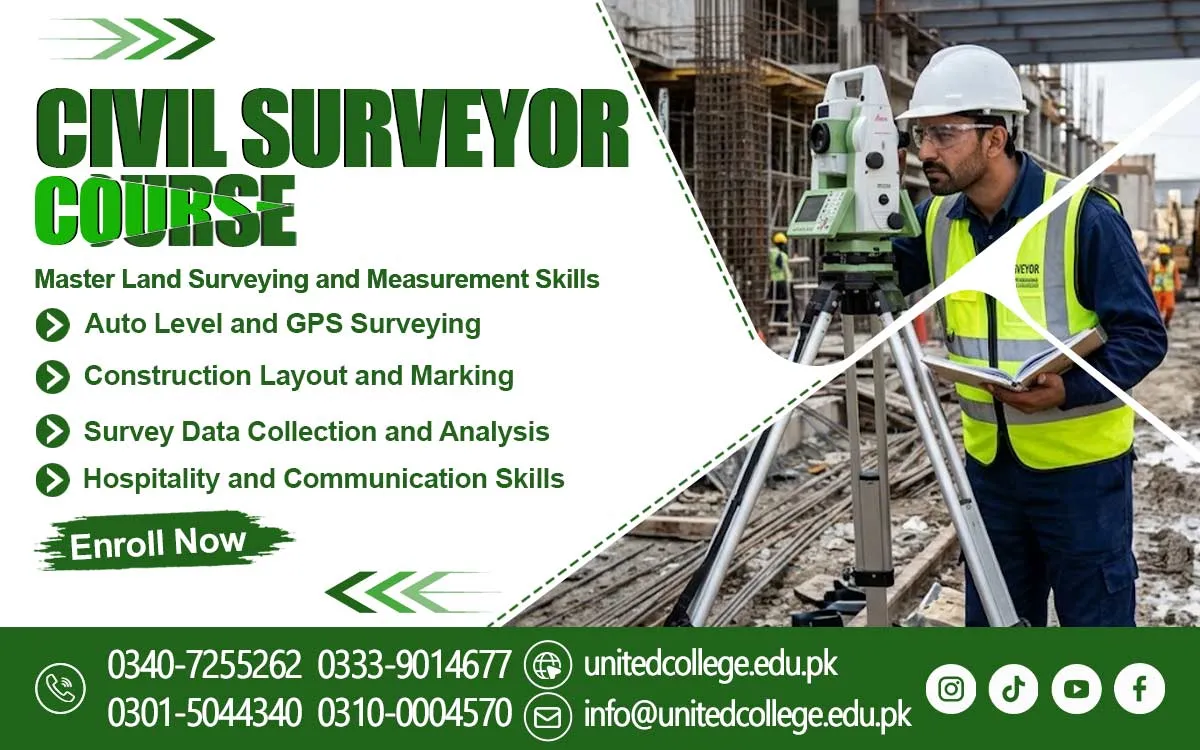

Civil Surveyor Course in Charsadda Build Technical Knowledge
Strong Construction Begins With Careful Ground Assessment
A well-planned construction project depends on understanding the land before any building work starts. From checking ground levels to identifying site boundaries, accurate measurements help construction teams follow the correct plans and avoid unnecessary mistakes. Civil surveyors play an important role in this process by collecting land information and providing measurements that support engineers, architects, and construction workers.
The Civil Surveyor Course in Charsadda introduces beginners and students to the basic methods used in professional surveying. It helps learners understand how land is measured, how site conditions are examined, and how field information is used during construction planning. For individuals interested in civil engineering, technical work, or infrastructure development, learning these fundamentals can provide a useful starting point for exploring the surveying field.
Transforming Raw Land Information Into Reliable Construction Layouts
Civil surveying connects the physical condition of land with the technical requirements of a construction project. Before a building, road, or other structure can be developed, professionals need information about distances, directions, elevations, and site boundaries. Surveyors collect this information through measurements and observations, helping project teams understand the area where construction will take place.
For example, when a building is planned on an empty plot, surveyors help identify its dimensions and establish reference points for the proposed layout. Their measurements support decisions about where different parts of the structure should be positioned. The Civil Surveyor Course in Charsadda helps learners explore these responsibilities and understand how Construction Surveying contributes to organized development work.
Technical Abilities That Turn Beginners Into Confident Learners
Surveying involves several practical activities that require attention, mathematical understanding, and careful observation. Students entering a Land Surveying Course need to become familiar with the methods used to collect and record field information. These skills help them understand how surveyors work with actual land conditions instead of depending only on drawings or assumptions. Distance measurement helps determine the dimensions between different points, while levelling is used to identify differences in ground elevation.
Angle measurement supports the establishment of directions and positions, and site marking helps transfer planned measurements onto the ground. Learners also need to understand basic surveying calculations and how field readings are recorded. Developing these Civil Engineering Skills gradually helps beginners become more comfortable with technical tasks and measurement procedures.
Surveying Instruments That Bring Precision to Every Measurement
Surveyors use different instruments depending on the type of work and the accuracy required. Understanding these tools is an important part of Civil Surveyor Training because each instrument has a specific purpose. Beginners should first learn how the equipment works and why correct handling matters during field activities.
Commonly used surveying equipment includes measuring tape, which is used to measure distances and basic site dimensions; an auto level, which helps check differences in elevation between ground points; and a theodolite, which measures horizontal and vertical angles. A total station is used to measure distances and angles electronically, while GPS devices help identify geographical positions and coordinates.
Surveyors Establish the Site Information Needed Before Construction Starts
Before construction teams begin their work, they need a clear picture of the site. Surveyors help provide this information by examining the land, identifying important reference points, checking boundaries, and measuring ground elevations. Their observations help engineers understand whether the existing site conditions match the requirements of the proposed project.
Site inspection and measurement are particularly important when construction takes place on uneven or irregular land. For example, a surveyor may need to identify differences in ground height before a foundation is prepared. Similarly, checking boundaries helps clarify the limits of a particular construction area. Through the Civil Surveyor Course in Charsadda, learners can understand how surveyors collect this information and why their responsibilities are important before physical construction begins.
Surveying Knowledge Supports Roads, Buildings, and Infrastructure Development
Civil surveying has applications across many types of construction projects. Road development requires measurements to establish alignment, direction, and elevation. Building projects depend on accurate site dimensions and layout positions, while bridge construction requires detailed information about the surrounding land and structural locations. Housing schemes and land development also depend on reliable measurements for planning different areas.
Understanding these applications helps students recognize that surveying is connected to more than one type of construction activity. It provides useful information for engineers and technical teams working on different stages of a project. In Charsadda, learning about these applications can help interested individuals understand how surveying knowledge relates to local construction, property development, and infrastructure planning without assuming that every project requires the same measurement methods.
Building a Strong Technical Foundation Through Practice and Observation
Beginners often find surveying easier when they connect technical explanations with practical examples. Understanding how measurements are taken, how instruments are positioned, and how readings are checked requires patience and regular learning. Civil Surveyor Training can help learners become familiar with the sequence of field activities and the importance of following correct measurement procedures.
Good surveying also requires responsible working habits. Students should develop concentration, basic mathematical skills, clear communication, and the ability to observe small differences in site conditions. Safety awareness is equally important because field activities may take place near vehicles, machinery, uneven surfaces, and active construction areas. Learning to follow instructions and maintain organized records helps beginners understand the professional responsibilities associated with surveying work.
Professional Training Creates a Path Toward Deeper Surveying Knowledge
Choosing an appropriate institute is an important decision for anyone interested in technical education. Learners should review the course syllabus, understand which subjects are covered, and ask about the practical learning arrangements. They should also consider whether the teaching approach makes technical topics understandable for beginners and provides a clear introduction to the responsibilities of a civil surveyor.
The Civil Surveyor Course offered by United College of Technology is an educational option for individuals interested in learning the fundamentals of land measurement and construction surveying. Before enrolling, interested learners should confirm the available course details directly with the institute rather than making assumptions about its duration, facilities, or other arrangements.
Expanding Your Technical Understanding Beyond Basic Surveying Methods
Completing basic surveying training can encourage learners to explore more advanced technical subjects. As their understanding improves, they can become familiar with additional measurement methods, digital surveying concepts, coordinate systems, and more detailed site mapping techniques. Exploring these areas helps students understand how surveying continues to develop alongside changes in construction technology. Civil surveying knowledge can also support further learning in related areas of construction and engineering.
Individuals may explore subjects such as civil drafting, construction planning, land development, and engineering drawing interpretation according to their interests and educational goals. The Civil Surveyor Course in Charsadda provides a starting point for understanding how measurements, observations, and technical information contribute to development projects. With regular practice, careful learning, and a willingness to improve, beginners can build a stronger foundation for continued technical education in the civil surveying field.
Frequently Asked Questions (FAQs)
Chain surveying is a basic method used to measure land distances with a chain or tape. It is commonly suitable for smaller and relatively simple areas.
Horizontal distance is the distance measured between two points along a level plane, regardless of differences in ground height.
Coordinates help identify the exact position of points on the ground, making it easier to prepare maps and locate specific areas.
A traverse is a series of connected survey lines used to determine the positions of different points across a particular area.
They take readings at different locations and compare the height measurements to understand variations in the land surface.
Clear communication helps engineers and construction teams understand measurement findings and use the information correctly during project planning.
Admission Open: Start Your Professional Journey Today!
Join United College of Technology and build a career with practical training, recognized certifications, and Gulf job support. Seats are limited.
Apply Now via WhatsAppContact Information
- Address: Rawalpindi: F-272 Main New Katarian Stop, Old IJP Road | Lahore Campus: Lahore, Pakistan
- Phone/WhatsApp: 0340-7255262 / 0333-9014677 / 0301-5044340 / 0310-0004570 / 051-8770756
- Website: unitedcollege.edu.pk
















Leave a Comment