


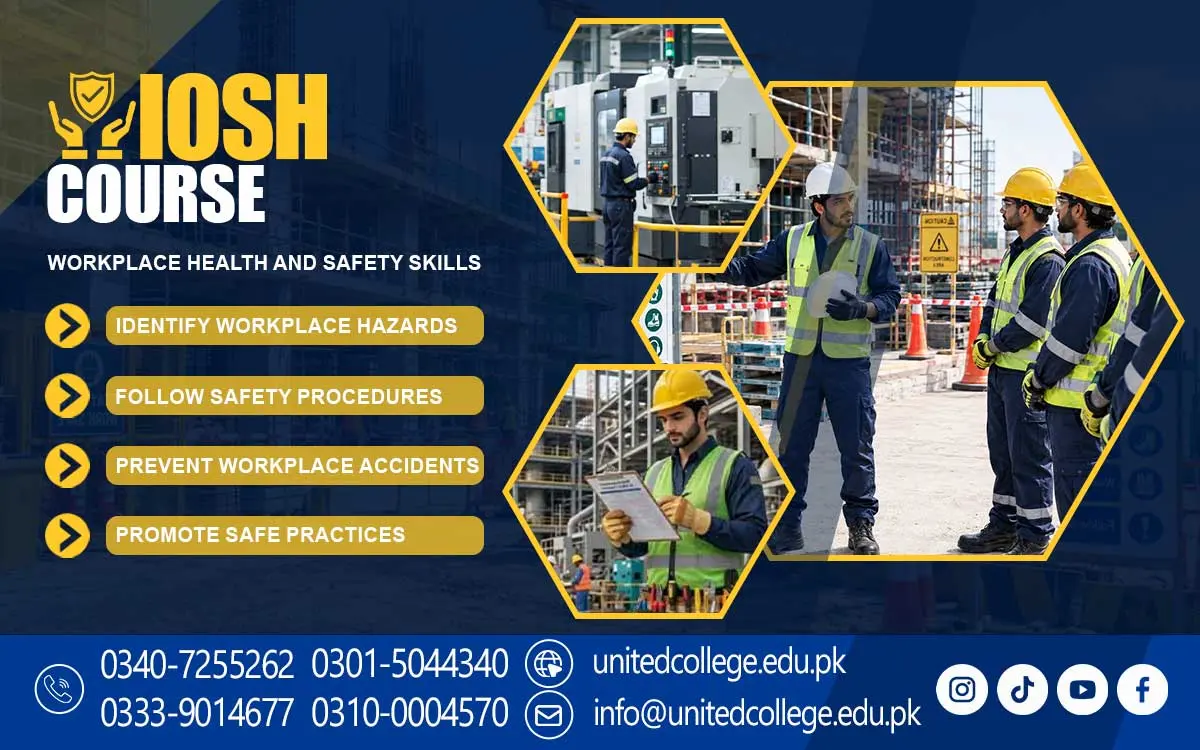

IOSH Course in Kohat for Workplace Health and Safety Skills
A Small Workplace Hazard Can Lead to a Serious Accident
Imagine a worker entering a construction site where electrical wires are lying across the floor, heavy materials are stored carelessly, and some employees are working without safety helmets. A loose wire can result in an electric shock, poorly stored materials can fall, and a slippery surface can cause injuries. Such situations show why workplace health and safety should never be ignored. Every organisation needs employees who understand safety precautions and can recognise possible dangers before they become serious problems. The IOSH Course in Kohat, offered by United College of Technology (UCT), provides an opportunity for learners to develop knowledge of occupational health and safety and understand safer working practices.
IOSH training introduces important subjects such as hazard identification, risk assessment, accident prevention, personal protective equipment, and workplace safety responsibilities. These subjects are useful in different working environments, including construction sites, factories, warehouses, workshops, and offices. For students, new learners, and working individuals, learning about workplace safety can build a better understanding of how risks affect employees and daily operations. Instead of waiting for an accident to happen, trained individuals can recognise unsafe conditions and take appropriate steps to reduce workplace risks.
Workplace Safety Standards in Modern Industries
Workplace safety has become an important part of daily operations in almost every industry. Construction workers handle heavy equipment, factory employees operate machines, warehouse staff move materials, and office workers use electrical devices throughout the day. Each environment has different hazards that require suitable safety precautions. For example, a construction worker may face risks from falling objects or working at height, while a factory employee may be exposed to moving machinery, noise, or chemicals. Occupational Health and Safety (OHS) focuses on protecting workers from these dangers through proper procedures, training, and workplace controls.
The IOSH Course in Kohat introduces learners to the importance of maintaining safe working conditions and following workplace safety regulations. Students can understand how safety awareness helps reduce injuries, equipment damage, and unnecessary interruptions to work. They also learn that safety is not only the responsibility of a safety officer; managers, supervisors, and employees all have important roles. A safe workplace requires cooperation, clear instructions, suitable equipment, and regular attention to possible hazards. Understanding these responsibilities can help learners recognise the value of health and safety management in professional environments.
IOSH Training and Recognised Safety Learning Programmes
IOSH stands for the Institution of Occupational Safety and Health, a professional organisation associated with workplace health and safety. Its training programmes are designed to improve safety awareness and help people understand their responsibilities in different working environments. Two commonly known IOSH courses are IOSH Working Safely and IOSH Managing Safely. IOSH Working Safely is generally designed for employees who need to understand workplace hazards, safety responsibilities, and basic precautions. IOSH Managing Safely is intended for managers and supervisors who need to understand how to manage health and safety within their teams and work areas. Both programmes cover important safety concepts, although their learning objectives and target audiences are different.
Through IOSH Training in Kohat, learners can explore these subjects and understand how safety knowledge applies to everyday workplace situations. The training introduces concepts such as identifying hazards, controlling risks, preventing accidents, and maintaining safe working practices. It is important to understand that IOSH training is different from a general Safety Officer Course, even though both areas cover workplace safety. Learners should check the specific course level, syllabus, assessment requirements, and certificate arrangements before enrolment. This helps them select training that matches their existing knowledge, responsibilities, and learning goals.
Hazard Identification and Workplace Risk Assessment
A workplace accident often begins with a hazard that was not recognised or controlled in time. A damaged electrical cable, an uncovered floor opening, an overloaded shelf, or a leaking chemical container can create serious risks for employees. Hazard identification means recognising anything that has the potential to cause harm. Risk assessment goes a step further by considering how likely an accident is and how serious its consequences could be. During the IOSH Course in Kohat, learners become familiar with these important workplace safety concepts and their practical importance. For example, if employees are working on a construction site, they may face risks from falling objects, unstable ladders, exposed electrical connections, and moving machinery.
A risk assessment helps identify these dangers and determine suitable control measures. These may include installing safety barriers, providing protective equipment, improving storage arrangements, or restricting access to dangerous areas. Learners also develop an understanding of workplace hazard control and the importance of reviewing safety arrangements when working conditions change. Risk assessment is not simply a document prepared for recordkeeping; it is a process that supports better decisions and safer working conditions. Developing this knowledge can help individuals recognise potential problems before they cause injuries or disrupt normal workplace activities.
Employee Responsibilities and Safe Working Practices
Workplace safety depends on the behaviour and cooperation of everyone involved in daily operations. Employers and managers are responsible for providing suitable working conditions, relevant safety instructions, and appropriate protective equipment. Supervisors help communicate safety procedures, monitor work activities, and report unsafe conditions. Employees also have responsibilities, such as following instructions, using equipment correctly, wearing required protective gear, and informing supervisors about hazards. The IOSH Course in Kohat helps learners understand these different responsibilities and why they matter. Consider a factory where an employee notices that a machine guard has become loose.
Continuing to operate the machine without reporting the problem could put several workers at risk. A responsible employee should stop and report the unsafe condition according to workplace procedures rather than attempting an unfamiliar repair. Personal Protective Equipment (PPE) is another important part of safe working practices. Depending on the task, workers may need helmets, safety shoes, gloves, goggles, ear protection, or high-visibility clothing. However, PPE should not be treated as the only method of controlling hazards. Organisations should also consider safer equipment, proper machine guards, suitable work arrangements, and other preventive measures.
Fire Prevention and Emergency Response Procedures
A fire can spread quickly when combustible materials are stored carelessly, electrical equipment is damaged, or workplace safety procedures are ignored. Even a small fire can create panic if employees do not know how to respond. This is why fire prevention and emergency preparedness are important subjects in occupational health and safety training. Learners studying the IOSH Course in Kohat can develop an understanding of common fire hazards and the precautions used to reduce fire risks. For example, keeping emergency exits clear, storing flammable materials correctly, checking electrical equipment, and maintaining suitable fire safety equipment can help improve workplace preparedness.
Fire extinguishers must be suitable for the type of fire, and only people with appropriate training should attempt to use them when it is safe to do so. In situations involving spreading flames or heavy smoke, evacuation should take priority. Emergency response procedures also cover other incidents, such as chemical spills, electrical accidents, and workplace injuries. Clear communication and regular emergency drills help employees become familiar with the actions expected of them. Fire safety training and accident prevention are not limited to industrial locations; offices, shops, educational buildings, and warehouses also need suitable emergency arrangements.
Safety Inspections, Incident Reporting and Documentation
A workplace may appear clean and organised while hidden safety problems remain unnoticed. A damaged ladder, an exposed electrical connection, an obstructed emergency exit, or a faulty machine can create risks that require attention. Regular safety inspections help identify these problems before they result in accidents. During IOSH training, learners become familiar with the purpose of workplace inspections and the importance of observing working conditions carefully. For instance, a warehouse inspection may involve checking storage racks, walking areas, lifting equipment, fire exits, and the condition of protective equipment. If an unsafe condition is discovered, it should be reported through the organisation's established procedure so that appropriate action can be taken.
Incident reporting is equally important because accidents and near misses can reveal weaknesses in existing safety arrangements. A near miss is an event that could have caused an injury or damage but did not. Recording such incidents helps organisations understand what happened and reduce the chances of similar events occurring again. Safety documentation may include inspection records, risk assessments, accident reports, training records, and maintenance information. The IOSH Course in Kohat introduces learners to the importance of these activities in workplace risk management. Proper records support communication, help monitor safety improvements, and provide useful information when reviewing workplace procedures.
Practical Applications Across Different Workplace Environments
The knowledge gained through IOSH training can be relevant to many types of workplaces because safety risks exist in different forms across industries. On a construction site, workers may need to understand fall protection, safe scaffolding, equipment movement, and the correct use of helmets and safety footwear. In a factory, important concerns may include machine guarding, chemical handling, noise exposure, and safe operating procedures. Warehouse employees may deal with heavy lifting, forklift movement, stacked materials, and blocked walkways. Office environments also require attention to electrical safety, fire exits, workstation arrangements, and slip hazards. The IOSH Course in Kohat helps learners understand how general safety principles can be applied to these different situations.
For example, a person working in a warehouse should recognise the danger of walking beneath an unstable load, while an office employee should know why damaged electrical cables must be reported. Although the specific hazards vary, the basic approach remains similar: identify the danger, understand the possible consequences, follow suitable control measures, and report unsafe conditions. This knowledge can also support communication between workers and supervisors because individuals become more familiar with common safety terms and procedures. Practical examples make occupational safety easier to understand and show how small preventive actions can contribute to a safer working environment.
Professional Learning Opportunities Through IOSH Training at UCT
Developing workplace safety knowledge can be a useful step for individuals interested in industries where health and safety responsibilities are part of daily operations. Students, fresh learners, supervisors, and working professionals may all benefit from understanding hazard identification, risk assessment, accident prevention, and safety communication. The IOSH Course in Kohat offered by United College of Technology (UCT) gives interested learners an opportunity to explore important occupational health and safety subjects through structured training. The knowledge gained can be relevant to construction, manufacturing, logistics, warehousing, maintenance, and other working environments.
Individuals who already work in these sectors may find safety training helpful for understanding workplace procedures and their responsibilities. Beginners can also develop a foundation for further learning in occupational health and safety. However, completing an IOSH course does not automatically qualify someone for every safety-related position. Job requirements can differ according to the employer, industry, experience, and additional qualifications needed. Learners should also check the particular IOSH programme being offered, including its level, course content, assessment method, and certification arrangements. With a clear understanding of these details, students can make informed decisions about their training.
Frequently Asked Questions (FAQs)
The IOSH Course in Kohat is a workplace safety training programme that helps learners understand occupational health and safety, hazard identification, risk assessment, and accident prevention.
The training covers workplace hazards, risk assessment, fire safety, personal protective equipment (PPE), emergency procedures, and safe working practices.
IOSH Working Safely is designed for employees, while IOSH Managing Safely is intended for managers and supervisors responsible for workplace safety.
Students, beginners, job seekers, employees, and supervisors interested in learning workplace health and safety can explore suitable IOSH training programmes.
IOSH training helps individuals recognise workplace hazards, understand safety responsibilities, and learn practical ways to reduce accident risks.
Admission Open: Start Your Professional Journey Today!
Join United College of Technology and build a career with practical training, recognized certifications, and Gulf job support. Seats are limited.
Apply Now via WhatsAppContact Information
- Address: Rawalpindi: F-272 Main New Katarian Stop, Old IJP Road | Lahore Campus: Lahore, Pakistan
- Phone/WhatsApp: 0340-7255262 / 0333-9014677 / 0301-5044340 / 0310-0004570 / 051-8770756
- Website: unitedcollege.edu.pk
















Leave a Comment