


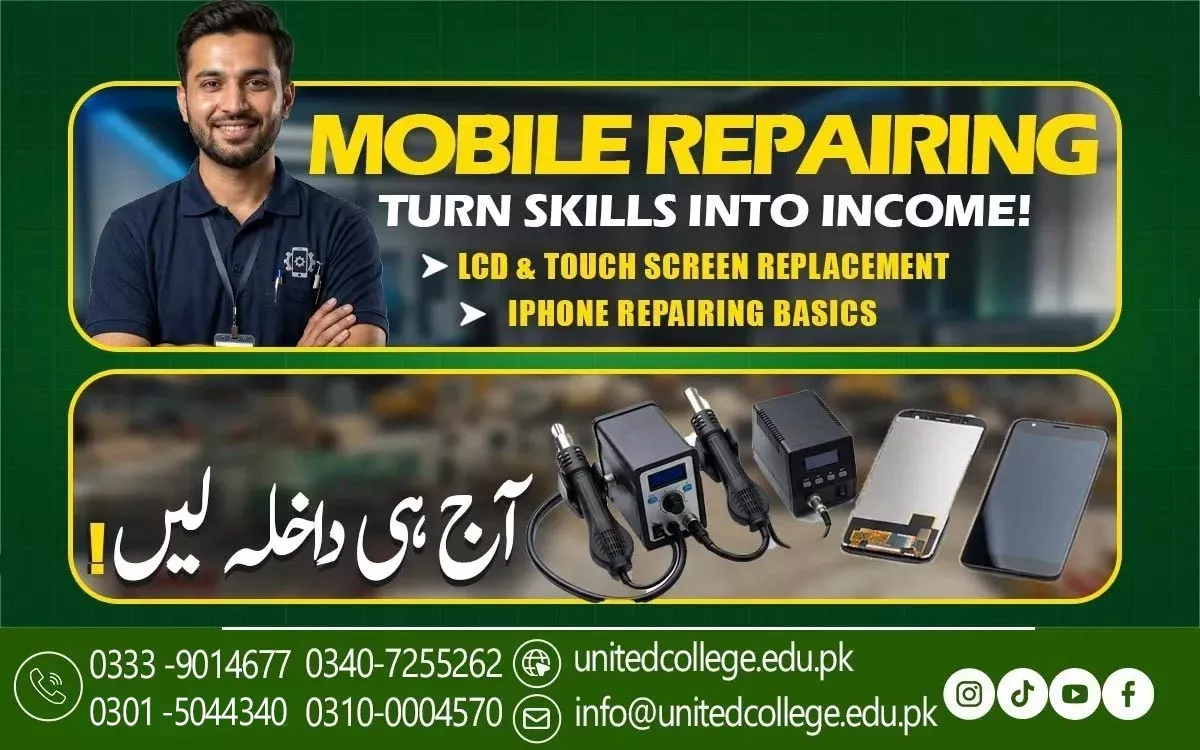

Mobile Repairing Course in Batagram Develops Mobile Repair Skills
Turn Your Interest in Smartphones Into a Practical Technical Skill
A smartphone can develop a fault at any time. The screen may stop responding, the battery may drain quickly, or the device may refuse to charge even when connected to a power source. Understanding these problems requires more than guesswork; it takes observation, technical knowledge, and careful testing. The Mobile Repairing Course in Batagram is a topic worth exploring for people who want to learn how mobile phones work and how technicians investigate common faults.
This field combines basic electronics, problem-solving, and practical work with small tools. Beginners do not need to know everything before they start learning. They can build their knowledge step by step, starting with phone components and simple checks before moving toward more complex problems. For students, job seekers, and people interested in technology, mobile repairing can provide a useful starting point for developing practical skills.
Discover the Small Components Behind Every Smartphone Function
Modern smartphones contain several connected parts that help them perform different tasks. The display presents images and responds to touch, the battery supplies power, and the motherboard connects important electronic components. Charging ports, cameras, microphones, speakers, buttons, and internal connectors also contribute to the phone's operation. Through a Mobile Repairing Course in Batagram, learners can become familiar with these parts and understand how one damaged component may affect other functions.
Recognising these possibilities helps learners avoid replacing components without checking the cause. Mobile Phone Hardware Repair begins with understanding the purpose and location of each part. Students can gradually learn to identify visible damage, recognise different connectors, and understand basic circuit relationships. This foundation makes later repair lessons easier to follow because learners can connect technical concepts with actual smartphone behaviour.
Trace Charging and Battery Faults Without Guesswork
Charging problems are common examples of faults that require systematic investigation. A phone may charge slowly, disconnect repeatedly, or fail to respond when plugged in. The cause could involve a damaged cable, an unsuitable adapter, debris in the charging port, a worn battery, or an internal circuit problem. Learners studying Mobile Repairing Training in Batagram can explore how technicians separate these possibilities through suitable checks and testing methods. Battery-related symptoms also need careful attention.
Unexpected shutdowns, swelling, overheating, or rapid power loss should never be ignored. A swollen battery must not be pressed, punctured, or handled as an ordinary component because damaged lithium-ion batteries can create serious safety risks. Display faults require a similar process of observation. A cracked screen, touch problems, flickering images, and a completely black display may have different causes. Learning to record symptoms and examine the device before selecting a repair method helps beginners develop better judgement.
Build a Strong Foundation in Mobile Software Troubleshooting
Not every phone fault requires opening the device. Software problems can cause freezing, application crashes, slow performance, restart loops, and unexpected errors. Mobile Software Troubleshooting introduces learners to the ways operating systems, applications, storage, and settings affect smartphone performance. For instance, an application that repeatedly closes may have a software compatibility issue, while a phone with very little free storage may struggle to perform routine tasks.
They should also recognise that a software symptom does not always prove that the software is responsible; hardware faults can sometimes produce similar behaviour. Data protection is another essential part of this learning. Before carrying out procedures that may erase files or reset a device, technicians should understand the risks and follow appropriate backup and permission practices.
Master Repairing Tools Through Careful, Step-by-Step Practice
Mobile repairing involves small components that can be damaged by unsuitable tools or excessive force. Learners may study precision screwdrivers, plastic opening picks, tweezers, suction tools, magnification equipment, and multimeters. Precision screwdrivers help remove tiny screws, while plastic opening tools can help separate covers without unnecessary scratching.
A multimeter can measure electrical values and test continuity, helping technicians investigate certain power-related faults. However, owning tools does not automatically make someone a skilled technician. Learners need to understand what each tool does, when it is appropriate, and how to use it safely. Basic electronics concepts, including voltage, current, resistance, and circuit connections, also help explain why some tests are necessary. During the Basic Mobile Repairing Course in Batagram, beginners should start with suitable practice devices and straightforward tasks before attempting delicate repairs.
Develop Precision Through Realistic Repair Exercises
Practical learning helps turn technical information into skills that learners can apply. Reading about a charging connector is useful, but examining a suitable training device helps students understand its position, connections, and possible signs of damage. A well-planned exercise may involve identifying a phone model, recording its reported symptoms, inspecting visible parts, and deciding which checks should come first. More advanced practice can introduce connector inspection, component testing, and supervised disassembly where appropriate.
Delicate connectors, flexible cables, and small screws require controlled movements and attention to detail. Students should also learn to recognise the limits of their current abilities and seek guidance before attempting complex motherboard repairs or other high-risk procedures. Regular practice, clear notes, and honest evaluation of mistakes help build confidence over time. These habits support the development of reliable Mobile Repairing Skills rather than dependence on memorised fixes.
Apply Smartphone Repair Knowledge to Local Projects and Work
Mobile repairing skills can be useful in several practical settings once a learner has developed sufficient knowledge and experience. Someone may explore opportunities to assist an experienced technician, apply for a suitable role in a mobile repair shop, or eventually consider running a small repair service. Others may use their knowledge for personal electronics projects or to better understand device faults before seeking professional assistance.
People considering a service business should also understand part compatibility, record keeping, customer communication, privacy, and how to explain repair options clearly. A technician must not promise a successful repair before understanding the fault, especially when a device has severe physical or liquid damage. The Mobile Repairing Training in Batagram may interest students, beginners, job seekers, and people who enjoy practical technical tasks.
Explore Training Options Offered by United College of Technology
Choosing a suitable learning path can help beginners organise their studies and understand which technical topics to focus on first. People interested in mobile repairing can explore the course offered by United College of Technology and confirm whether its current content matches their needs. Before making a decision, prospective learners should contact the institution directly to verify available course details, fees, duration, admission information, and practical training arrangements. These details should be confirmed rather than assumed.
Beginners should also consider how much time they can devote to practising and whether they are comfortable working with small, delicate parts. No one needs to master every type of phone repair at the beginning. Building a strong foundation first can make more advanced topics easier to approach later. The training offered by United College of Technology is one option learners can investigate while comparing their interests, goals, and available learning opportunities.
Take the Next Step Toward Greater Technical Confidence
Learning to repair smartphones involves curiosity, patience, and a willingness to solve problems carefully. Some tasks may seem straightforward, while others require detailed testing, model-specific knowledge, and experience with electronic circuits. A Mobile Repairing Course in Batagram can be a starting point for people who want to explore this field, understand common phone faults, and develop a practical technical foundation.
Students should give themselves time to practise, review mistakes, and strengthen their understanding of both hardware and software. They should also stay aware of changing smartphone designs because repair methods can vary between models. For anyone who enjoys electronics and hands-on learning, mobile repairing may be a worthwhile subject to investigate.
Frequently Asked Questions (FAQs)
A technician can test each button's response, inspect its physical condition, and check whether the issue may be related to settings or an internal connection.
The motherboard connects many essential circuits and components. Understanding its role helps learners recognise complex faults and know when specialised repair skills are necessary.
Smartphones use different connectors for displays, batteries, cameras, and other components. Recognising them helps technicians handle connections correctly and avoid accidental damage.
Dust can collect around speakers, microphones, buttons, and charging ports. Careful inspection and appropriate cleaning methods may help address problems caused by accumulated debris.
Comparing test results helps technicians check whether the original problem has improved and whether other functions remain operational after the repair.
Different models may use different layouts, components, and repair procedures. Checking the exact model helps technicians choose compatible parts and follow suitable instructions.
Admission Open: Start Your Professional Journey Today!
Join United College of Technology and build a career with practical training, recognized certifications, and Gulf job support. Seats are limited.
Apply Now via WhatsAppContact Information
- Address: Rawalpindi: F-272 Main New Katarian Stop, Old IJP Road | Lahore Campus: Lahore, Pakistan
- Phone/WhatsApp: 0340-7255262 / 0333-9014677 / 0301-5044340 / 0310-0004570 / 051-8770756
- Website: unitedcollege.edu.pk
















Leave a Comment