


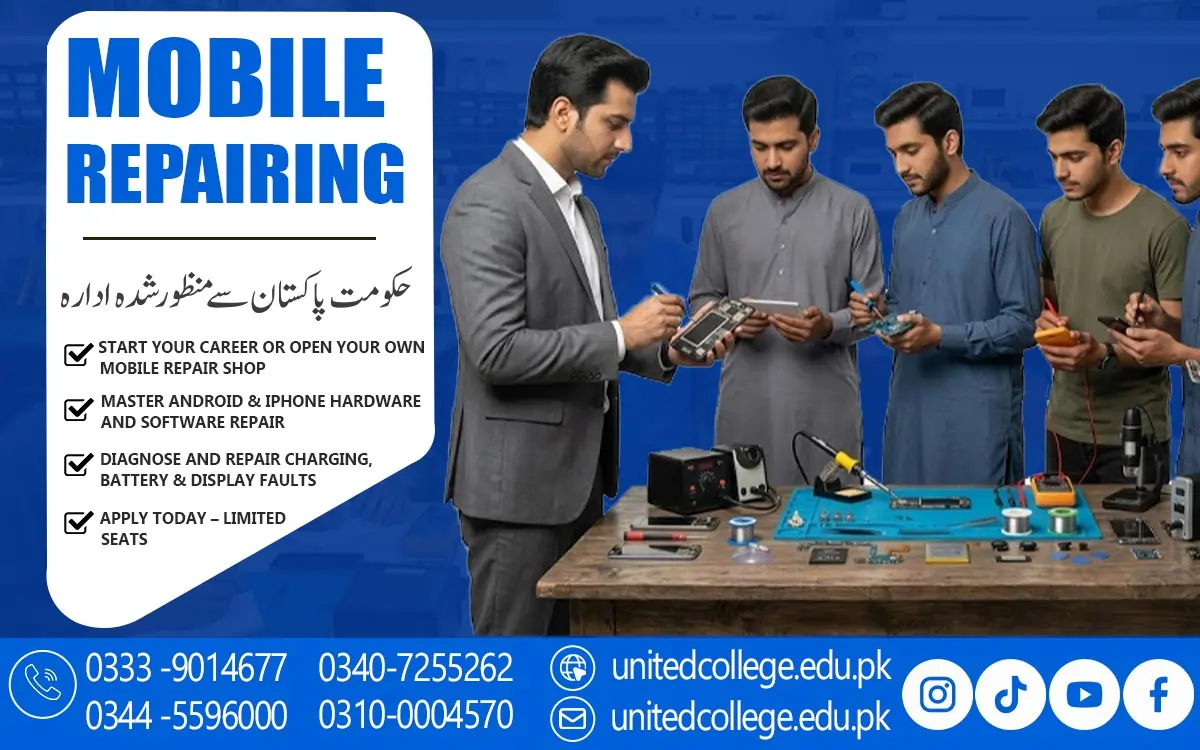

Mobile Repairing Course in Bhimber AJK for Practical Success
Learn the Craft Behind Every Repair
A phone that refuses to charge, a screen that suddenly goes blank, or a device that loses its network can quickly become a serious inconvenience. Since smartphones are now part of everyday communication, study, business, and entertainment, people need reliable technicians who can understand these problems and handle them carefully.
For learners in Bhimber AJK, this creates an opportunity to develop a practical technical skill. The Mobile Repairing Course in Bhimber AJK offered by United College of Technology introduces students to the knowledge, tools, and repair techniques needed to understand modern mobile phones. Instead of learning only from theory, students can gradually develop the ability to examine faults and work toward suitable solutions.
A Smartphone Problem Can Become a Practical Skill
Many people use smartphones every day but have little idea about what happens inside them. When something goes wrong, they usually depend on a technician. Learning mobile phone repair changes this situation by helping students understand the reasons behind common device problems. A mobile repairing course can be a useful choice for students, fresh learners, and job seekers who prefer practical learning.
It combines technical understanding with careful observation and problem-solving, allowing learners to build a skill that improves with continuous practice. For young people interested in vocational training, a Mobile Repairing Course in Bhimber, AJK can offer a different learning path. It does not require a learner to begin as an expert. Learners can start with basic concepts, then move to more detailed repair work as their technical confidence grows.
The Inside of a Phone Starts Making Sense
A smartphone contains many components that perform different jobs. The battery supplies power, the display provides visual output, the microphone captures sound, and the speaker produces audio. Other parts handle charging, cameras, connectivity, and processing. Students can learn how these mobile hardware components work together and what may happen when one of them develops a fault.
Understanding these relationships is important because the visible symptom is not always the actual cause of the problem. For example, a phone that does not turn on may have a battery issue, charging fault, connection problem, or another hardware-related cause. Learning to inspect possibilities systematically helps students develop mobile hardware troubleshooting skills rather than relying on guesses.
Hardware Repair Requires More Than Replacing Parts
A common beginner mistake is assuming that every faulty phone needs a replacement component. Professional mobile repair involves much more than removing an old part and installing a new one. During smartphone repair training, learners can become familiar with basic repair procedures involving displays, batteries, charging systems, speakers, microphones, connectors, and other components.
They can also learn how to examine a device before deciding which repair approach is appropriate. This diagnostic thinking is valuable because unnecessary replacement can waste both time and money. A developing mobile repair technician needs to understand symptoms, inspect the relevant area, and test possible causes before attempting a repair.
Software Can Be the Problem Even When Hardware Looks Fine
Not every smartphone fault comes from a physical component. Sometimes a device may experience system errors, application problems, slow performance, boot-related issues, or other software difficulties while its hardware remains functional. The Mobile Repairing Course in Bhimber AJK can help learners understand the difference between hardware and software faults.
Basic software troubleshooting introduces students to another side of mobile phone technician work and helps them approach device problems more logically. Learners may also become familiar with procedures such as software installation or flashing where appropriate. The focus should remain on understanding the correct process, selecting suitable software, and handling devices carefully rather than treating software repair as a trial-and-error activity.
Common Faults Become Easier to Understand Through Practice
A repair technician may encounter many different complaints from customers. One person may bring a phone with a damaged display, while another may have a battery that drains quickly or a microphone that no longer works properly.
Practical mobile repair training can expose learners to faults such as:
- Charging and power-related problems
- Display and touch issues
- Battery-related faults
- Speaker and microphone problems
- Camera or connectivity issues
- Network-related faults
- Common software errors
For learners interested in practical technical skills, the Mobile Repairing Course in Bhimber, AJK can provide exposure to different types of smartphone faults and repair situations. Each problem can require a different checking process. This variety teaches students that repair work is not about memorizing one solution. It is about identifying symptoms, narrowing down possible causes, and selecting a suitable technique.
The Right Tools Make Careful Work Possible
Mobile devices contain small and sensitive components, so repair work requires patience and proper tool handling. Students need to understand that using excessive force or an unsuitable tool can create additional damage. A mobile repair course introduces learners to the purpose and careful use of relevant mobile repair tools. Practical exposure can help them become more comfortable with opening devices, inspecting components, testing faults, and performing repair procedures under guidance.
Safety is also an important part of technical learning. Learners need to understand how to handle batteries, electronic components, connectors, and other parts responsibly. Good repair habits developed early can become valuable throughout a technician's career.
Hands-On Work Turns Knowledge Into Confidence
Watching someone repair a phone can look simple, but performing the same task personally can be very different. Beginners need opportunities to handle tools, inspect devices, follow procedures, and learn what happens when something does not go according to plan. This is where practical exposure becomes important. At United College of Technology, students can develop their skills through a learning approach that connects technical concepts with practical work.
Instructor guidance can help beginners understand difficult steps and correct mistakes during the learning process. Working through real repair examples can also improve confidence. A learner gradually becomes familiar with different faults, develops better observation skills, and learns to remain patient when the first attempt does not solve a problem.
A Skill That Can Fit Different Learners
Mobile repairing is not limited to one type of student. Someone who has completed school or college can explore it as a practical skill, while a job seeker can use the training to build technical knowledge for future work. Previous experience in electronics or mobile repair can be helpful, but beginners can also start by learning the fundamentals.
What matters most is interest, willingness to practise, attention to detail, and the patience to improve gradually. Students in Bhimber AJK who enjoy working with technology may find mobile repairing particularly interesting because the learning process involves both thinking and doing. Instead of simply studying concepts, they can see how those concepts apply to actual devices.
From Learning Repairs to Building a Professional Direction
Developing mobile repairing skills can open different professional possibilities, although success depends on experience, accuracy, customer service, and continued learning. A trained learner may look for opportunities in a mobile repair shop or explore work with a service center. Another possibility is independent work. After gaining sufficient practical experience, someone may consider offering repair services on a small scale.
A person could begin by handling familiar faults and gradually expand their capabilities as their knowledge grows. The important point is to build a strong foundation before taking on complex repairs independently. Good technicians earn trust through careful work, honest diagnosis, proper handling of devices, and a willingness to keep improving.
Start With One Skill and Keep Building From There
Mobile technology continues to change, so a technician cannot depend forever on the methods learned at the beginning. New smartphone models, components, software systems, and repair approaches can create fresh challenges. This makes continuous learning an important part of a mobile repairing career. Students can continue developing their knowledge by practising on different devices, observing new repair techniques, studying updated technology, and learning from experienced professionals.
For someone in Bhimber AJK looking for a practical direction, the Mobile Repairing Course in Bhimber AJK at United College of Technology can provide a starting point for building useful technical abilities. The goal is not simply to learn how to fix one type of phone, but to develop a problem-solving mindset that can grow with experience. A practical career often begins with one decision to learn something useful.
Frequently Asked Questions (FAQs)
Patience, concentration, curiosity, neat working habits, and a willingness to learn from mistakes can help a beginner improve steadily.
Yes. Anyone interested in understanding electronic devices can explore mobile repairing and gradually develop practical knowledge through guided practice.
Experience plays an important role. Working with different devices helps learners recognize symptoms and develop a more organized approach to inspection.
It can provide useful exposure to electronic components, testing methods, tools, and troubleshooting concepts that may support further technical learning.
A beginner should first build strong fundamentals, learn proper tool handling, understand basic components, and practise simpler repair procedures carefully.
No. Some faults may not show clear external damage, which is why systematic testing and careful diagnosis are important parts of technical repair work.
Admission Open: Start Your Professional Journey Today!
Join United College of Technology and build a career with practical training, recognized certifications, and Gulf job support. Seats are limited.
Apply Now via WhatsAppContact Information
- Address: Rawalpindi: F-272 Main New Katarian Stop, Old IJP Road | Lahore Campus: Lahore, Pakistan
- Phone/WhatsApp: 0340-7255262 / 0333-9014677 / 0301-5044340 / 0310-0004570 / 051-8770756
- Website: unitedcollege.edu.pk
















Leave a Comment