


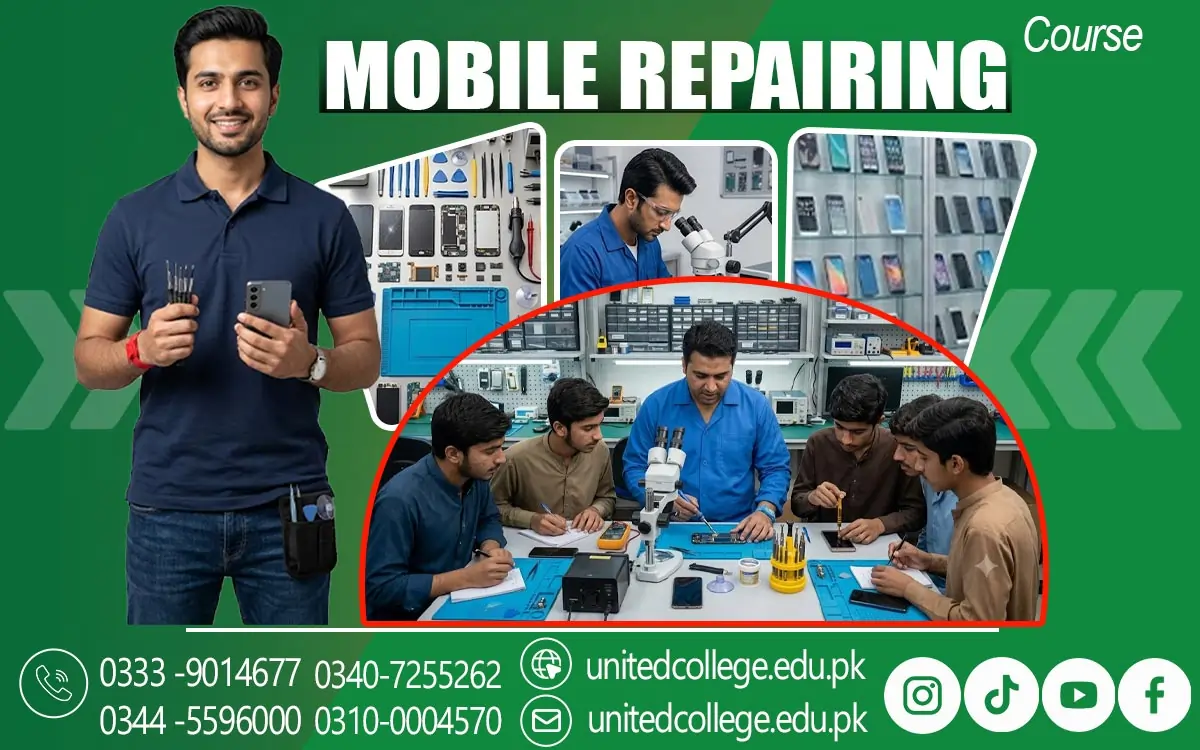

Mobile Repairing Course in Jhang for Your Next Career Move
Turn Your Interest Into a Skilled Trade
A mobile phone can carry a person's contacts, work, studies, photographs, payments, and daily communication. When its screen stops responding or the device refuses to charge, even a small fault can cause a major problem. This everyday dependence has made skilled mobile technicians an important part of modern technical services.
For young people, students, and job seekers in Jhang, this field offers a practical way to develop useful technical abilities. The Mobile Repairing Course in Jhang offered by United College of Technology allows learners to understand smartphones, practise repair techniques, and gradually build the confidence needed to work with mobile devices.
The First Step Is Learning How a Phone Works
Repairing becomes much easier when a learner understands what is inside the device. A smartphone is made up of different components, and each one performs a specific function. The display shows information, the battery provides power, the microphone captures sound, while the speaker produces audio.
During the Mobile Repairing Course in Jhang, beginners can become familiar with these basic mobile components and their roles. They can learn how hardware works together and why one faulty part can sometimes affect another function. This basic knowledge gives students a stronger starting point than simply memorizing repair procedures. Once they understand the purpose of different parts, they can approach a damaged phone with greater awareness and curiosity.
A Fault Is a Clue, Not the Final Answer
When a customer says that a phone is not working, the statement alone does not tell a technician what needs to be repaired. The real challenge is finding the reason behind the symptom. For example, a phone that will not charge might have an issue with its charging port, battery, connection, or another internal component.
Through mobile fault diagnosis, students learn to observe the problem and consider possible causes before taking action. This method develops an important professional habit. Instead of replacing parts without proper checking, learners begin to understand the value of inspection, testing, and logical troubleshooting.
From Screen Damage to Power Problems, Every Case Teaches Something
Mobile repair work involves a wide range of everyday faults. A damaged display may require a different approach from a weak battery, while a microphone problem needs another type of inspection. A smartphone repair course can introduce learners to common issues such as screen and touch faults, battery problems, charging-port concerns, speaker failures, microphone issues, camera faults, and power-related difficulties.
Students can also learn basic disassembly and assembly procedures. Handling a phone carefully during these processes is important because forcing a component or incorrectly reconnecting a part can create further damage.
Software Repair Adds Another Layer to Technical Knowledge
Sometimes a phone looks perfectly fine from the outside but still behaves incorrectly. Slow performance, system errors, application problems, update failures, and other software-related issues can affect the user experience without any visible physical damage. Mobile software repair and smartphone troubleshooting help learners understand this side of the field.
They can learn how to distinguish software faults from hardware problems and how basic troubleshooting methods can be used before opening a device. Training may also introduce suitable software procedures, including installation, updates, and flashing where relevant. Students need to understand that such tasks require the correct files, proper steps, and careful handling rather than random experimentation.
Good Tools Help a Technician Work With Precision
A smartphone contains small components that cannot always be handled safely with ordinary tools. Developing familiarity with appropriate mobile repair tools is therefore an important part of practical learning. A Mobile Repairing Course in Jhang can help students learn the purpose of different tools and how to use them carefully while working with mobile hardware.
They can practise opening devices, inspecting parts, checking connections, and carrying out repair tasks under guidance. Safe handling should remain a priority throughout the training. Learners need to develop habits such as working patiently, protecting delicate components, and treating batteries and electronic parts responsibly. These habits can become valuable when they begin handling customer devices.
Workshop Practice Makes Technical Lessons Easier to Remember
A student may understand a repair procedure after reading about it, but personal practice creates a different level of understanding. When learners actually handle devices, they discover how much care and concentration a small repair task can require. At United College of Technology, practical-focused learning can help students connect classroom concepts with hands-on activities.
Instructor guidance can make it easier for beginners to understand unfamiliar procedures and identify mistakes during practice. Repeated exposure to different repair situations also improves confidence. A learner gradually becomes more comfortable with tools, components, inspection methods, and the general workflow followed by a mobile repair technician.
Technical Skill Also Includes Understanding the Customer
Repairing a device is only one part of professional service. A technician also needs to understand what the customer is reporting and communicate clearly about the problem. For instance, a customer may describe a phone as “dead” when the actual issue is limited to charging or power. Listening carefully and asking relevant questions can help the technician understand the situation before beginning the inspection.
This kind of communication can become useful for anyone planning to work in a mobile repair workshop or service environment. Careful handling, honest explanations, and responsible treatment of customer devices can help create a professional reputation.
A Practical Skill Can Open More Than One Door
After developing strong fundamentals and gaining sufficient experience, learners can explore different ways to use their mobile repairing skills. Employment in a mobile repair shop or service center is one possible direction for someone who wants to work under experienced professionals. Self-employment is another option worth considering.
Starting with familiar services and expanding gradually can be a sensible way to build experience. Freelance or independent repair work may also be possible depending on a person's technical ability, resources, and local demand. However, professional progress depends on accuracy and experience rather than simply completing training.
Keep Your Skills Moving With Mobile Technology
Smartphones continue to evolve, which means technicians also need to keep learning. New models can introduce different designs, components, software systems, and repair challenges. A person entering a mobile repairing career should therefore treat training as a foundation rather than the final stage of learning. Regular practice, exposure to different devices, and interest in newer repair methods can help technicians remain adaptable.
For learners in Jhang, the Mobile Repairing Course in Jhang at United College of Technology can be a starting point for developing practical mobile repair skills. Beginners can build their knowledge step by step while learning how technical concepts are applied to real devices. The journey does not begin with knowing every complicated repair.
Frequently Asked Questions (FAQs)
Yes. People who like working with their hands and solving technical challenges may find mobile repairing an interesting field to explore.
A beginner should develop the habit of checking a device carefully before making any repair decision. Careful observation can prevent avoidable mistakes.
Yes. Working with compact phone parts requires concentration and careful observation, which can naturally strengthen attention to small details.
Different models may have different layouts and components. Exposure to various devices helps learners become more flexible when handling repair tasks.
Keeping the workspace and components clean helps reduce handling problems and supports more organized, careful repair practices.
If a fault requires unfamiliar procedures or advanced equipment, it is better to seek experienced guidance instead of attempting a risky repair without preparation.
Admission Open: Start Your Professional Journey Today!
Join United College of Technology and build a career with practical training, recognized certifications, and Gulf job support. Seats are limited.
Apply Now via WhatsAppContact Information
- Address: Rawalpindi: F-272 Main New Katarian Stop, Old IJP Road | Lahore Campus: Lahore, Pakistan
- Phone/WhatsApp: 0340-7255262 / 0333-9014677 / 0301-5044340 / 0310-0004570 / 051-8770756
- Website: unitedcollege.edu.pk
















Leave a Comment