


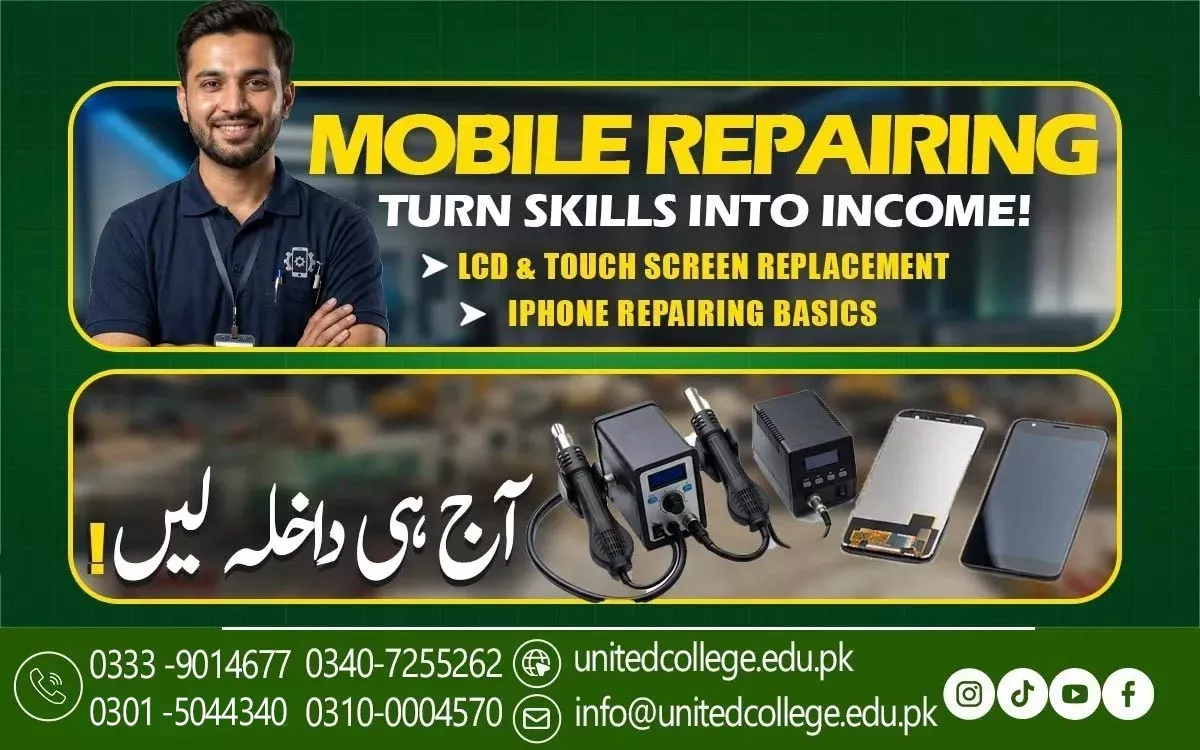

Mobile Repairing Course in Swat – Build Practical Phone Repair Skills
When a Smartphone Stops Working, the Right Skills Can Make a Difference
Another person may drop their phone and crack the screen, while a shopkeeper may experience a device that keeps restarting or loses its network connection. These problems can interrupt daily activities, communication, and work. Although many people use smartphones every day, they do not know what happens inside these devices or how technicians identify faults. Learning mobile repairing can help beginners understand these problems and develop practical technical skills. The Mobile Repairing Course in Swat, offered by United College of Technology (UCT), is a training option for people interested in smartphone repair, mobile hardware, and software troubleshooting.
This field involves understanding electronic components, using suitable tools, diagnosing faults, and learning how different phone models operate. Beginners don't need prior repair experience to start learning, though patience and careful practice matter. A mobile repairing technician must understand that two phones showing the same problem may have different causes. For example, a phone that does not turn on might have a drained battery, a damaged charging port, a faulty power button, or an internal hardware problem. Simply replacing parts without checking the cause can lead to unnecessary expenses. Through structured learning and supervised practice, students can begin to understand how technicians approach such situations.
Understanding the Components That Keep a Mobile Phone Running
A smartphone contains several connected components that work together to provide calling, messaging, internet access, photography, and other functions. Understanding these parts is an important step in mobile repair training because a fault in one component can affect the entire device. The motherboard is the main electronic board that connects and supports many important circuits, chips, and connectors. The battery supplies electrical power, while the charging port allows compatible charging equipment to connect to the phone. The display shows images, text, and applications, and the touch panel allows users to interact with the screen. Cameras capture photos and videos, while speakers and microphones support sound output and voice input.
Some smartphones also contain separate fingerprint readers and specialized camera modules. During a Mobile Repairing Course in Swat, learners can study these components and understand their basic functions before attempting repair procedures. They can also learn that different Android phones and iPhones may use different internal layouts, connectors, and assembly methods. A charging port that appears similar on two models may not be interchangeable, and a replacement screen must match the device's specifications. Understanding component names is only the starting point; students also need to recognize how parts connect and how to inspect them without causing damage.
Solving Common Mobile Phone Problems Through Practical Repair Skills
A phone may develop several problems during everyday use, but identifying the correct cause is more important than immediately replacing a component. A cracked display, for example, may affect only the outer glass in some devices, while other damage can interfere with the display or touch function. Charging problems may result from a damaged cable, a faulty adapter, debris in the charging port, battery deterioration, or an internal electrical fault. Similarly, a phone that loses power quickly may have an aging battery or a software process that consumes excessive energy.
Mobile repairing training introduces learners to the process of checking symptoms, considering possible causes, and deciding which inspection is appropriate. The Mobile Repairing Course in Swat can be relevant to students who want to understand common smartphone faults and learn how repair technicians approach them. Practical topics may include screen replacement, battery replacement, charging-port inspection, speaker testing, microphone problems, and button faults, depending on the course syllabus. Beginners should understand that modern phones are delicate and may contain adhesive-sealed batteries, fragile flex cables, and water-resistant seals that can be damaged during careless opening.
Exploring Mobile Software Troubleshooting and Smartphone Performance
Not every mobile phone problem requires opening the device. Sometimes a smartphone becomes slow, applications repeatedly close, storage fills up, or the operating system fails to start correctly. These issues may be related to software rather than damaged hardware. Mobile software troubleshooting helps technicians distinguish between possible software faults and physical component problems. For example, an application that crashes repeatedly may need an update, while a phone with insufficient storage may perform poorly until unnecessary files are removed. A device stuck during startup may require a careful diagnostic process using the manufacturer's recommended recovery methods.
Learners studying a Mobile Repairing Course in Swat can benefit from understanding basic Android phone troubleshooting, iPhone repair fundamentals, software updates, application management, and the safe use of official diagnostic or recovery tools. They should also learn the importance of backing up data before procedures that may erase information. A factory reset, for instance, can remove personal files and settings, so it should never be treated as a harmless first step. Similarly, reinstalling software without checking the device model and procedure can create further problems. Technicians must respect security protections and obtain the owner's permission before accessing personal information or performing actions that affect stored data.
Developing Hardware Diagnosis and Understanding Motherboard Faults
A phone that repeatedly shuts down may have a battery problem, an unstable power connection, overheating, or a fault on its motherboard. A device that fails to charge may have a damaged port, a faulty charging circuit, or another issue within its power system. Hardware fault diagnosis involves inspecting the device, checking its history, observing its behaviour, and using suitable testing methods to narrow down possible causes. During the Mobile Repairing Course in Swat, learners can explore how technicians identify damaged connectors, examine visible signs of corrosion, check suitable electrical points, and understand the relationship between different components.
Repairing it can require advanced knowledge, specialized tools, and considerable practice. Micro-soldering, for example, involves working with very small electronic connections and components, so it should not be attempted by beginners without proper training. Students can start by learning component identification and basic diagnostic principles before moving towards more demanding tasks. They should also understand that some devices are difficult or uneconomical to repair, depending on the damage and availability of parts. A responsible technician explains the likely problem and available options instead of promising that every phone can be repaired.
Getting Familiar with Mobile Repair Tools and Workshop Equipment
Common mobile repair tools include precision screwdrivers, plastic opening picks, tweezers, suction tools, and anti-static equipment. Precision screwdrivers help remove small screws, while plastic opening tools can help separate suitable phone covers without scratching or damaging surrounding surfaces. Tweezers are useful for handling small components, and a multimeter can help trained users measure electrical values when investigating certain faults. Some repairs require specialized heating equipment to soften adhesive, but temperature control and correct technique are important to avoid damaging batteries, displays, or nearby components.
Learners exploring the Mobile Repairing Course in Swat should look for training that explains tool selection, correct handling, workspace organization, and practical demonstrations. Knowing the name of a tool is not enough; students need to understand when it should be used and which tasks require additional expertise. For example, forcing open a phone with the wrong tool may break the screen, damage a cable, or bend the frame. A clean, organized workbench also helps prevent small screws and components from getting lost. Learners should practise on appropriate training devices and follow model-specific instructions rather than experimenting on valuable customer phones.
Protecting Devices, Batteries, and Customer Data During Repairs
Repairing a smartphone requires attention to personal safety as well as the protection of the device and its information. Modern phones commonly use lithium-ion batteries, which can become dangerous if punctured, crushed, overheated, or bent during removal. Work involving a damaged battery should be handled by someone trained in the appropriate safety procedures. Electrical components also need careful treatment, and anti-static precautions can help protect sensitive circuits from electrostatic discharge. Before opening a device, a technician should follow the manufacturer's guidance, use appropriate tools, and ensure that the phone is powered down when the repair procedure requires it.
Technicians should obtain clear permission before accessing customer data, avoid opening unrelated files, and explain when a repair could result in data loss. Backups should be recommended before procedures that may erase stored information, and customer passwords should not be requested unless genuinely necessary for an agreed diagnostic task. Learners taking the Mobile Repairing Course in Swat should develop these habits alongside technical skills. A professional approach includes keeping devices organized, documenting the reported problem, handling customer property carefully, and communicating any additional damage discovered during inspection. Following these practices builds trust and reduces avoidable risks.
Exploring Mobile Repairing Training and Career Paths in Swat
For people in Swat who enjoy technology and practical problem-solving, mobile repairing training can be a way to explore a technical field. Smartphones are used by students, shopkeepers, office workers, families, and businesses, and repair needs can range from basic maintenance to complicated electronic faults. The Mobile Repairing Course in Swat, offered by United College of Technology (UCT), is relevant to individuals who want to learn about mobile phone hardware, software troubleshooting, repair tools, and common device problems. Before enrolling, prospective students should contact the institution to confirm the current course syllabus, duration, fees, admission requirements, practical training facilities, and certificate details.
After developing suitable skills and gaining relevant experience, individuals may explore opportunities in mobile repair shops, electronics service centres, smartphone maintenance businesses, or supervised technical roles. Some may eventually consider running a repair service, although this also requires business planning, suitable equipment, access to reliable replacement parts, customer service, and an understanding of local demand. Employment and business results depend on individual ability, experience, market conditions, and other factors, so completing a course does not guarantee a job or a particular income.
Building Stronger Repair Skills Through Practice and Continuous Learning
A beginner may initially find it difficult to identify a charging fault or distinguish between a software problem and a damaged component. With guidance and practice, however, these tasks can become easier to understand. Students can strengthen their knowledge by reviewing component functions, studying device diagrams, practising approved procedures on training phones, and recording the steps used during fault diagnosis. The Mobile Repairing Course in Swat can be a starting point for learners who want to build these foundations and explore more advanced smartphone repair techniques over time.
It is also important to develop communication skills because customers often describe problems in everyday language rather than technical terms. A technician may need to ask when a fault began, whether the phone was dropped, or whether it was exposed to water. Clear questions can provide useful clues without guaranteeing an immediate diagnosis. Learners should become familiar with responsible repair practices, including obtaining permission, protecting personal data, explaining possible repair costs, and avoiding unnecessary part replacement. Mobile technology also changes continuously, with new device designs, security systems, charging methods, and internal components appearing over time.
Frequently Asked Questions (FAQs)
The Mobile Repairing Course in Swat is a technical training option for people who want to learn smartphone repair, hardware troubleshooting, software problem-solving, and mobile maintenance.
United College of Technology (UCT) offers training for individuals interested in developing mobile phone repair and technical skills.
Students can learn about smartphone components, charging problems, screen replacement, battery issues, mobile software troubleshooting, fault diagnosis, and repair tools.
Yes, beginners can explore mobile repairing training without previous repair experience. Patience, attention to detail, and regular practice are important for developing technical skills.
Depending on the course syllabus, students may learn basic hardware repair alongside software troubleshooting, including common startup problems, application errors, and device performance issues.
Admission Open: Start Your Professional Journey Today!
Join United College of Technology and build a career with practical training, recognized certifications, and Gulf job support. Seats are limited.
Apply Now via WhatsAppContact Information
- Address: Rawalpindi: F-272 Main New Katarian Stop, Old IJP Road | Lahore Campus: Lahore, Pakistan
- Phone/WhatsApp: 0340-7255262 / 0333-9014677 / 0301-5044340 / 0310-0004570 / 051-8770756
- Website: unitedcollege.edu.pk
















Leave a Comment