


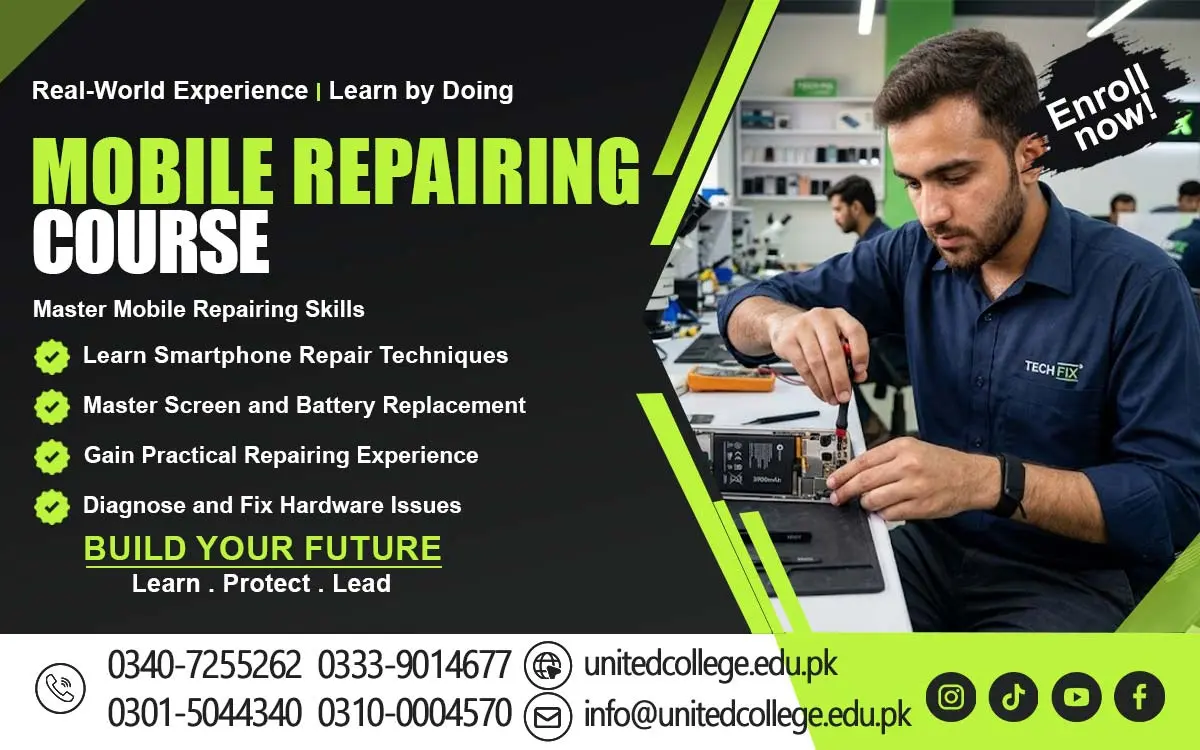

Mobile Repairing Course in Waziristan: Modern Phone Repair Techniques
Mobile Repairing Course in Waziristan Opens a Path to Practical Smartphone Skills
Smartphones have become an important part of daily life, helping people communicate, study, manage work, and access online services. When a phone stops charging, develops a display fault, or experiences software problems, understanding the cause can make a real difference. The Mobile Repairing Course in Waziristan offers a relevant learning direction for beginners, students, fresh learners, and people interested in developing technical abilities.
Mobile repairing combines knowledge of electronic components with careful inspection, problem-solving, and practical work. Learners can begin by understanding phone parts, recognising common faults, and discovering how technicians test devices before attempting repairs. With regular practice and suitable guidance, they can build a foundation in smartphone troubleshooting and learn to approach different technical problems in a systematic way.
Turn Common Phone Problems Into Useful Repairing Knowledge
A mobile phone may develop several problems during everyday use. Its battery might drain quickly, the speaker may produce unclear sound, the charging connection may become unreliable, or the screen may stop responding properly. These issues can have different causes, so replacing a component without checking the device may waste time or create additional damage. Mobile repairing training helps beginners understand why technicians examine symptoms before selecting a repair method.
For learners interested in a Mobile Repairing Course in Waziristan, this approach connects technical education with practical situations. Students can learn to distinguish visible damage from faults that require further testing. For example, a phone that does not charge might have a damaged cable, a faulty adapter, a blocked connector, a battery problem, or an internal electrical fault. Each possibility needs an appropriate check
Understand the Components That Control Smartphone Performance
Before repairing a phone, learners need to understand the main parts inside it and the purpose of each component. A smartphone commonly contains a motherboard, battery, display, charging port, cameras, microphone, speakers, buttons, and connecting cables. These components work together, and a problem in one area can sometimes affect other functions. Knowing their roles helps a learner understand the relationship between a fault and the device's behaviour.
A Smartphone Repairing Course can introduce students to basic electronics and mobile hardware repair concepts. They may study how power reaches different components, how connectors link internal parts, and how physical damage can interrupt normal operation. Learners should also understand the difference between hardware faults and software issues. A damaged charging port is a physical problem, while an application error or incorrect system setting may require a software-related solution.
Master the Basic Checks Behind Charging, Battery, and Screen Faults
Charging problems, battery issues, and display damage are among the faults beginners may study during training. A device might charge intermittently, lose power unexpectedly, show lines across the screen, or fail to respond to touch. Although these symptoms can appear straightforward, their causes are not always obvious. A technician needs to inspect the device, consider possible explanations, and perform suitable tests before deciding what needs attention.
Learners can explore the Basic Mobile Repairing Course in Waziristan through guided demonstrations and supervised exercises. They can study how to examine charging accessories, identify visible connector damage, recognise possible battery problems, and understand the basic steps involved in display inspection. They can also learn why screen connectors and delicate internal cables must be handled carefully. Battery safety is particularly important because damaged or improperly handled batteries can present risks.
Develop Accuracy With Repair Tools and Software Troubleshooting
Successful mobile repair work requires more than familiarity with phone parts. Technicians must also know how to use tools correctly and select suitable diagnostic steps. Precision screwdrivers, opening tools, tweezers, and multimeters may be relevant to different repair tasks, depending on the device and procedure. Learners should understand the purpose of each tool before using it and follow safe handling practices to avoid damaging small components.
Mobile Software Troubleshooting is another important area. Some phones experience system errors, application crashes, slow performance, storage problems, or difficulties following an update. Beginners can learn basic checks involving settings, available storage, application behaviour, and system performance. They should also understand that software procedures can sometimes erase data or change device settings. Protecting personal information and obtaining permission before performing data-affecting actions are essential responsibilities.
Build Confidence Through Demonstrations and Supervised Repair Practice
Practical learning helps turn technical information into useful ability. Reading about a charging port or motherboard is only one part of learning; students also need opportunities to observe repair procedures and practise suitable tasks under guidance. Demonstrations can show how technicians inspect devices, organise components, use tools, and test a phone after completing a repair.
During Mobile Technician Training, beginners can gradually become familiar with troubleshooting exercises and repair procedures appropriate to their current skill level. They can learn to record the reported problem, examine possible causes, carry out basic checks, and review the results. Regular practice can improve hand control, attention to detail, and confidence when working with small components. Mistakes should be treated as learning opportunities, provided that practice takes place safely and under appropriate supervision.
Explore Technical Learning Opportunities Relevant to Waziristan
For people in Waziristan who want to develop practical abilities, mobile repairing can provide an introduction to a technical field that continues to evolve alongside smartphone technology. Learning the basics can help students understand how devices work, why common faults occur, and how technicians approach diagnosis. These skills may also be useful for people who want to explore technical work while continuing to improve their knowledge over time.
The Mobile Repairing Training in Waziristan is worth considering for learners who enjoy practical tasks, solving problems, and understanding electronic devices. United College of Technology is a training provider that prospective students can contact to ask about relevant options. When reviewing a course offered by United College of Technology, learners should confirm the current syllabus, practical training arrangements, trainer guidance, and other details directly with the institution.
Prepare for Training With Patience, Curiosity, and Consistent Effort
Beginners do not need to know how to repair every smartphone before starting to learn. However, a willingness to follow instructions, ask questions, and practise carefully can make the learning process more productive. Basic familiarity with using a smartphone is a helpful starting point, while an interest in electronics and problem-solving can encourage further learning. Students should focus on understanding why a repair step is necessary instead of simply memorising a sequence of actions.
Attention to detail matters because phone components are small and sometimes delicate. Keeping screws organised, avoiding unnecessary force, following safety instructions, and testing a device after a repair are habits worth developing early. Learners should also practise explaining technical problems in simple language, especially when discussing faults with device owners. Mobile Phone Repair Skills improve through repetition, observation, and feedback rather than overnight results.
Turn Your Interest in Mobile Technology Into a Lasting Skill
Learning mobile repair can open several directions for further technical development, although the results depend on each person's effort, experience, and circumstances. After gaining suitable skills, learners may seek opportunities to assist an experienced technician, work in a mobile repair shop, or eventually explore self-employment. Working alongside an experienced professional can provide exposure to different phone models, customer concerns, repair decisions, and everyday workshop procedures.
Self-employment also requires careful planning, suitable tools, responsible service, and an understanding of business expenses. A course alone cannot guarantee employment, income, or business success. The best starting point is to develop reliable technical habits, practise within one's ability, and continue learning as devices and repair methods change. Anyone considering the Mobile Repairing Course in Waziristan should review the course content and practical learning opportunities before deciding whether it matches their goals.
Frequently Asked Questions (FAQs)
Bluetooth testing helps confirm whether the phone can connect to compatible devices, such as wireless earphones. It can reveal connectivity issues that may otherwise go unnoticed.
It helps control how electrical power is distributed to different components. Understanding its basic role helps learners explore power-related faults more effectively.
A bent or broken SIM tray may prevent the card from sitting correctly. Careful inspection can help identify a physical problem before further testing.
The earpiece produces sound during regular phone calls, while the loudspeaker provides audio for speakerphone use, media, and alerts. Testing them separately helps narrow down sound-related faults.
Different operating systems have different settings, update processes, and troubleshooting methods. Basic familiarity helps technicians approach software problems more appropriately.
Using a clean workspace, separating screws by location, and keeping removed parts in organised containers can reduce the risk of losing components or mixing them up.
Admission Open: Start Your Professional Journey Today!
Join United College of Technology and build a career with practical training, recognized certifications, and Gulf job support. Seats are limited.
Apply Now via WhatsAppContact Information
- Address: Rawalpindi: F-272 Main New Katarian Stop, Old IJP Road | Lahore Campus: Lahore, Pakistan
- Phone/WhatsApp: 0340-7255262 / 0333-9014677 / 0301-5044340 / 0310-0004570 / 051-8770756
- Website: unitedcollege.edu.pk
















Leave a Comment