


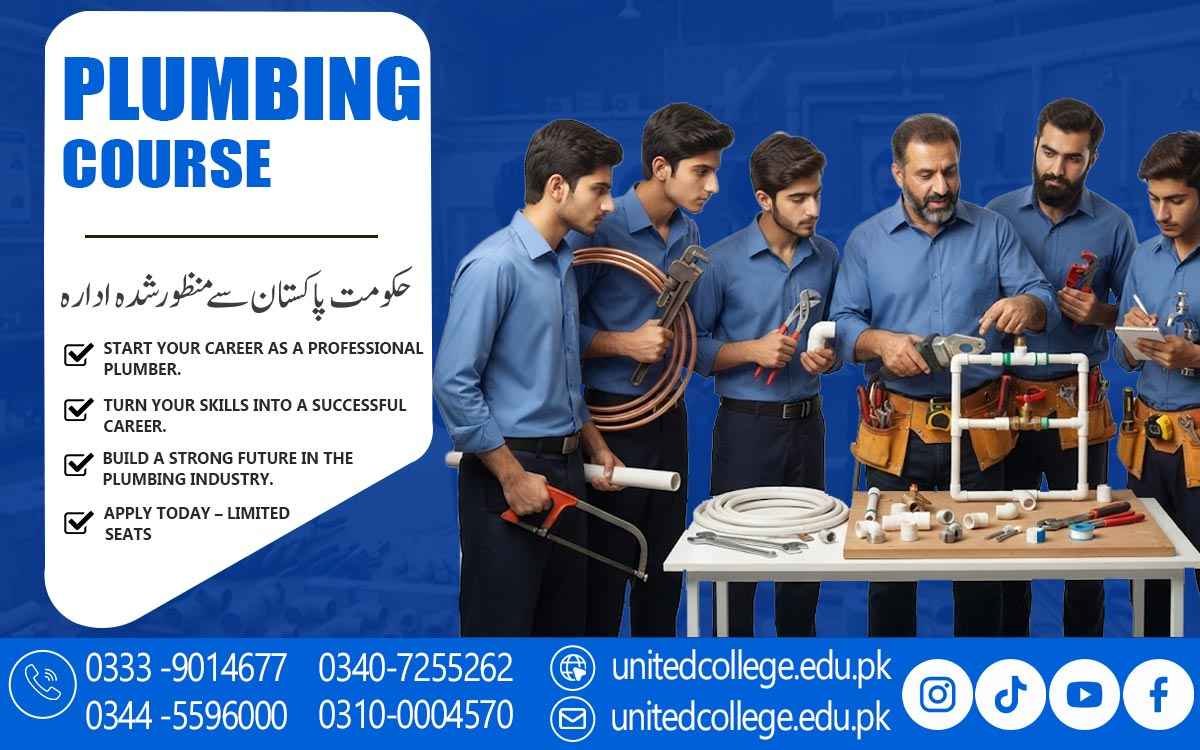

Plumbing Course in Mandi Bahauddin: Learn Plumbing with Practice
Turn Pipework into a Practical Skill
A building can have beautiful walls and modern fixtures, but without a properly arranged plumbing system, everyday life becomes difficult. Clean water needs a reliable route, used water needs a safe way out, and every connection must work as intended. Learning how these systems come together gives beginners a practical technical skill that can be used in many types of building work.
A Plumbing Course in Mandi Bahauddin can help learners move from basic concepts to practical tasks in a structured way. Students can become familiar with water pipes, fittings, tools, installation methods, drainage arrangements, sanitary fixtures, maintenance, and basic repairs. The focus is not only on knowing the names of plumbing components but also on understanding how and where they are used. United College of Technology offers training that introduces learners to relevant plumbing concepts and practical skill development.
See the Building Through Its Water Routes
Plumbing becomes easier to understand when learners first look at how water travels through a building. Supply lines carry water toward different points, while drainage lines move used water away. Valves, fittings, joints, and fixtures connect these routes and help control how the system operates.
For beginners, understanding this basic flow creates a strong starting point. A learner taking a Plumbing Course in Mandi Bahauddin can begin to recognize why one pipe connects to a sink, another leads toward a bathroom, and a separate route handles waste. This knowledge makes later pipe installation and repair exercises more meaningful because every component has a clear purpose.
Let the Right Tool Set the Standard for the Job
Practical work becomes much easier when a learner knows which tool to use and how to handle it correctly. Plumbing tools can include pipe cutters, adjustable wrenches, pliers, measuring tools, screwdrivers, and equipment used for preparing or joining pipes.
Plumbing classes can introduce these tools through practical examples rather than difficult explanations. Learners can practice measuring pipe sections, handling fittings, tightening connections, and preparing materials for installation. They also learn that forcing a tool or using the wrong equipment can damage a component. Careful tool use is therefore part of developing reliable plumbing skills.
Shape Raw Pipe into a Working Connection
Pipe cutting and joining are central parts of many plumbing tasks. A pipe must be measured before cutting, and its edges may need preparation before it is connected with another section or fitting. A small error in measurement can affect the complete arrangement.
Through practical plumbing training, beginners can work with different types of water pipes and fittings while learning how connections are prepared. They can explore elbows, tees, connectors, valves, and other components and understand their purpose within a layout. Repeated practice helps learners become more comfortable with the sequence from measurement to fitting and final checking.
Build a Clean Route for Water Supply
A water supply system needs an organized route so that water can reach its required points. During training, learners can explore how water lines are planned and connected for different areas of a building. They can also understand why pipe position, joint quality, and suitable fittings matter during installation.
Practical exercises can show how a line may branch toward several fixtures. Instead of treating each connection as a separate task, students can learn to view the complete arrangement as a system. This approach develops useful planning skills and helps beginners understand the relationship between individual pipes and the larger water supply network.
Give Drainage Work Its Own Direction
Drainage requires a different type of planning because its purpose is to carry used water away from fixtures. Sinks, wash areas, bathrooms, and kitchens all need suitable waste connections. If a drainage route is poorly arranged, water may drain slowly or create blockage and leakage problems.
Learners in Mandi Bahauddin can study basic drainage systems and practice understanding waste-pipe routes through a Plumbing Course in Mandi Bahauddin. They can explore how different sections connect and why keeping the path clear matters. This part of training also introduces practical maintenance skills, allowing beginners to recognize that good plumbing includes both installation and the continued care of a working system.
Turn Familiar Rooms into Practical Learning Grounds
Bathrooms and kitchens offer some of the clearest examples of plumbing in everyday life. A bathroom may involve a toilet, wash basin, shower, taps, supply lines, and drainage connections. A kitchen can include a sink, water inlet, waste outlet, and related fittings.
A learner can use these familiar settings to understand sanitary installation more clearly. Training can cover the positioning and connection of fixtures while showing how supply and drainage work together. When students connect technical lessons with common building areas, it becomes easier to understand where their newly developed skills can be applied.
Approach Leaks Like a Problem to Be Solved
Not every plumbing problem is visible at its actual source. Water appearing around one joint may come from another point along the line. A slow drain can also indicate an issue farther inside the waste route. This is where observation and troubleshooting become important.
A Plumbing Course in Mandi Bahauddin can introduce learners to basic leak detection and repair methods through practical examples. Students can learn to inspect joints, fittings, valves, and visible pipe sections before deciding what needs attention. They can also explore simple pipe repair techniques and understand why replacing a component without identifying the actual problem may not solve the issue.
Make Safe Work Part of Good Work
Plumbing involves cutting, tightening, lifting, water connections, and working around wet surfaces. Safety should therefore remain part of every practical task. Learners need to understand responsible tool handling, suitable protective equipment, organized work areas, and careful inspection before and after an installation.
United College of Technology can help learners build this awareness alongside their technical lessons. Practical training is more useful when students develop the habit of working carefully rather than rushing through a task. Checking a connection, keeping tools organized, and maintaining a clean workspace are simple habits that can support safer and more controlled work.
Carry the Skill Beyond the Training Space
Learning plumbing does not end with understanding a pipe or fitting. The real value of training comes from connecting individual lessons into a practical skill set. A learner who understands tools, water supply, drainage, sanitary fixtures, pipe fitting, maintenance, and basic troubleshooting has a clearer picture of how plumbing systems function. For people in Mandi Bahauddin, a Plumbing Course in Mandi Bahauddin can provide a structured way to begin developing these practical abilities.
United College of Technology focuses on relevant concepts and practice that can help learners build a foundation for further learning in plumbing, building maintenance, installation, and repair work. The next stage is continued practice. As learners repeat tasks, observe different plumbing arrangements, and improve their handling of tools and materials, their understanding can become stronger.
Frequently Asked Questions (FAQs)
Pipe sizing means selecting a suitable pipe diameter for a particular water or drainage requirement so the system can work properly.
Valves help control or stop water flow in selected sections, making inspection, maintenance, and repairs easier to manage.
It can involve fitting items such as wash basins, toilets, sinks, taps, and related water and waste connections in the correct positions.
Checking joints can help identify loose connections, visible leakage, or other issues before the system is put into regular use.
It involves observing symptoms, checking likely problem areas, and examining connections or components to identify where an issue may be coming from.
Yes. Basic knowledge can help learners understand routine checks, minor repairs, fixture connections, water lines, and drainage-related maintenance.
Admission Open: Start Your Professional Journey Today!
Join United College of Technology and build a career with practical training, recognized certifications, and Gulf job support. Seats are limited.
Apply Now via WhatsAppContact Information
- Address: Rawalpindi: F-272 Main New Katarian Stop, Old IJP Road | Lahore Campus: Lahore, Pakistan
- Phone/WhatsApp: 0333-9014677 / 0344-5596000 / 0310-0004570 / 0301-5044340 / 0340-7255262
- Website: unitedcollege.edu.pk
















Leave a Comment