


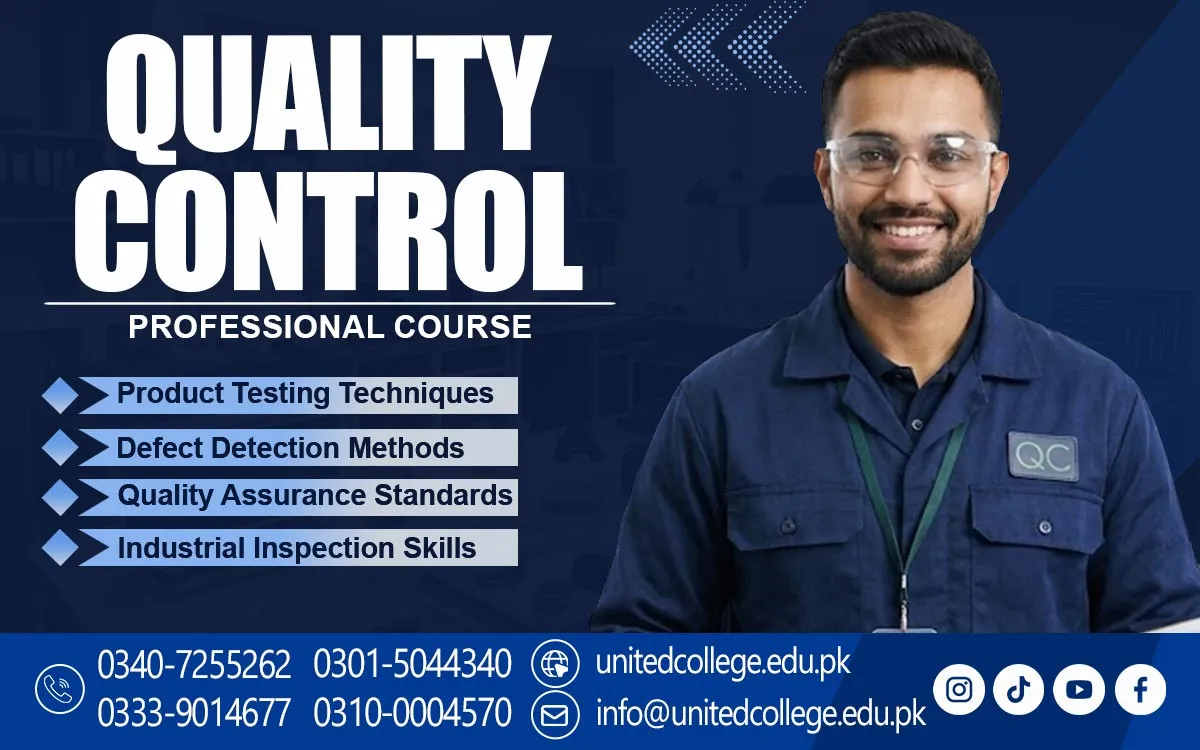

Quality Control Course in Bajaur Advances Industrial Quality Awareness
Quality Checks That Prevent Small Mistakes From Becoming Major Problems
Quality matters wherever people manufacture products, prepare food, produce construction materials, or complete industrial work. Customers expect items to meet certain standards, work as intended, and arrive without damage. When businesses overlook small defects, they may face wasted materials, delayed orders, customer complaints, and additional costs. Regular quality checks help identify problems early and support more consistent results. Imagine a workshop producing metal fittings for construction projects.
The Quality Control Course in Bajaur introduces learners to the basic methods used to inspect products, recognize defects, and maintain work standards. It can be a useful learning option for students, beginners, fresh learners, and job seekers who want to understand quality-related responsibilities. By developing a foundation in inspection and quality management, learners can prepare themselves for further training and explore different areas of industrial work.
Build Practical Knowledge Through Quality Control Training
Quality control is the process of checking materials, products, or completed work against defined requirements. A Quality Control Training program helps learners understand what to inspect, how to compare results, and when to report an issue. These skills are important because businesses need reliable information to decide whether their products meet the expected standard. A course may introduce learners to quality inspection, defect identification, measurement techniques, basic product testing, documentation, and workplace procedures.
Another important topic is the meaning of quality standards. These standards or specifications describe the requirements a product or process must meet. They may cover size, weight, appearance, material quality, performance, or other features depending on the product. The Quality Control Course in Bajaur can help beginners understand these ideas step by step. Learners do not need to begin with advanced technical knowledge. They can first develop an understanding of basic inspection methods and then build their skills through practice and further study.
Understand the Difference Between Quality Control and Quality Assurance
Quality Control and Quality Assurance support the same overall goal, but they focus on different parts of the process. Understanding this difference helps beginners recognize how businesses maintain consistent standards. Quality Control (QC) focuses mainly on checking products or results to identify problems. For instance, a worker may inspect a batch of plastic containers and discover that some lids do not close properly.
Quality Assurance (QA) focuses more on the procedures and systems designed to prevent quality problems. A business may review its production instructions, staff training, or process controls to reduce the chance of the same issue happening again. Both areas require careful work, clear procedures, and accurate information.
Develop the Accuracy and Observation Skills Employers Value
Quality-related work requires more than simply looking at a product and deciding whether it appears acceptable. Workers must observe carefully, follow the correct procedure, use suitable tools, and record findings honestly. These habits help make inspection results useful and consistent. Attention to detail allows an inspector to notice issues such as uneven surfaces, missing components, damaged packaging, or incorrect labels.
Problem-solving helps workers respond sensibly when results do not match expectations. An inspector may not have the authority to change a production process, but they can report the issue and provide accurate information for further investigation. Communication and teamwork also support quality work. Inspectors may need to explain findings to supervisors, production workers, or other departments.
Learn Inspection Methods Through Practical Exercises
Practical exercises help learners connect quality concepts with real tasks. Instead of only memorizing definitions, students can practice observing items, comparing measurements, following written instructions, and recording results. These activities build confidence and show how small differences can affect product acceptance. A basic inspection exercise might involve checking several similar objects for visible damage, measuring their dimensions, and comparing the results with a sample specification.
Product testing basics may also be introduced, depending on the course content. Testing methods differ according to the material, product, and purpose. Some tests require specialized equipment or qualified personnel, so learners should understand the limits of basic inspection and follow appropriate safety instructions. Anyone considering the Quality Control Course in Bajaur should ask which practical activities are included before enrolling. Training content and available practice opportunities can vary.
Explore Quality Applications Across Production and Industry
Quality control knowledge can be useful in several industries because each workplace needs a reliable way to check materials, products, or completed tasks. The inspection criteria differ, but the main principles remain similar: follow requirements, observe carefully, record findings, and report problems. In manufacturing, inspectors may examine metal components, electrical items, furniture, plastic goods, or machine-produced parts. They may check dimensions, appearance, assembly, or other features specified by the manufacturer.
Packaging companies may inspect cartons, bottles, seals, printed labels, and protective materials to help ensure products are properly identified and protected. Textile production and other industrial operations may use different inspection procedures suited to their products. Learning about these applications can help students identify areas that match their interests. However, specialized positions may require additional qualifications, industry-specific training, or practical experience beyond an introductory course.
Prepare for Quality-Related Roles With Realistic Career Planning
Quality control training can introduce learners to possible career directions such as junior quality inspector, quality control assistant, production inspection worker, or quality documentation assistant. These roles may involve checking products, recording measurements, reviewing specifications, or reporting defects. With additional experience and relevant training, some people may work toward responsibilities in Quality Assurance, supplier quality, process monitoring, or quality management.
The Quality Control Training in Bajaur may suit students, beginners, job seekers, and people interested in production or inspection work. It can help them build foundational knowledge, but completing a course does not guarantee employment. Employers may also consider educational background, technical ability, communication skills, work experience, and specific industry requirements. United College of Technology is one institution learners can explore when considering quality-related training. The course offered by United College of Technology may be worth reviewing alongside other relevant learning options.
Choose Training That Matches Your Learning Goals
Selecting a suitable course requires more than looking at its name. Learners should first review the topics covered and determine whether they match their current knowledge and future plans. A useful beginner-level program should explain inspection concepts clearly and help students understand how quality procedures work. Consider whether the syllabus includes defect detection, measurement, product specifications, documentation, and relevant workplace procedures.
Learners should check the course schedule, fees, admission requirements, and any certificate details directly with the provider rather than relying on assumptions. If a particular industry interests you, find out whether the training covers its basic inspection needs or whether additional study may be necessary. Before enrolling, identify the skills you want to improve. Someone interested in manufacturing may focus on measurements and product inspection, while another learner may want to understand documentation and quality assurance procedures.
Turn Quality Knowledge Into Consistent Professional Habits
Learning quality control is a gradual process. After introductory training, learners can continue improving through practice exercises, further study, and supervised workplace experience. Simple activities such as comparing products with written specifications, recording measurements, and identifying visible differences can help strengthen accuracy and attention to detail. As their knowledge grows, learners can explore inspection planning, quality standards, process monitoring, and industry-specific procedures.
The purpose is not simply to find defective items but to understand how accurate checks support better decisions and more consistent results. For people in Bajaur, the Quality Control Course in Bajaur offers a learning path worth considering if they are interested in product inspection, industrial processes, or quality management. Review the available course details, compare them with your goals, and choose training that supports your next steps.
Frequently Asked Questions (FAQs)
An acceptance criterion is a specific condition a product must meet before it can be approved for use, delivery, or the next production stage.
First article inspection checks an initial item from a production run to identify possible issues before more units are produced.
Measurement uncertainty helps explain the possible variation in a measurement, allowing inspectors to interpret results more carefully.
A quality audit trail keeps a traceable record of relevant actions, changes, and decisions so authorized reviewers can understand how a result was reached.
Choosing an appropriate inspection frequency helps teams monitor products or processes at suitable intervals based on their requirements and risks.
Reviewing the cost of poor quality helps businesses understand expenses linked to defects, wasted materials, repeated work, and customer complaints.
Admission Open: Start Your Professional Journey Today!
Join United College of Technology and build a career with practical training, recognized certifications, and Gulf job support. Seats are limited.
Apply Now via WhatsAppContact Information
- Address: Rawalpindi: F-272 Main New Katarian Stop, Old IJP Road | Lahore Campus: Lahore, Pakistan
- Phone/WhatsApp: 0340-7255262 / 0333-9014677 / 0301-5044340 / 0310-0004570 / 051-8770756
- Website: unitedcollege.edu.pk
















Leave a Comment