


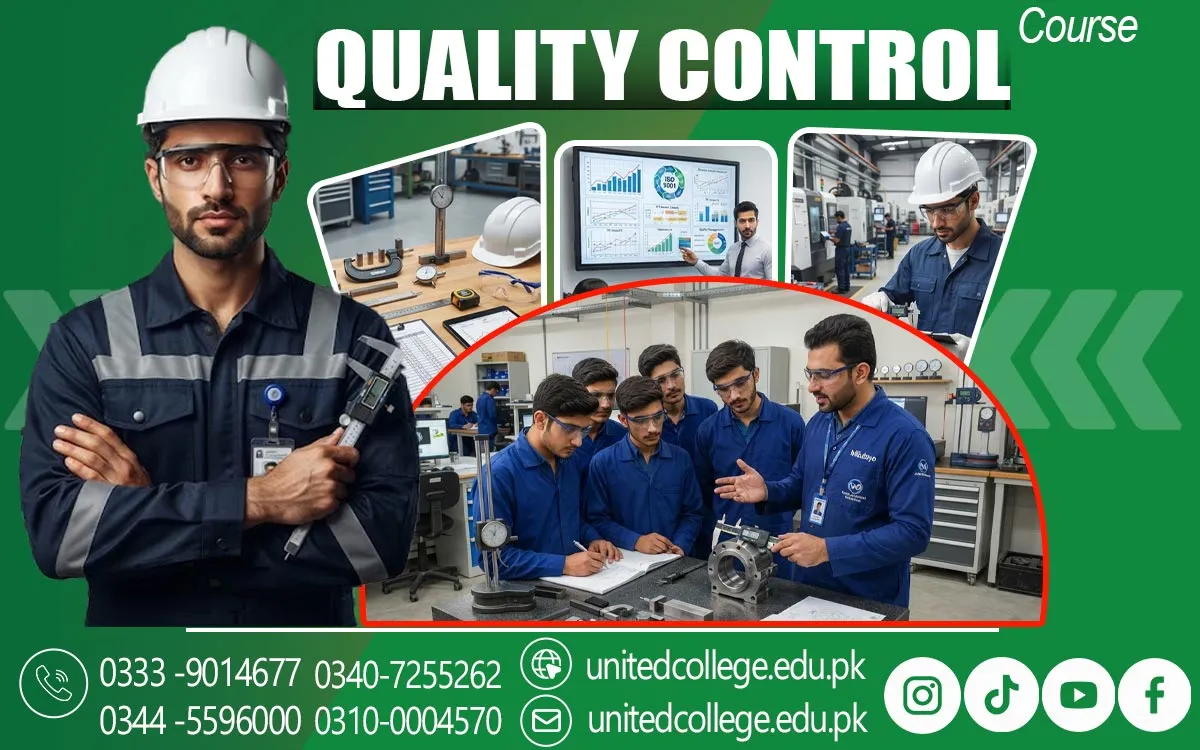

Quality Control Course in Gujrat for Career Advancement
Meeting Industry Expectations Through Effective Quality Control
Modern industries operate in highly competitive markets where customers expect products that meet strict quality standards. Delivering consistent quality is no longer considered an advantage but a necessity for every successful organization. Businesses that maintain high-quality standards earn stronger customer trust, improve operational efficiency, and reduce unnecessary production costs. This makes quality control one of the most valuable functions within any industrial environment.
The Quality Control Course in Gujrat explains how quality control supports every stage of production by ensuring that products comply with technical specifications before reaching customers. Students learn how inspection procedures help identify problems early, allowing organizations to correct issues before they become costly manufacturing defects. This preventive approach improves productivity while reducing waste and material losses.
Participants also explore the responsibilities of quality control professionals in maintaining production standards and supporting continuous improvement. They understand how effective communication between inspectors, engineers, and production teams contributes to better manufacturing performance. This knowledge provides learners with a clear understanding of why quality control has become an essential part of every successful industry.
Essential Inspection Methods Used in Manufacturing
Inspection is a systematic process that verifies whether products meet defined quality requirements throughout manufacturing. Instead of relying only on final inspections, modern industries monitor quality at multiple production stages to identify defects before they affect finished products. This approach increases efficiency while ensuring that customers receive reliable products that meet expected standards.
During the Quality Control Course in Gujrat, students become familiar with various inspection techniques used across manufacturing, engineering, construction, pharmaceutical, and production industries. They study incoming material inspections, process inspections, visual examinations, dimensional verification, sampling procedures, and final product evaluations. Understanding these inspection methods enables learners to perform quality assessments with greater accuracy and confidence.
Practical demonstrations provide opportunities to observe common production defects, evaluate product quality, and compare inspection results with technical specifications. Learners also understand how inspection findings are used to improve manufacturing processes and reduce recurring quality problems. These practical experiences help prepare graduates for professional responsibilities within industrial quality departments.
Maintaining Product Consistency Across Every Production Stage
Consistent product quality depends on effective monitoring throughout the entire production cycle. Every manufacturing stage presents opportunities for errors that can affect the final product if not detected early. Maintaining quality requires continuous observation, regular inspections, and proper process control rather than depending only on final product testing.
The Quality Control Course in Gujrat introduces learners to production monitoring techniques that help organizations maintain consistent quality from raw material inspection to finished product approval. Students understand how quality checkpoints, production records, inspection schedules, and process verification activities contribute to better manufacturing performance. These systems help reduce variation while improving production reliability.
Participants also learn how early defect detection supports continuous improvement by reducing material waste, minimizing equipment downtime, and preventing customer complaints. Through practical examples, learners recognize the importance of maintaining quality throughout every production stage instead of correcting problems after manufacturing has been completed.
Using Testing Equipment for Accurate Quality Verification
Quality verification requires more than visual inspection because many products must be tested using precision measuring instruments and specialized equipment. Accurate measurements help inspectors determine whether products meet engineering drawings, technical specifications, and customer requirements. Even minor measurement errors can influence product performance, making precision an essential part of quality control.
The Quality Control Course in Gujrat provides practical knowledge of commonly used measuring tools, including vernier calipers, micrometers, dial gauges, steel rules, measuring tapes, and other inspection instruments. Students learn correct measuring procedures, calibration awareness, and methods for interpreting inspection results accurately. These practical skills improve confidence while preparing learners for professional industrial environments.
The course also explains how testing procedures verify product strength, dimensions, surface quality, and performance before products are approved for delivery. Practical exercises help participants understand how inspection and testing work together to improve manufacturing accuracy, reduce production errors, and maintain high-quality standards. Mastering these techniques prepares graduates for technical careers where precision and quality are essential.
Improving Production Through Better Quality Documentation
Quality documentation serves as the backbone of every successful quality management system because it records inspection activities, testing results, corrective actions, and production performance. Without accurate documentation, organizations cannot monitor quality trends, investigate recurring issues, or demonstrate compliance with industry requirements. Proper records also provide valuable information that helps companies make informed decisions for future production improvements.
The Quality Control Course in Gujrat teaches learners how professional quality documents are prepared and maintained in industrial environments. Students become familiar with inspection reports, quality checklists, non-conformance reports, corrective action forms, material inspection records, and production quality logs. They understand how each document contributes to maintaining transparency and improving communication between quality inspectors, engineers, supervisors, and production teams.
Practical exercises allow participants to prepare technical reports based on inspection findings and workplace scenarios. Learners also discover how organized documentation supports internal audits, customer inspections, and continuous improvement programs. By developing strong reporting skills, graduates become more capable of handling quality-related responsibilities while meeting the documentation standards expected by modern industries.
Quality Systems That Drive Industrial Success
Industrial organizations achieve consistent results by following structured quality systems that define responsibilities, establish procedures, and monitor every production activity. These systems help businesses maintain product consistency while reducing operational risks and unnecessary manufacturing costs. Companies that invest in effective quality systems are often able to improve productivity, strengthen customer confidence, and compete more successfully in local and international markets.
Throughout the Quality Control Course in Gujrat, learners explore the principles of quality management systems and understand how standardized procedures improve industrial performance. They study process control, quality objectives, standard operating procedures, workplace compliance, and continuous improvement practices that help organizations maintain high production standards. These concepts show students how every department contributes to achieving quality goals.
The course also highlights the importance of teamwork in maintaining effective quality systems. Quality inspectors work alongside engineers, production supervisors, maintenance staff, and management to identify opportunities for improvement and prevent production problems. Understanding this collaborative approach prepares learners to become productive members of professional quality teams within different industrial sectors.
Career Opportunities After Completing Quality Control Training
As industries continue to expand, the demand for skilled quality control professionals continues to increase across Pakistan and many international markets. Organizations require qualified personnel who can inspect products, monitor production activities, evaluate manufacturing processes, and ensure compliance with industrial quality standards. This growing demand makes quality control one of the most promising technical career fields for individuals seeking long-term employment.
After completing the Quality Control Course in Gujrat, graduates can apply for positions such as Quality Control Inspector, QA/QC Technician, Production Quality Officer, Process Inspector, Documentation Coordinator, Laboratory Assistant, Quality Auditor, and Quality Supervisor. These opportunities are available in manufacturing companies, construction projects, pharmaceutical industries, food processing plants, engineering firms, textile factories, automotive industries, and oil and gas organizations.
The practical knowledge gained during this course also provides an excellent foundation for advanced certifications and professional development. As industries adopt more advanced manufacturing technologies and international quality standards, professionals with strong quality management skills continue to enjoy excellent career prospects and opportunities for promotion.
Prepare for Professional Success in Quality Management
Building a successful career requires more than technical knowledge alone. Employers seek professionals who possess practical skills, analytical thinking, problem-solving abilities, and the confidence to perform responsibilities independently. Quality control professionals who combine these qualities with strong inspection skills become valuable assets for any organization focused on maintaining high standards.
The Quality Control Course in Gujrat prepares learners for these professional expectations by combining classroom instruction with practical industrial training. Students develop expertise in inspection techniques, testing methods, production monitoring, quality documentation, and quality management practices that reflect current industry requirements. This balanced approach enables graduates to transition smoothly into professional working environments.
Whether your goal is to begin a new career, strengthen your existing qualifications, or prepare for future advancement, this course offers practical learning that supports long-term success. By mastering quality control principles and applying them in real industrial situations, learners become capable of contributing to safer production processes, improved operational efficiency, and higher product quality across a wide range of industries.
Frequently Asked Questions (FAQs)
The course combines practical inspection techniques, quality management concepts, testing procedures, and documentation skills that are directly applicable in manufacturing, engineering, construction, and production industries.
No. The course starts with fundamental quality control concepts and gradually progresses to practical inspection methods, making it suitable for both beginners and experienced professionals.
Yes. Learners participate in practical sessions involving inspection techniques, measuring instruments, quality reporting, testing methods, and process evaluation to build job-ready skills.
Graduates can work in manufacturing, construction, pharmaceuticals, food processing, engineering, automotive, textile, electronics, packaging, and many other industries that require quality assurance and inspection.
Effective quality control reduces defects, improves customer satisfaction, minimizes production waste, strengthens compliance with standards, enhances operational efficiency, and helps organizations maintain a strong reputation in competitive markets.
Admission Open: Start Your Professional Journey Today!
Join United College of Technology and build a career with practical training, recognized certifications, and Gulf job support. Seats are limited.
Apply Now via WhatsAppContact Information
- Address: Rawalpindi: F-272 Main New Katarian Stop, Old IJP Road | Lahore Campus: Lahore, Pakistan
- Phone/WhatsApp: 0333-9014677 / 0344-5596000 / 0310-0004570 / 0301-5044340 / 0340-7255262
- Website: unitedcollege.edu.pk
















Leave a Comment