



Welding Course in Bagh AJK – Shape Your Future With Skill
Turn Metalwork Into a Practical Technical Skill
Metalwork becomes useful when a person knows how to handle tools, control heat, and create strong joints with care. Welding is a hands-on technical skill used in many types of repair, fabrication, construction, and workshop work. For beginners in Bagh AJK, learning welding can provide a practical way to understand how metal pieces are prepared, joined, shaped, and handled safely.
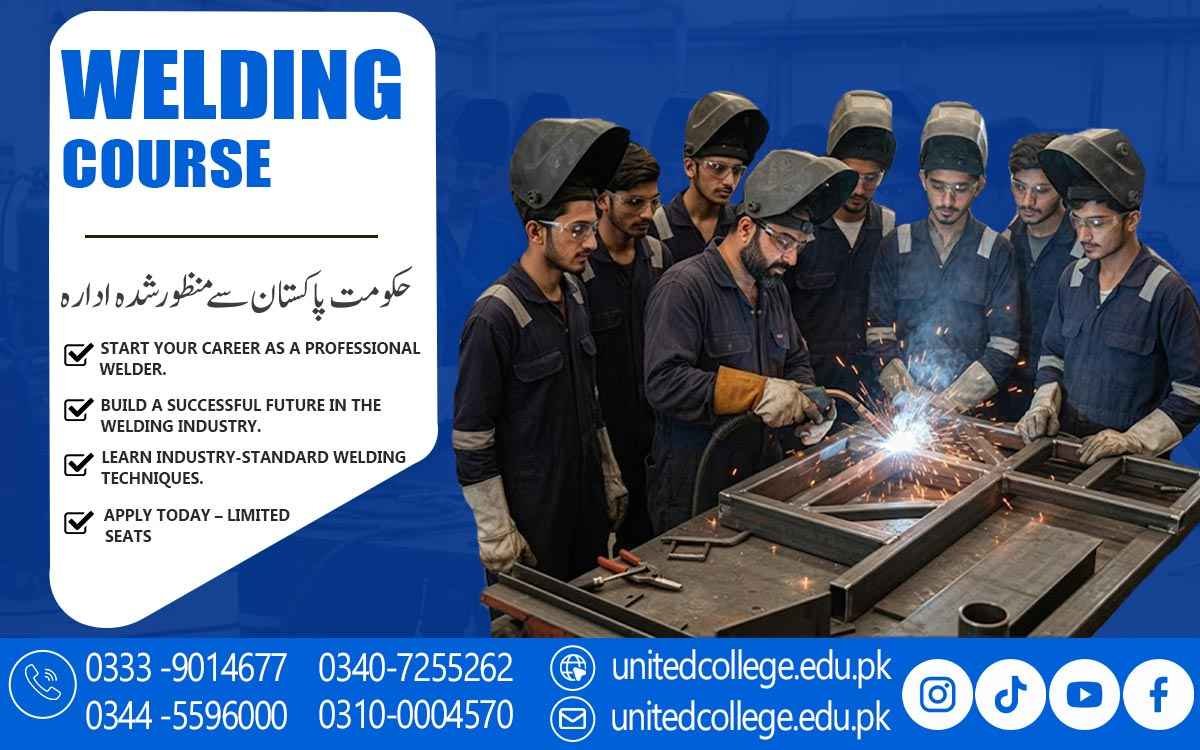
A Welding Course in Bagh AJK can help learners move beyond simply watching welding work and start developing controlled practical skills. United College of Technology offers this course for people who want to learn welding fundamentals through practical training. The learning process can introduce students and fresh learners to equipment, techniques, safety practices, and workshop habits needed for responsible welding practice.
From Raw Metal To A Strong, Clean Joint
Welding is more than bringing two pieces of metal together. A good weld depends on preparation, correct positioning, suitable equipment, controlled heat, and steady hand movement. During a Welding Course in Bagh AJK, learners can start by understanding how different metal pieces behave during work and why preparation matters before switching on a welding machine. Metal surfaces may need cleaning, alignment, marking, or cutting before joining begins.
These basic steps help learners understand the complete process instead of focusing only on the welding arc. Practical welding skills develop gradually as learners repeat simple tasks and observe the results. With regular practice, they can become more familiar with metal joining, fabrication work, and the careful movements required to produce more consistent joints.
Tools on the Bench That Build Real Workshop Skills
A welding workshop introduces learners to equipment that has a direct role in practical work. Depending on the training setup and welding method, students may become familiar with welding machines, electrodes, welding cables, clamps, grinders, measuring tools, cutting equipment, and workholding devices. Protective equipment is equally important because welding involves heat, sparks, fumes, and bright light.
Familiarity with tools also includes learning how to inspect equipment, keep the work area organized, and handle tools correctly. This combination of equipment knowledge and workshop discipline gives beginners a stronger foundation for future fabrication and maintenance tasks.
Arc, MIG, TIG, and Gas Work in the Practical Mix
Different welding techniques are suited to different types of work, materials, and working conditions. Arc welding is widely used for joining metal and is an important part of many basic welding programs. MIG welding uses a continuously fed wire and can be useful for certain fabrication applications, while TIG welding offers greater control for particular types of precise work.
Gas welding uses heat produced by a fuel gas and oxygen and has its own equipment and working methods. Beginners do not need to master every process immediately. Instead, welding classes can introduce the fundamentals of these techniques and help learners understand how their equipment and applications differ. Knowing these differences makes it easier to select an appropriate method for a particular practical task.
Better Welding Starts Before the Machine Is Switched On
Preparation often determines how smoothly a welding task will proceed. Learners need to understand measurements, markings, edges, gaps, alignment, and workpiece positioning before beginning a joint. Metal may require cleaning to remove dirt, rust, paint, or other unwanted material from the working area. Cutting and shaping must also be carried out carefully so that pieces fit correctly.
During welding practice, students can learn how to hold or secure workpieces and maintain a suitable position while working. They may also practice simple joints before moving toward more demanding tasks. These welding fundamentals help develop accuracy and control. A learner who pays attention to preparation is less likely to treat welding as a rushed process and more likely to understand the importance of each stage.
Safety Habits Belong At The Center Of Every Welding Task
Welding safety should never be treated as an extra part of technical training. The process can produce intense light, heat, sparks, fumes, and hot metal, so learners need appropriate protective equipment and safe working habits. During a Welding Course In Bagh, AJK, students can learn the importance of using a suitable welding helmet to protect the eyes and face from the intense arc, while gloves and protective clothing help reduce exposure to heat and sparks.
Proper ventilation is also important because welding fumes should not be allowed to build up in an enclosed work area. Learners should keep flammable materials away from welding operations, inspect cables and equipment, and follow safe machine-handling practices.
Small Beginner Errors Can Teach Valuable Lessons
Early welding practice may involve uneven joints, excessive spatter, poor alignment, weak penetration, inconsistent movement, or difficulty maintaining the correct position. These issues are a normal part of learning a hands-on technical skill, but they should be identified rather than ignored. Beginners can improve by checking their setup, preparing the metal properly, maintaining steady movement, and paying attention to the welding conditions being used.
Another common mistake is trying to complete difficult work before gaining control over basic techniques. Starting with manageable exercises allows learners to understand how the machine and material respond. Careful observation after each practice session can also reveal where improvement is needed. This approach turns mistakes into useful learning points and gradually strengthens welding accuracy.
Repetition Turns Basic Movements Into Useful Skill
Practical training becomes more valuable when learners get opportunities to repeat tasks and improve them. Welding requires coordination between the hands, eyes, equipment, and workpiece, so confidence normally develops through practice rather than reading alone. Learners can work on maintaining steady movement, controlling the welding arc, creating consistent joints, and positioning metal correctly. They can also become more comfortable with measurements, marking, cutting, grinding, and basic fabrication activities that support welding work.
A structured Welding Course in Bagh, AJK can give beginners a starting point for developing these workshop skills under practical guidance. Consistent practice also helps learners recognize that quality work is built through patience, attention to detail, and repeated correction rather than speed alone.
A Skill That Connects With Many Types of Technical Work
Welding knowledge can be useful in settings where metal components need to be joined, repaired, fabricated, or maintained. Workshop environments, construction-related activities, metal fabrication units, maintenance work, and various technical operations may involve welding or related metalworking tasks. The exact work performed depends on the learner's skill level, experience, workplace requirements, and the type of welding involved.
This is why strong fundamentals are important for beginners. Instead of focusing only on one task, learners can build a wider understanding of metal joining, welding equipment, cutting, preparation, and safe workshop practices. The practical foundation gained through training can also support further learning in fabrication and other technical areas as a learner gains experience.
Keep Building the Skill Beyond the First Weld
Completing basic training should be viewed as a starting point rather than the end of practical development. Learners can continue improving by practicing different joints, studying equipment instructions, observing experienced workers, reviewing safety procedures, and gradually working with more challenging tasks under appropriate supervision. Keeping tools organized and maintaining good workshop habits can also become part of professional development.
For someone searching for a Welding Course in Bagh AJK, the next step is to identify clear learning goals and choose training that provides practical exposure to welding fundamentals. United College of Technology can be explored as an option for beginning this technical learning journey. With regular practice, careful preparation, and a strong focus on safety, learners can continue turning basic welding knowledge into more reliable and useful workshop skills.
Frequently Asked Questions (FAQs)
Yes. Beginners can start with basic concepts and gradually become familiar with welding equipment, metal handling, and simple practical tasks.
Look for training that combines basic knowledge with hands-on practice, proper equipment handling, safety instruction, and guidance during practical exercises.
Yes. Repeated welding exercises require learners to coordinate their hands, eyes, tools, and workpieces, which can help improve control and precision.
Training may include practical exercises involving different metal pieces and applications, depending on the equipment, workshop setup, and learning level.
Accurate measurements help learners position and prepare metal pieces correctly. Good measurement can reduce alignment problems and support cleaner fabrication work.
A beginner should develop habits such as checking equipment, wearing suitable protective gear, keeping the workspace orderly, following instructions, and practicing carefully.
Admission Open: Start Your Professional Journey Today!
Join United College of Technology and build a career with practical training, recognized certifications, and Gulf job support. Seats are limited.
Apply Now via WhatsAppContact Information
- Address: Rawalpindi: F-272 Main New Katarian Stop, Old IJP Road | Lahore Campus: Lahore, Pakistan
- Phone/WhatsApp: 0333-9014677 / 0344-5596000 / 0310-0004570 / 0301-5044340 / 0340-7255262
- Website: unitedcollege.edu.pk
















Leave a Comment