


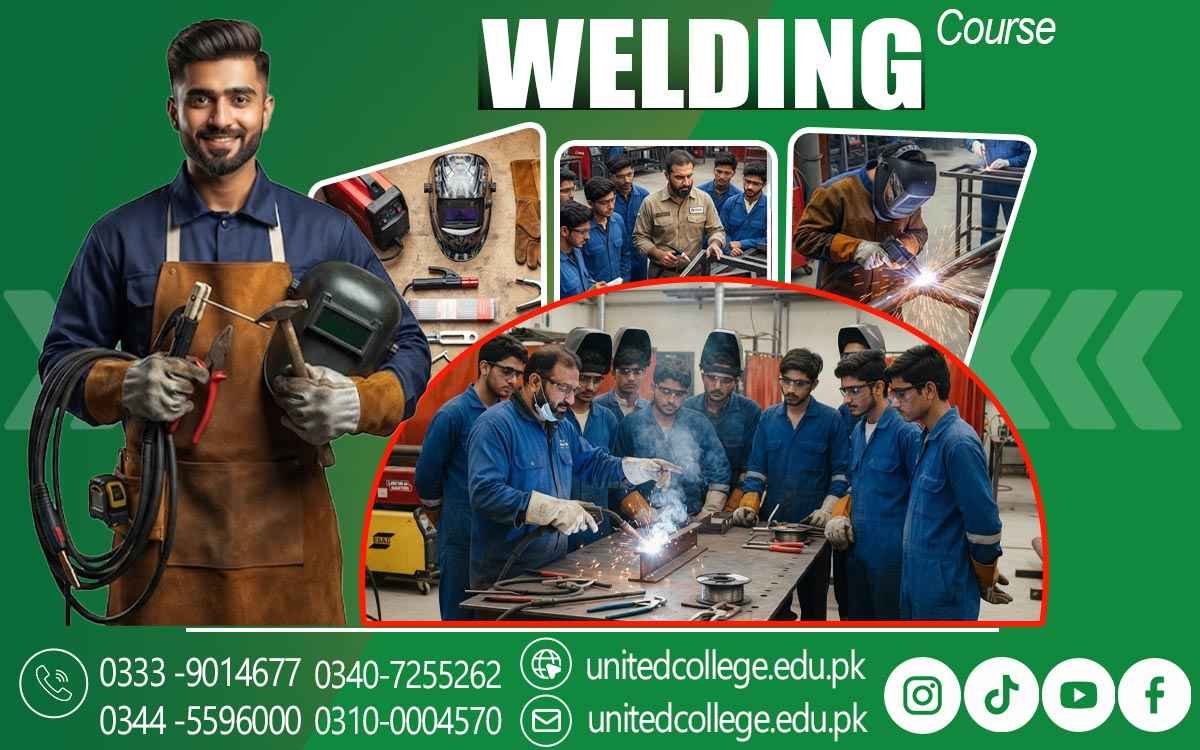

Welding Course in Khushab – Learn a Skill Made for Practical Work
Turn Hands-On Practice Into a Skill You Can Build
A metal frame, support, gate, machine part, or fabricated structure often begins with pieces that look completely separate. The skill of welding brings those pieces together through controlled heat, accurate positioning, and careful technique. What looks simple from a distance actually involves preparation, equipment handling, measurement, safety, and steady practice.
For beginners in Khushab, learning these elements can provide a practical way to develop useful technical knowledge. The Welding Course in Khushab, offered by United College of Technology, introduces learners to the basic processes behind welding while giving them a foundation for working with tools, machines, and metal materials.
Accurate Cutting and Fitting Give the Final Weld a Better Starting Point
Good welding often depends on work completed before the actual joining begins. Metal may need to be measured, marked, cut, cleaned, and fitted into position. If two pieces are poorly aligned, even a technically controlled weld may not produce the intended result. This is where metal cutting and metal fitting become useful supporting skills. Learners can practice taking measurements, checking dimensions, creating suitable edges, and positioning pieces before welding.
During a Welding Course in Mandi Bahauddin, students can also work with simple drawings to understand the intended size, shape, angle, or arrangement of a component. Welding joints provide another useful area for practice. Butt, lap, corner, and T-joints introduce learners to different ways of positioning metal. Working with these arrangements can improve awareness of joint preparation and help students understand why the welding movement may need to change from one task to another.
Build Familiarity With the Tools Before Taking on Complex Work
A beginner needs to become comfortable with the equipment used around a welding station. A welding machine is central to many tasks, but it works alongside other tools such as electrode holders, cables, clamps, grinders, measuring devices, cutting equipment, helmets, and protective clothing. Learning what each tool is designed to do helps prevent careless handling. Students can also understand how a workpiece is secured and why keeping equipment organized matters.
Good tool handling is not about using the largest number of tools; it is about selecting and using the appropriate equipment for the task. During welding classes, practical demonstrations can help learners understand how equipment is prepared and handled. The exact machines and exercises can vary by training environment, but the basic aim remains the same: help beginners become more confident and responsible around workshop equipment.
Explore Different Welding Methods Through Practical Understanding
Welding includes several processes, and each has its own working method. Arc welding uses an electric arc to produce the heat required for joining metal. It is commonly used in many general metalworking and fabrication situations. MIG welding feeds a wire electrode continuously while shielding gas helps protect the weld area. TIG welding uses a tungsten electrode and allows careful control in suitable applications.
Learners do not need to treat these processes as identical. Material type, thickness, joint design, required finish, and the nature of the task can influence which method is suitable. Understanding these differences gives beginners a stronger foundation in welding techniques. Practical training can make these differences easier to remember because students can see how equipment, movement, and working methods change from one process to another.
Precision Begins With Measuring, Cutting, Fitting, and Positioning
A clean weld depends heavily on what happens before joining begins. If metal pieces are incorrectly measured or poorly positioned, the finished structure may not match the intended shape. This is why metal cutting, fitting, and alignment are useful supporting skills for anyone learning welding. Beginners can learn how to take basic measurements, mark material, prepare edges, and position pieces before welding.
Simple technical drawings can also help learners understand dimensions, angles, shapes, and the arrangement of components. Different welding joints introduce learners to different forms of metal connection. Butt joints bring edges together, lap joints overlap pieces, while T-joints and corner joints create other arrangements.
Read the Weld Itself to Find Areas That Need Improvement
Practical welding is not finished when the machine is switched off. Learners also need to look at the completed work and understand what the result tells them. An uneven weld bead, excessive spatter, visible cracks, gaps, poor alignment, or weak-looking fusion may indicate that something in the process needs attention. These problems are commonly discussed as welding defects. Beginners can learn to recognize visible signs and consider possible causes.
Basic troubleshooting encourages learners to think instead of simply repeating the same action. During a Welding Course in Khushab, learners can review their preparation, positioning, equipment settings, movement, and technique to identify where an adjustment may be needed. Regular welding practice is especially useful here. Repeating a controlled task allows learners to compare results and gradually improve accuracy, movement, and finishing.
Make Safety a Working Habit From the First Practical Session
Welding involves heat, sparks, intense light, fumes, and electrical equipment, so safe working habits must remain part of every training session. Welding safety is not something to consider only after learning the technical side of the trade. Suitable protective equipment can include a welding helmet or appropriate eye protection, gloves, protective clothing, and safety footwear. Learners should also understand why ventilation is important when a welding process produces fumes or gases. Fire prevention is another important part of workshop safety.
Flammable materials should be kept away from sparks and heat, while the working area should remain clear of unnecessary objects. Equipment, cables, and connections should be checked before use, and instructions should be followed carefully. At United College of Technology, safety awareness can be treated as part of practical learning alongside equipment handling and welding techniques. Developing these habits early can help learners approach workshop activities with greater responsibility.
Take Practical Welding Skills Into Wider Areas of Technical Work
Welding knowledge can connect with several forms of hands-on technical work. Fabrication environments may involve assembling metal components, while maintenance activities can include suitable repair or modification work. Construction-related tasks may also involve metal joining, depending on the project. Welding can become more useful when combined with other fabrication skills.
Measuring, cutting, grinding, fitting, drawing interpretation, and equipment care can help learners understand the complete process behind creating or modifying metal components. For learners in Khushab, the Welding Course in Khushab offered by United College of Technology can provide a structured starting point for exploring this practical field. Students should focus on understanding each process, following safe procedures, and developing control through consistent hands-on work rather than trying to master difficult tasks immediately.
Let Steady Practice Shape the Skill You Carry Forward
Learning welding is a gradual process. A learner may begin by understanding equipment and basic joints, then move toward better control, cleaner finishing, improved preparation, and greater awareness of workshop procedures. Each stage adds another part to the overall skill. Anyone considering welding training should approach it with patience and an active willingness to practice.
The Welding Course in Khushab at United College of Technology can be considered by learners who want to explore practical metalwork and develop a foundation in welding. The most valuable progress comes from combining technical knowledge with repeated practice, careful preparation, and strong safety habits.
Frequently Asked Questions (FAQs)
Beginners can learn that settings may need to match factors such as the welding process, electrode or wire, and material being worked on.
The position of a joint can change how a learner approaches the weld. Different positions require attention to movement, access, and control.
A clamp can hold metal pieces securely in place, helping maintain their position while a learner prepares or joins the workpiece.
Careful inspection, controlled grinding where appropriate, accurate joint preparation, and attention to the final appearance can help improve finishing ability.
They should understand proper handling, positioning, and inspection of cables so that equipment can be used responsibly during workshop activities.
Welding involves several small skills that develop over time. Patient practice gives learners space to understand mistakes and improve their technique gradually.
Admission Open: Start Your Professional Journey Today!
Join United College of Technology and build a career with practical training, recognized certifications, and Gulf job support. Seats are limited.
Apply Now via WhatsAppContact Information
- Address: Rawalpindi: F-272 Main New Katarian Stop, Old IJP Road | Lahore Campus: Lahore, Pakistan
- Phone/WhatsApp: 0333-9014677 / 0344-5596000 / 0310-0004570 / 0301-5044340 / 0340-7255262
- Website: unitedcollege.edu.pk
















Leave a Comment