


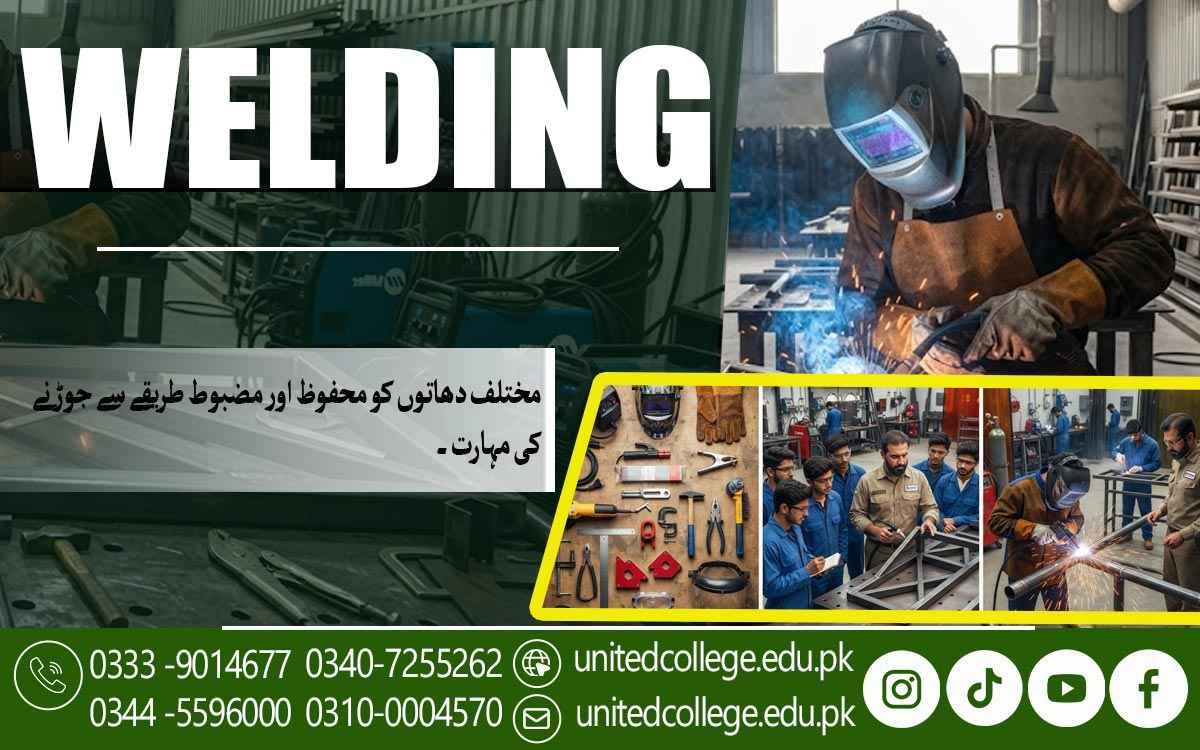

Welding Course in Mandi Bahauddin – Start Building Technical Skills
Build the Skill That Turns Metal Into Useful Work
A piece of metal may look simple, but turning it into a useful frame, support, component, or structure requires accuracy and control. Welding is the practical process that brings separate metal pieces together through controlled heat and suitable joining methods. It is used across workshops, fabrication work, maintenance, construction-related tasks, and many other technical activities.
For beginners in Mandi Bahauddin, learning this skill can provide valuable hands-on knowledge that is difficult to develop through theory alone. The Welding Course in Mandi Bahauddin, offered by United College of Technology, gives learners an opportunity to understand the fundamentals of welding, become familiar with workshop equipment, and develop practical skills through guided learning.
Start With the Metal, Then Learn What Makes a Weld Work
Before learning advanced techniques, beginners need to understand what actually happens during welding. In simple terms, welding joins metal by using heat to create a connection between pieces. Depending on the process, an electrode, wire, filler material, gas, or a combination of these may be involved.
A learner can begin by understanding terms such as welding arc, electrode, filler material, weld bead, joint, heat, and workpiece. During a Welding Course in Mandi Bahauddin, these concepts can become easier through practical demonstrations and workshop exercises. For example, the condition of a metal surface can affect the joining process, while the position of two pieces can influence the final shape of the joint.
Turn Workshop Equipment Into Familiar Tools Through Practice
Welding involves several tools and pieces of equipment, and knowing their purpose is an important part of practical learning. A welding machine, electrode holder, cables, clamps, helmet, gloves, grinder, measuring tools, and cutting equipment can all play different roles depending on the task. Beginners need time to become comfortable around these tools.
Proper handling also reduces unnecessary mistakes during practical work. The Welding Course in Mandi Bahauddin can help learners connect equipment knowledge with actual workshop activities. At United College of Technology, the focus can be approached from a learner's perspective: understand the tool first, use it correctly, observe the result, and improve with practice.
Explore Welding Processes Instead of Treating Every Joint the Same
Different welding techniques are designed around different working methods. Arc welding uses an electric arc to generate heat for joining metal and is widely associated with general fabrication and workshop work. Learning electrode control and arc handling can help beginners understand this process. MIG welding uses a continuously supplied wire electrode with shielding gas, while TIG welding uses a tungsten electrode and is suited to applications where careful control is important.
Gas welding produces heat through a flame created by burning fuel gas with oxygen. These processes are not interchangeable in every situation. Material type, thickness, joint design, required finish, and the nature of the task can influence process selection. A beginner does not need to master every technique at once. Understanding how the methods differ is an important first step toward developing broader welding skills.
Accurate Cutting and Fitting Give the Final Weld a Better Starting Point
Good welding often depends on work completed before the actual joining begins. Metal may need to be measured, marked, cut, cleaned, and fitted into position. If two pieces are poorly aligned, even a technically controlled weld may not produce the intended result. This is where metal cutting and metal fitting become useful supporting skills.
During a Welding Course in Mandi Bahauddin, students can also work with simple drawings to understand the intended size, shape, angle, or arrangement of a component. Welding joints provide another useful area for practice. Butt, lap, corner, and T-joints introduce learners to different ways of positioning metal.
Control Comes From Repetition, Observation, and Small Corrections
A beginner's first weld may not look perfectly even, and that is part of learning a hands-on trade. Welding requires coordination between hand movement, viewing angle, equipment control, and the position of the material. These abilities develop gradually through repeated welding practice. Learners can improve by paying attention to the results of each attempt.
Instead of simply repeating the same action, students can identify the problem and adjust their technique. Practical training may include exercises that allow beginners to work with different positions, materials, joint arrangements, or equipment settings. The exact exercises can vary according to the training environment. The important part is developing the habit of observing the work and making controlled improvements.
Safe Welding Depends on Habits as Much as Protective Equipment
Heat, sparks, intense light, fumes, and electrical equipment make safety essential in any welding environment. Welding safety should therefore be learned alongside practical technique rather than treated as a separate subject. Protective equipment can include a suitable welding helmet or eye protection, gloves, protective clothing, and safety footwear.
Safe workshop behavior includes checking equipment before use, maintaining cables properly, keeping unnecessary materials away from the work area, and controlling sources of heat and sparks. A clean and organized workspace can also make it easier to move and work safely. These habits are valuable because a skilled welder needs more than technical control.
Take Welding Beyond the Bench Into Broader Technical Work
Welding skills can connect with several areas where metal components need to be joined, assembled, repaired, or modified. Fabrication workshops may use welding for different metal structures, while maintenance environments can involve suitable repair and modification tasks. Construction-related work may also include metal joining as part of particular projects.
For someone considering practical technical training in Mandi Bahauddin, the Welding Course in Mandi Bahauddin offered by United College of Technology can serve as a starting point for exploring these skills. Learners should focus on developing a strong foundation rather than trying to master complicated work too quickly.
Let Your Next Step Be Built on Practical Skill and Consistent Learning
Welding is a skill where progress can be seen directly in the work. Better preparation, steadier movement, cleaner joints, accurate measurements, and safer equipment handling can each show improvement. With regular practice, learners can gradually understand how individual techniques fit into the larger process of metal fabrication.
The right next step is to approach training with patience and an active mindset. Observe demonstrations, practice under suitable guidance, follow workshop safety rules, and take time to understand why a particular technique is used. At United College of Technology, learners interested in the Welding Course in Mandi Bahauddin can begin exploring this practical field and work toward building a useful foundation in welding and related fabrication skills.
Frequently Asked Questions (FAQs)
The learner can check the joint for visible cracks, uneven areas, excessive spatter, gaps, and other signs that may indicate an issue with the welding process.
Oil, rust, paint, or dirt can interfere with the joining process. Proper surface preparation helps create a cleaner working area before welding begins.
Correct positioning keeps metal pieces in the intended arrangement and can make it easier to maintain control while completing the joint.
Fitting brings metal pieces into the required shape and position before they are permanently joined, helping the learner understand the relationship between preparation and final results.
They can compare their practice results, identify recurring problems, adjust one part of their technique at a time, and repeat the task under proper guidance.
Metal measuring, grinding, cutting, fitting, drawing interpretation, equipment care, and basic fabrication can expand a learner's understanding of practical metalwork.
Admission Open: Start Your Professional Journey Today!
Join United College of Technology and build a career with practical training, recognized certifications, and Gulf job support. Seats are limited.
Apply Now via WhatsAppContact Information
- Address: Rawalpindi: F-272 Main New Katarian Stop, Old IJP Road | Lahore Campus: Lahore, Pakistan
- Phone/WhatsApp: 0333-9014677 / 0344-5596000 / 0310-0004570 / 0301-5044340 / 0340-7255262
- Website: unitedcollege.edu.pk
















Leave a Comment