


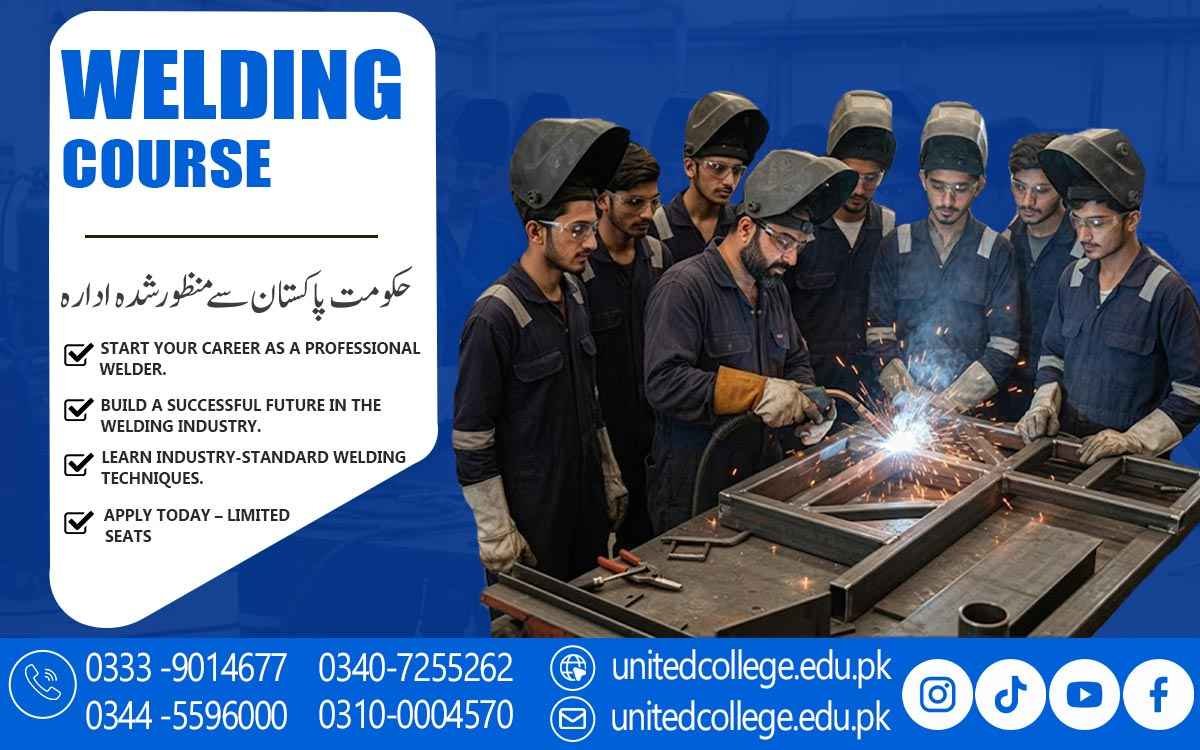

Welding Course in Jhang – Learn Welding for Real Workshop Work
Shape Metal Into a Skill You Can Build On
Welding is one of those practical skills where learning becomes visible in front of you. A correct joint, a clean edge, and controlled movement can turn separate metal pieces into something useful. For beginners in Jhang, learning this trade can be a practical way to develop hands-on technical knowledge instead of depending only on classroom theory.
The Welding Course in Jhang offered by United College of Technology introduces learners to the basic ideas, equipment, techniques, and working habits involved in welding. The focus can be especially useful for students, fresh learners, job seekers, and anyone interested in understanding metalwork from a practical point of view.
From Metal Preparation To A Finished Joint: Understanding The Work Behind Welding
Good welding starts before the welding machine is turned on. Learners first need to understand the material they are working with, prepare its surface, position the pieces correctly, and select a suitable method for the task. These small steps can have a direct effect on the final joint. During a Welding Course In Jhang, beginners can learn important terms such as heat, arc, electrode, filler material, joint, weld bead, and shielding through practical workshop activities.
Learners gradually see how preparation, machine settings, hand movement, and material position work together. Basic welding joints are another important part of this learning process. Butt, lap, corner, and T-joints are commonly used to understand different ways of joining metal. Practicing these arrangements helps learners notice how joint position and alignment can change the way a welding task is handled.
The Welding Bench Becomes a Place for Skill, Control, and Observation
A welding workshop teaches more than simply producing a weld. Beginners have to learn how to hold equipment correctly, maintain suitable movement, observe the weld area, and make adjustments when something does not look right. These abilities develop through repeated practice rather than through reading alone. During welding practice, hand control matters greatly. Moving too quickly can affect the joint, while poor positioning may make the weld uneven.
Learners can work on maintaining a steady movement and keeping their attention on the area being joined. Practical welding training may also include exercises based on different metal shapes, positions, or joining requirements. The exact exercises can vary according to the training setup and learning plan. The main purpose is to give beginners a chance to turn basic instructions into controlled workshop actions.
Arc, MIG, TIG and Gas Welding Bring Different Working Methods
Welding does not rely on one technique for every task. Arc welding uses an electric arc to create the heat needed for joining metal and is widely associated with practical metalwork. MIG welding uses a continuously fed wire and shielding gas, while TIG welding uses a tungsten electrode and provides precise control for suitable applications. Gas welding uses heat produced by burning a fuel gas with oxygen. Each process has its own equipment, working method, advantages, and limitations.
A strong starting point is understanding what makes the methods different and how the selected technique relates to the material and task. The Welding Course in Jhang can help learners become familiar with these basic differences while developing an understanding of welding equipment. This knowledge gives students a clearer picture of how welding methods are selected in different workshop situations.
Tools And Measurements Give Every Welding Task Its Direction
A welding machine is only one part of the workshop setup. During a Welding Course In Jhang, learners may work with electrodes, welding cables, clamps, holders, grinding equipment, measuring tools, cutting equipment, and other workshop items. Knowing the purpose of each tool helps beginners work in a more organized way. Metal cutting is also closely connected with fabrication work.
Simple measurements can help maintain correct dimensions and improve alignment. Reading basic technical drawings can add another useful skill. A drawing may show measurements, shapes, angles, or the intended arrangement of components. Beginners who learn to understand simple visual instructions can connect workshop work with the information shown on paper.
Safety Is Part of the Technique, Not an Extra Step
Welding produces intense heat, bright light, sparks, fumes, and other hazards. For this reason, welding safety must become part of normal workshop behavior from the beginning. Learners need to understand why protective equipment is used and how a safe working area is maintained. Suitable protective equipment can include a welding helmet or appropriate eye protection, gloves, protective clothing, and safety footwear.
Flammable materials should be kept away from sparks and heat, while electrical connections and machines should be checked before use. Workshop safety is not only about avoiding accidents. It also develops discipline. Returning tools properly, keeping the work area organized, checking equipment, and following instructions can make practical training more controlled and responsible.
Small Errors Reveal Where Better Welding Practice Is Needed
Beginners naturally make mistakes while learning. A weld may become uneven, the electrode may stick, the joint may not align properly, or the movement may become inconsistent. These problems can be useful learning points when they are identified and corrected carefully. One common issue is trying to move too quickly before developing enough control.
Poor cleaning, incorrect tool handling, and ignoring protective equipment can also affect both the quality of the work and workshop safety. Instead of expecting perfect results immediately, learners should pay attention to what changes between one attempt and another. A small improvement in hand movement, angle, distance, or preparation can make the next practice session more productive. This gradual approach helps build genuine welding skills.
Practical Welding Skills Can Connect With Wider Technical Work
Welding is closely connected with metal fabrication, maintenance, workshop assembly, construction-related tasks, and various forms of technical work. The exact duties vary from one workplace to another, but the ability to understand metal joining and fabrication processes can be useful in settings where metal components are made, repaired, adjusted, or assembled. Learners can also continue developing related skills after understanding welding fundamentals.
At United College of Technology, the Welding Course in Jhang provides a learning setting where beginners can explore these practical areas and gradually become more familiar with workshop work. Learners should focus on understanding each process rather than rushing through it. Strong results come from careful practice, attention to safety, and a willingness to improve technique.
Let Each Practice Session Add Something New to Your Skill Set
Learning welding is not simply about making a spark or joining two pieces of metal. It involves preparation, control, measurement, equipment handling, safety, and repeated practice. Once beginners understand these parts of the process, they can approach workshop tasks with greater awareness and confidence.
For someone in Jhang who wants to develop a practical technical skill, the Welding Course in Jhang can provide a starting point for exploring metalwork in a structured learning environment. The next step is to keep building knowledge through practice, observe every result, and gradually add related fabrication skills. A useful welding skill is built joint by joint, task by task, and practice session by practice session.
Frequently Asked Questions (FAQs)
Training may introduce learners to commonly used metals and help them understand how different materials can affect the welding process.
The appropriate electrode can depend on the welding process, material, and task. Learning this connection helps beginners make informed choices.
It refers to the visible shape and consistency of the deposited weld. Learners can observe the bead to understand how their technique affects the result.
A stable working position can make equipment easier to control. Learners can practice arranging their body, hands, and workpiece for better stability.
Welding can produce fumes and gases, so suitable ventilation helps maintain a safer working environment and reduces exposure to airborne contaminants.
Welding principles can be relevant to certain repair and maintenance tasks involving metal components, depending on the material, damage, and required repair method.
Admission Open: Start Your Professional Journey Today!
Join United College of Technology and build a career with practical training, recognized certifications, and Gulf job support. Seats are limited.
Apply Now via WhatsAppContact Information
- Address: Rawalpindi: F-272 Main New Katarian Stop, Old IJP Road | Lahore Campus: Lahore, Pakistan
- Phone/WhatsApp: 0333-9014677 / 0344-5596000 / 0310-0004570 / 0301-5044340 / 0340-7255262
- Website: unitedcollege.edu.pk
















Leave a Comment