


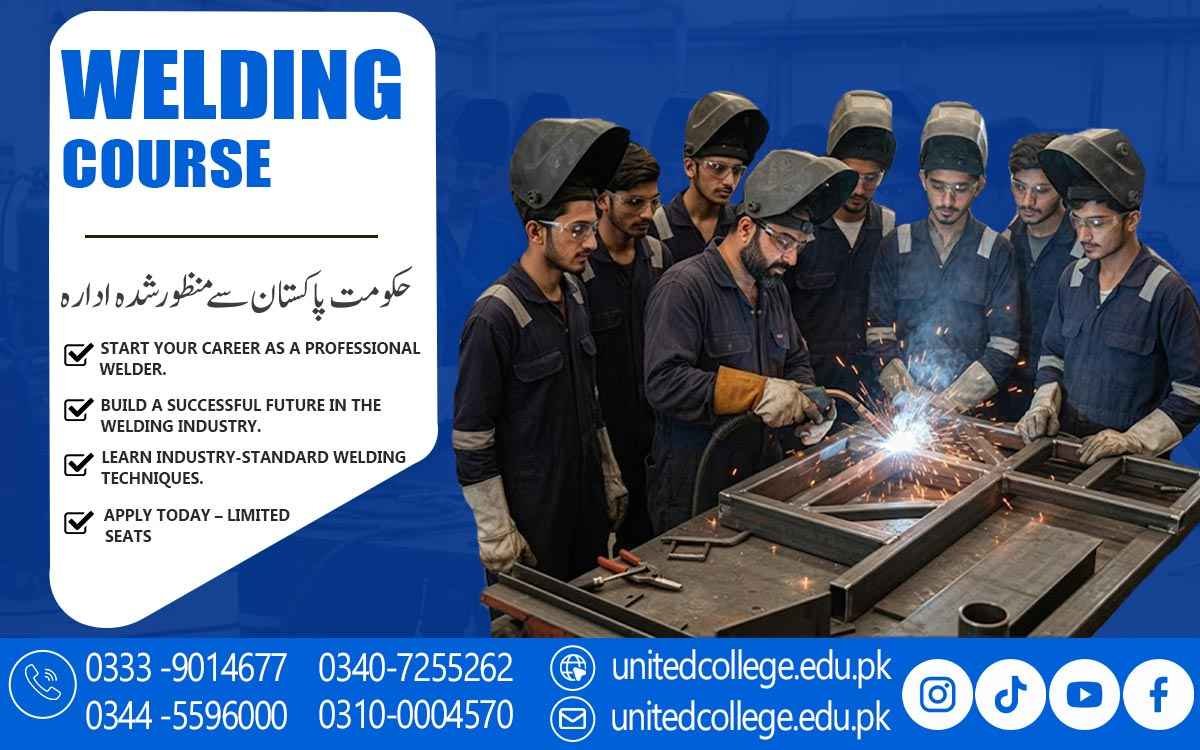

Welding Course in Mirpur | Learn Industry-Ready Welding Skills
Learn Advanced Welding Skills for a Strong Technical Future
Welding is more than joining two pieces of metal. It is a professional skill that supports the construction of buildings, bridges, factories, pipelines, vehicles, and industrial machinery. As industries continue to expand, skilled welders are becoming increasingly valuable because quality welding directly affects the strength and safety of every project. For students and beginners who want to learn a practical trade, enrolling in a Welding Course in Mirpur is an excellent way to build technical knowledge and gain hands-on experience.
The United College of Technology offers a training program that combines classroom learning with workshop practice, allowing students to understand modern welding methods in a real learning environment. Instead of focusing only on theory, the course helps learners develop confidence by working with professional equipment and completing practical welding tasks.
Develop a Skill That Continues to Grow with Every Industry
Every major industry depends on reliable welding work. Whether it is constructing commercial buildings, manufacturing heavy equipment, repairing machinery, or fabricating steel structures, trained welders remain essential. Learning through a structured training program helps students build skills that meet professional standards instead of relying only on trial-and-error experience.
A Welding Course in Mirpur provides the opportunity to gain organized technical knowledge while learning safe working methods. As industries continue to modernize, employers increasingly prefer candidates who have completed Professional Welding Training from a recognized institution because they are already familiar with workplace procedures and quality standards.
Gain Practical Experience with Industry-Based Welding Techniques
Learning welding successfully requires continuous practice. During the course, students work on different welding projects that gradually improve their accuracy, confidence, and technical understanding. Practical exercises are designed to simulate real industrial tasks so learners become comfortable working with various materials and welding positions. The training introduces Arc Welding Techniques, where students learn electrode selection, machine settings, joint preparation, and proper welding methods used in construction and fabrication projects.
They understand wire feeding systems, shielding gas selection, and techniques that produce clean and consistent welds. Another important part of the program is the TIG Welding Course, which develops precision welding abilities for stainless steel, aluminum, and other metals that require neat finishing and stronger control. Alongside welding methods, learners also study metal cutting, Fabrication and Welding, blueprint reading, welding inspection, equipment maintenance, safe machine operation, and quality checking.
Learn Through Practical Workshops Instead of Only Reading Books
Technical education becomes more effective when students actively perform the work they are learning. That is why practical workshop sessions remain the foundation of this program. Students regularly participate in Hands-on Welding Practice, where they complete guided exercises under the supervision of experienced instructors. Using Modern Welding Equipment, learners become familiar with welding machines, grinders, measuring tools, protective gear, cutting equipment, clamps, and finishing tools commonly found in professional workshops.
Working directly with these tools helps students improve precision while becoming comfortable with industry-standard equipment. Every workshop activity builds practical confidence and prepares students for the challenges they may face in industrial environments after completing their training.
Safety Habits That Support Professional Growth
A successful welder must understand that technical skill and workplace safety always go together. Throughout the training, students are taught how to work responsibly while protecting themselves and others around them. The course includes guidance on personal protective equipment, electrical safety, fire prevention, safe handling of materials, workshop discipline, equipment inspection, and emergency procedures.
Developing these habits early helps students become responsible professionals who can maintain safe working conditions throughout their careers. Strong safety awareness is also appreciated by employers because it contributes to efficient and accident-free workplaces.
Build Confidence with Practical Technical Education
Many beginners worry that welding may be difficult to learn, but structured training makes the process much easier. Instead of expecting students to master everything immediately, instructors explain each concept step by step while providing regular opportunities for practice. A Welding Course in Mirpur follows this practical approach, helping learners build confidence while developing essential technical skills.
This approach creates Practical Technical Education where learners improve through repetition, instructor feedback, and practical assignments. Students gradually strengthen their Professional Technical Skills, making it easier to complete increasingly advanced welding projects with greater confidence and accuracy. By combining theory with workshop experience, the program develops technical abilities that remain useful across different industries.
A Certification That Reflects Your Practical Knowledge
Completing a recognized Welding Certification Course provides evidence that a student has successfully developed technical knowledge and practical abilities. Certification demonstrates commitment to learning and helps employers identify candidates who have completed structured technical training.
The Certified Welding Program also encourages students to continue improving their skills through additional industrial experience and advanced technical education. For many learners, certification becomes the first milestone in building a long-term professional career.
Explore Industries That Depend on Skilled Welders
One of the greatest advantages of learning welding is the variety of industries that require qualified professionals. Skilled welders are involved in almost every sector where metal structures are manufactured, repaired, or assembled. After completing the Welding Course in Mirpur, graduates can pursue opportunities in construction companies, steel fabrication workshops, mechanical engineering industries, manufacturing plants, maintenance companies, shipyards, pipeline projects, and heavy machinery workshops.
The growing number of infrastructure projects has increased demand for professionals capable of supporting Construction Industry Jobs, while industrial expansion continues to create new opportunities in fabrication and production facilities. Many experienced welders also establish independent workshops, allowing them to provide repair and fabrication services within their local communities.
Professional Learning Inside a Trusted Technical Environment
Choosing the right institution plays an important role in technical development. A reliable Welding Institute in Mirpur should provide experienced instructors, practical workshops, updated equipment, and a supportive learning atmosphere that encourages continuous improvement. At United College of Technology, students receive Technical Training in Mirpur that focuses on real industrial requirements rather than memorizing theoretical concepts.
Instructors demonstrate professional techniques, supervise workshop activities, and help learners improve through continuous practice and practical assessments. This balanced teaching approach helps students understand both the technical and professional responsibilities expected in modern industries.
Technical Skills That Continue Creating New Possibilities
The demand for trained welders continues to grow because every industrial project requires durable and accurate metal joining. Completing one of today's valuable Skilled Trade Courses provides students with technical knowledge that remains useful across different sectors for many years. The course also introduces important Metal Joining Techniques, industrial standards, equipment handling methods, and production practices commonly used in modern Industrial Training Programs.
These experiences help learners adapt more easily when working with professional teams and industrial projects. Students who continue improving their practical skills often discover new opportunities as industries adopt advanced manufacturing technologies and modern fabrication systems.
Start Building a Strong Technical Future with Confidence
Learning welding is an investment in practical knowledge that can support lifelong professional growth. The Welding Course in Mirpur offered by United College of Technology provides students with the opportunity to develop technical expertise through structured learning, practical workshops, and industry-focused training.
With experienced instructors, modern equipment, hands-on practice, and a supportive Vocational Training Institute environment, students gain the confidence needed to apply their skills in real industrial settings. Whether your goal is personal skill development, technical education, or becoming a highly capable welding professional, this course offers a solid foundation for a successful future.
Frequently Asked Questions (FAQs)
Most students begin performing basic welding tasks confidently after regular practical sessions. Consistent practice throughout the course helps improve accuracy and control over time.
Yes. Students are introduced to welding techniques for commonly used metals so they can understand how different materials require different welding approaches.
No. The course is designed for beginners, and every topic is taught from the basics before moving to more advanced practical exercises.
Yes. Welding knowledge can help with repairing gates, frames, grills, metal furniture, agricultural tools, and many other metal structures in everyday life.
Yes. Students gradually practice various joint positions to improve their balance, precision, and ability to handle different fabrication tasks.
Students are assessed through practical workshop performance, skill improvement, safe working practices, and their ability to complete welding tasks according to the required standards.
Admission Open: Start Your Professional Journey Today!
Join United College of Technology and build a career with practical training, recognized certifications, and Gulf job support. Seats are limited.
Apply Now via WhatsAppContact Information
- Address: Rawalpindi: F-272 Main New Katarian Stop, Old IJP Road | Lahore Campus: Lahore, Pakistan
- Phone/WhatsApp: 0333-9014677 / 0344-5596000 / 0310-0004570 / 0301-5044340 / 0340-7255262
- Website: unitedcollege.edu.pk
















Leave a Comment