


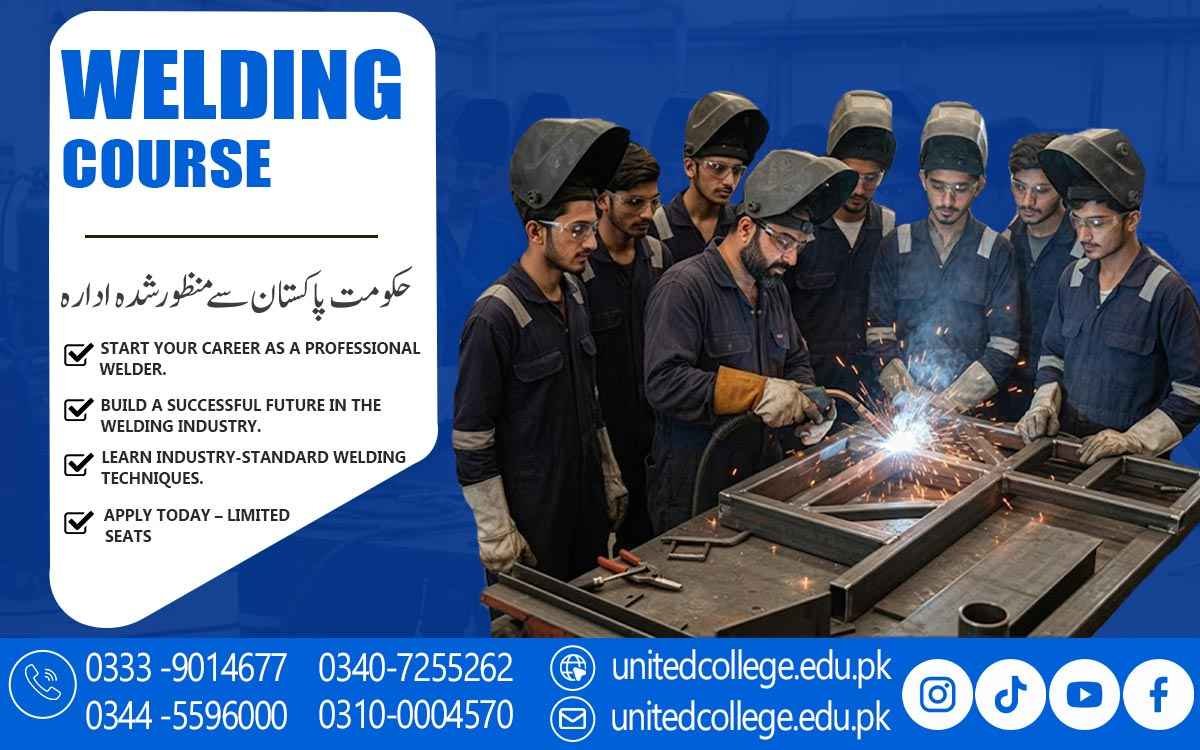

Welding Course in Okara – Build Practical Welding Skills
When a Strong Metal Structure Starts With the Right Weld
Look at a metal gate, workshop frame, machine part, vehicle component, or construction structure, and you may notice something they all have in common: separate pieces of metal have to be joined accurately to create something useful and durable. A welding job may appear simple when an experienced worker completes it in a few moments, but good welding requires proper preparation, equipment handling, positioning, heat control, and attention to safety. For beginners in Okara who want to develop a practical technical skill, a Welding Course in Okara can provide a structured way to understand these processes.
Learners can gradually become familiar with welding machines, electrodes, cables, hand tools, metal preparation, welding joints, and workshop procedures. Rather than learning only by watching others, practical training allows students to understand how different techniques work and how small changes in movement, positioning, or machine settings can affect the final weld. This type of learning can be useful for students, fresh learners, job seekers, and anyone interested in metal fabrication, repair, construction, or workshop-based technical work.
Learning How Different Welding Processes Work
Have you ever wondered why one welding method is used for a particular metal job while another method is chosen for a different task? The answer often depends on the material, thickness, required finish, equipment, and working conditions. A beginner can develop a stronger foundation by understanding the basic differences between common welding processes. Arc welding uses an electric arc to produce heat for joining metal, while MIG welding generally uses a continuously fed wire electrode with shielding gas.
During the welding Course in Okara, learners can be introduced to these techniques and understand their general uses without becoming overwhelmed by complicated terminology. They can also learn that choosing a welding process involves more than simply selecting the machine available in a workshop. Understanding the characteristics of arc welding, MIG welding, TIG welding, and gas welding gives students a broader view of welding work and prepares them to recognize why different fabrication, maintenance, and repair tasks may require different approaches.
Getting Familiar With Welding Machines and Essential Tools
A welding machine may create the arc, but a complete welding task usually involves several other tools and pieces of equipment. Beginners need to know how welding machines, electrodes, cables, clamps, measuring tools, wire brushes, grinders, cutting tools, and protective equipment fit into the overall process. A practical welding course can help learners become familiar with these items through direct handling and supervised exercises. Students can learn the purpose of different tools, how equipment is prepared before a task, and why checking cables, connections, clamps, and machine condition is important.
Electrode handling can also be practiced because the electrode has a direct role in many common welding processes. Learners may discover that small details, such as keeping the work area organized or cleaning a metal surface before welding, can make practical work easier and more controlled. At United College of Technology, students can gain exposure to welding tools and workshop procedures while developing their technical understanding. Instead of memorizing the names of tools, learners can connect each tool with a real task, helping them understand how equipment is used during preparation, welding, finishing, and inspection.
Turning Metal Preparation Into a Controlled Welding Process
Before two pieces of metal can be joined, they may need to be measured, cut, cleaned, positioned, and aligned correctly. Skipping these steps can make the welding process more difficult and may affect the final result. During hands-on welding training, learners can practice preparing metal surfaces, checking dimensions, positioning workpieces, and creating suitable joints before beginning the actual weld. They can become familiar with common joint arrangements such as butt joints, lap joints, and corner joints and understand how positioning affects welding movement.
Metal cutting and basic fabrication exercises can also show learners how separate pieces are prepared before they become part of a larger structure. As students practice, they can observe how electrode angle, travel speed, arc length, and heat influence the weld bead. This helps them understand why experienced welders pay close attention to preparation and movement rather than rushing through the task. A Welding Course in Okara can provide beginners with repeated opportunities to practice these stages, allowing them to gradually improve coordination and develop a more careful approach to metal joining and fabrication work.
Developing Better Control Through Hands-On Welding Practice
Watching a skilled welder can make the process look effortless, but beginners quickly discover that controlling an electrode or welding tool requires practice. The hand needs to move steadily while the learner watches the arc and weld area, maintains an appropriate position, and tries to keep the joint consistent. During a Welding Course, hands-on training gives students the chance to repeat these movements and learn from each attempt. A learner may notice excessive spatter in one exercise, uneven movement in another, or poor alignment in a different task. Instead of simply moving on, practical training can help the learner understand what may have caused the problem and what can be adjusted.
Repeated practice also helps students become more comfortable with workshop equipment and procedures. Over time, they can develop better awareness of metal positioning, machine operation, electrode handling, and weld appearance. This is particularly important for beginners because welding is a skill where physical coordination develops gradually. For learners in Okara, practical training can therefore provide a useful environment for building confidence while understanding that continued practice and real working experience remain important for further improvement.
Making Welding Safety Part of Everyday Workshop Work
A welding workshop contains heat, sparks, intense light, electrical equipment, hot metal, and fumes, so safe working habits need to be developed alongside technical skills. A beginner should understand why protective equipment is required and how the working environment should be prepared before starting a welding task. A suitable welding helmet helps protect the eyes and face from intense welding light and sparks, while gloves and protective clothing provide protection from heat and hot materials. Ventilation is also important because some welding processes can produce fumes that should not accumulate in an enclosed space.
Fire prevention requires attention to nearby materials, sparks, and the condition of the work area. Learners should also understand the importance of checking cables, electrical connections, machines, and tools before use. Safe handling of equipment and proper workshop organization can reduce avoidable risks. During practical welding education, these procedures should become normal habits rather than rules that are remembered only during training. United College of Technology can help learners become familiar with workshop practices while they develop welding skills. Understanding safety alongside welding techniques allows students to approach practical tasks with greater awareness and responsibility.
Improving Weld Quality Through Inspection and Careful Observation
A completed weld should not automatically be considered a good weld simply because two metal pieces are now connected. The appearance, consistency, alignment, and condition of the joint can provide useful information about how well the process was controlled. Learners can be introduced to basic welding inspection by examining their practice joints and looking for visible problems such as uneven beads, excessive spatter, poor alignment, surface irregularities, or incomplete joining. They can also understand how welding defects may develop when preparation, machine settings, electrode movement, heat control, or positioning are not appropriate for the task.
Learning to inspect work encourages students to slow down and examine the result instead of assuming that finishing the weld is the end of the job. During practical exercises, comparing different welds can help learners understand what makes a joint appear more consistent and controlled. This attention to detail can be useful in fabrication, construction welding, maintenance, and workshop activities where the quality of a metal joint matters. A Welding Course in Okara can introduce beginners to this habit of checking and improving their work, giving them a stronger understanding of why accuracy and inspection are important parts of welding.
Connecting Welding Skills With Fabrication and Technical Work
Once basic welding exercises become familiar, learners can start seeing how individual skills connect with real workshop tasks. Metal fabrication may involve measuring material, cutting pieces, preparing surfaces, aligning components, creating joints, welding them, and inspecting the finished structure. Similar skills can appear in repair and maintenance work, although the correct approach depends on the material, component, damage, and intended use. Welding is also relevant to construction-related metalwork, workshop projects, machinery, frames, gates, supports, and other fabricated structures. Practical training can help beginners understand these connections without suggesting that completing a course alone makes someone an expert.
Technical ability develops through continued practice, supervision, and exposure to different working conditions. Learners can use their training as a foundation for further development in welding techniques, fabrication skills, construction welding, industrial work, maintenance, or related technical areas. For students and fresh learners in Okara, understanding these applications can make welding education feel more connected to real work. It also helps them see why learning equipment handling, joint preparation, safety, and inspection is valuable beyond a single workshop exercise.
Building a Stronger Skill Base Through Consistent Practice
The most useful welding skills are usually developed one practical task at a time. A beginner may first learn how to handle equipment safely, then practice simple joints, improve metal preparation, develop better movement, and gradually understand how machine settings and heat affect the finished weld. This steady process can help students become more comfortable with welding equipment while identifying areas where additional practice is needed. At United College of Technology, learners can gain practical exposure to welding machines, tools, metal preparation, workshop procedures, safety practices, and welding techniques as part of their learning experience.
A Welding Course in Okara can therefore serve as a starting point for someone who wants to understand welding in a practical and structured way. Whether a learner is interested in fabrication, construction-related work, repair, maintenance, or workshop skills, continued practice remains an important part of technical development. Patience, careful observation, safe equipment handling, and regular hands-on work can help beginners build a stronger foundation and continue improving their welding abilities over time.
Frequently Asked Questions (FAQs)
A Welding Course in Okara teaches learners how to use welding equipment and techniques for joining, preparing, cutting, and fabricating metal in practical workshop settings.
Yes. Beginners can start by learning workshop safety, equipment handling, metal preparation, basic welding movements, and simple joints before progressing to more detailed tasks.
Depending on the training structure, learners may be introduced to arc welding, MIG welding, TIG welding, and gas welding and understand their common applications.
Students may work with welding machines, electrodes, cables, clamps, measuring tools, cutting equipment, grinders, welding helmets, gloves, and other workshop equipment.
Hands-on practice helps learners develop coordination, equipment-handling skills, joint preparation techniques, welding control, and the ability to inspect their own work.
Admission Open: Start Your Professional Journey Today!
Join United College of Technology and build a career with practical training, recognized certifications, and Gulf job support. Seats are limited.
Apply Now via WhatsAppContact Information
- Address: Rawalpindi: F-272 Main New Katarian Stop, Old IJP Road | Lahore Campus: Lahore, Pakistan
- Phone/WhatsApp: 0333-9014677 / 0344-5596000 / 0310-0004570 / 0301-5044340 / 0340-7255262
- Website: unitedcollege.edu.pk
















Leave a Comment