


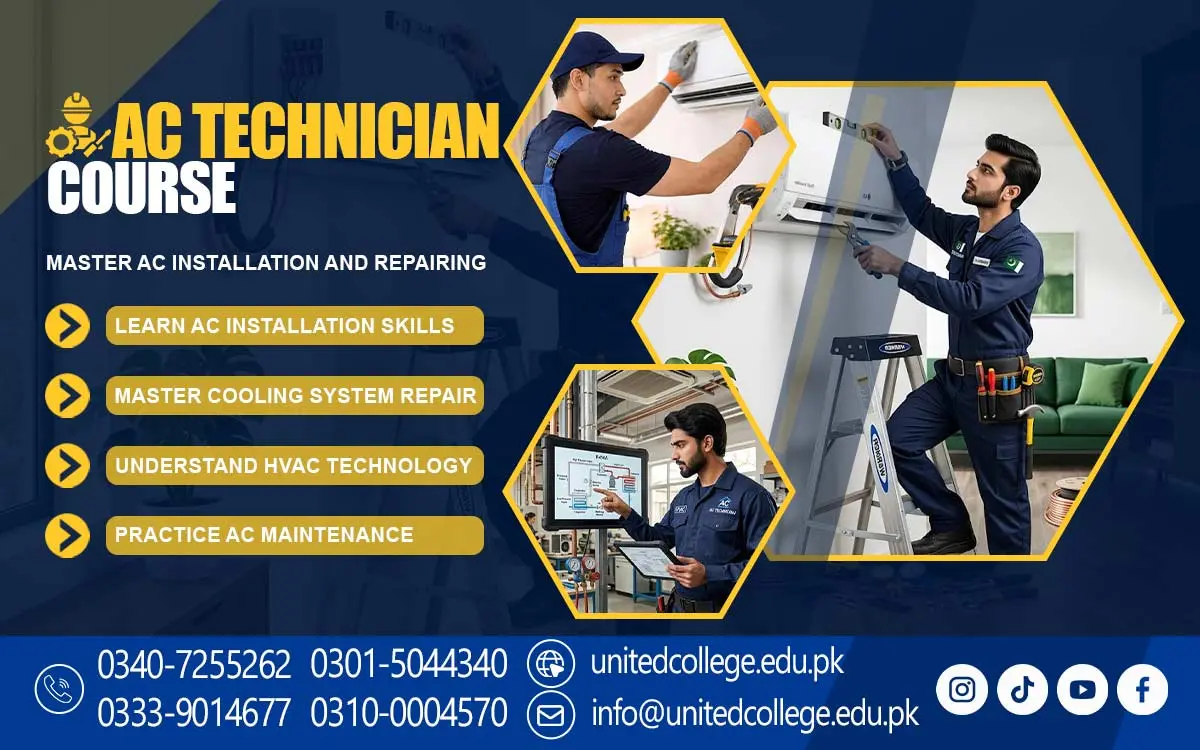

AC Technician Course in Shangla – Master Cooling System Repairs
When an Air Conditioner Stops Cooling, Skilled Technicians Make the Difference
Imagine returning home on a hot summer afternoon, switching on your air conditioner, and discovering that it is running but not cooling the room. Perhaps water is dripping from the indoor unit, the fan is making an unusual noise, or the system refuses to start. These problems can make daily life uncomfortable and disrupt work in homes, shops, offices, and other buildings. In such situations, a trained technician can identify the possible cause and recommend a suitable repair. As air conditioning systems become an important part of modern living, learning how to install, maintain, and repair them can be a useful technical step for people interested in practical work.
The AC Technician Course in Shangla introduces learners to the knowledge and skills involved in air conditioner servicing, cooling systems, and basic refrigeration work. Offered by United College of Technology (UCT), this training opportunity can help beginners understand how air conditioners operate and what technicians do when faults occur. Instead, they can gradually develop their understanding of tools, equipment, electrical components, and maintenance procedures. For learners in Shangla and nearby communities, exploring AC repair training in Shangla can be a practical way to discover a technical field that combines problem-solving, hands-on activities, and an understanding of everyday cooling equipment.
What Students Can Learn Through AC Technician Training in Shangla
Learning to repair an air conditioner involves more than opening a unit and replacing a faulty part. A technician must understand how different components work together, recognize common problems, and follow safe procedures when inspecting equipment. The AC Technician Course in Shangla can introduce learners to the basic principles of air conditioning, refrigeration, installation, servicing, and maintenance. Students can begin by learning the purpose of an air conditioning system and how it transfers heat from an indoor space to the outside environment. They can also explore the differences between common cooling systems, including split air conditioners and other types of units used in residential and commercial buildings.
Another important area is technical terminology, because understanding words such as compressor, condenser, evaporator, thermostat, and refrigerant makes it easier to follow repair instructions. Beginners can also learn why technicians inspect equipment carefully before deciding which repair is necessary. For example, an air conditioner that provides weak cooling may have a dirty filter, restricted airflow, an electrical fault, or another underlying problem. Each possibility requires a different approach. An air conditioning technician course can therefore help students build their knowledge step by step instead of relying on guesswork.
Understand the Components That Keep an Air Conditioner Running
Have you ever wondered why an air conditioner can cool a room even when the outdoor weather is extremely hot? The answer lies in the way its main components work together to move heat. During an AC Technician Course in Shangla, learners can study the essential parts of an air conditioning system and understand their individual functions. The compressor circulates refrigerant through the system and raises its pressure, allowing the refrigeration cycle to continue. The condenser releases heat from the refrigerant into the outdoor air, while the evaporator absorbs heat from the indoor air. A fan helps move air across the relevant coils, allowing heat transfer to take place.
The thermostat or temperature sensor helps regulate cooling by monitoring temperature and controlling system operation. Refrigerant is the substance that circulates through the system and changes pressure and temperature as it transfers heat. Students can also become familiar with pipes, electrical connections, control boards, capacitors, and other components found in common air conditioners. Understanding these parts is important because a fault in one area can affect the performance of the entire unit. For instance, restricted airflow caused by a dirty filter may reduce cooling performance, while a defective electrical component may prevent the system from starting.
Develop Practical Skills in AC Installation, Cleaning, and Maintenance
An air conditioner may contain advanced components, but its reliable performance often depends on correct installation and regular maintenance. Poor installation, blocked filters, restricted airflow, or neglected drainage can lead to cooling problems that become more expensive if ignored. The AC Technician Course in Shangla can help learners understand the steps involved in air conditioner installation, servicing, and routine maintenance. Students can learn why an indoor unit must be positioned carefully, how outdoor-unit placement affects ventilation, and why drainage arrangements are important for removing condensed water.
Maintenance training may cover cleaning air filters, inspecting accessible coils, checking drain lines, examining visible wiring for signs of damage, and observing the unit for unusual sounds or operating conditions. Correct tool handling is another important skill. Screwdrivers, spanners, pliers, measuring instruments, and other suitable tools help technicians complete different tasks accurately. More advanced procedures, such as refrigerant charging, pressure testing, and work on sealed refrigeration circuits, require appropriate equipment, training, and safety precautions. Beginners should practise these tasks only under suitable supervision.
Identify Common AC Problems Instead of Guessing at Repairs
An air conditioner can show several warning signs before it stops working completely. Weak cooling, water leakage, unusual noises, frequent shutdowns, and failure to start are common complaints that require careful inspection. Through AC repair training in Shangla, learners can develop an organized approach to troubleshooting rather than immediately replacing parts. If a unit runs but does not cool properly, a technician may begin by checking the filter, airflow, thermostat settings, and visible condition of the system. If water leaks from the indoor unit, a blocked drain line, incorrect drainage arrangement, or another issue may be responsible.
An air conditioner that fails to start may have a power supply problem, a faulty control component, or another electrical issue. These examples show why diagnosis matters: two units can display similar symptoms while needing different repairs. Students can learn to record symptoms, ask useful questions, carry out safe visual checks, and use appropriate diagnostic instruments when trained to do so. They should also understand when a problem requires an experienced technician. Electrical testing, refrigerant leaks, compressor faults, and damaged wiring can present serious risks if handled incorrectly.
Explore Refrigeration, Cooling Cycles, and Energy-Efficient Operation
An air conditioner does not simply produce cold air; it removes heat from an indoor space and transfers it outside. Understanding this process helps learners see why refrigeration knowledge is an important part of HVAC technician training. In a typical air conditioning system, refrigerant circulates through a closed circuit and changes pressure and temperature as it passes through different components. The evaporator absorbs heat from indoor air, the compressor raises the refrigerant's pressure, the condenser releases heat outdoors, and the expansion device reduces its pressure before the cycle continues.
During the AC Technician Course in Shangla, learners can explore these stages in simple terms and understand how airflow, temperature differences, and component condition affect cooling performance. Energy efficiency is another useful subject because an air conditioner may consume more electricity when filters are dirty, airflow is restricted, settings are unsuitable, or equipment is poorly maintained. Students can learn why selecting an appropriate temperature, keeping filters clean, maintaining clear airflow around outdoor units, and arranging regular servicing can support efficient operation. Refrigerant handling also requires special attention.
Follow Electrical Safety Rules Before Touching AC Equipment
A repair that appears simple can become dangerous when electrical power, moving components, or pressurized refrigerant systems are involved. For this reason, electrical safety for AC technicians must be treated as a core part of technical training rather than an optional extra. The AC Technician Course in Shangla can introduce learners to common hazards and the precautions required when working around air conditioning equipment. Students should understand that electrical power must be isolated before maintenance begins, and the isolation should be verified using an appropriate method by someone trained to do so. Capacitors can retain an electrical charge even after an air conditioner has been switched off, so they must be handled according to proper safety procedures.
Tools must be suitable for the task and maintained in good condition. When working with outdoor units, technicians should consider weather conditions, stable access, and the risks associated with ladders or elevated positions. Refrigerant circuits require separate precautions because the contents may be under pressure and can cause cold burns or other injuries. Students should never attempt unfamiliar electrical repairs or pressurized-system work without proper training and supervision. Developing safe habits early helps protect the technician, the customer, and the equipment. It also encourages professional conduct, because reliable technical work depends on following safety procedures consistently, even when a repair seems routine or urgent.
Build Confidence Through Hands-On Practice and Guided Learning
Reading about an air conditioner can explain how its components work, but practical experience helps learners understand how those components behave in real situations. A student may know the purpose of a compressor from a lesson, yet still need guided practice to recognize its connections, understand its operating conditions, and identify signs of a possible fault. This is why hands-on learning is valuable in an air conditioning technician course. At United College of Technology (UCT), learners interested in technical education can explore training options related to developing practical skills, while confirming the specific course facilities, practical arrangements, and learning content directly with the institution.
During suitable supervised activities, students can become familiar with tools, observe common servicing procedures, identify major AC components, and practise basic inspection methods. They can also learn how to follow instructions, keep work areas organized, record observations, and explain a problem clearly. These habits matter because technical work often involves communicating with customers or working alongside other technicians. For example, when a customer reports that an AC unit is making noise, a technician needs to listen carefully, ask when the problem occurs, and inspect the equipment safely before deciding what to do next.
Turn Technical Knowledge into Useful Skills for Future Work
Learning AC installation and repair can open different paths for continued technical development, but progress depends on how learners apply their knowledge after training. People who complete an AC Technician Course in Shangla may explore opportunities to assist experienced technicians, work in suitable maintenance environments, or develop their abilities through supervised service work, depending on their competence and the requirements of employers. Air conditioning knowledge can be relevant in homes, shops, offices, hotels, workshops, and other buildings where cooling equipment needs installation or maintenance.
Others may prefer to continue studying refrigeration, HVAC systems, electrical troubleshooting, or related technical subjects. Before making career decisions, students should understand that employers can require different levels of experience, technical ability, safety knowledge, and recognized credentials. Employment is not guaranteed by completing a course, and more advanced tasks may require additional training or authorization. A sensible next step is to strengthen core skills, practise under experienced supervision, follow equipment manufacturers' instructions, and stay informed about changing technologies and refrigerant requirements.
Frequently Asked Questions (FAQs)
The AC Technician Course in Shangla introduces students to air conditioner installation, repair, maintenance, refrigeration systems, and troubleshooting techniques.
Students, beginners, fresh learners, and job seekers interested in technical skills can explore this course. Contact United College of Technology (UCT) to confirm the admission requirements.
You can learn about AC components, split AC repair, installation procedures, routine servicing, fault diagnosis, refrigeration principles, and electrical safety.
Practical training is important for developing AC repair skills. Contact UCT to confirm the available practical sessions and training facilities for this course.
Yes, beginners can start by learning basic concepts, tools, components, and safety procedures before progressing to more advanced tasks under proper supervision.
Admission Open: Start Your Professional Journey Today!
Join United College of Technology and build a career with practical training, recognized certifications, and Gulf job support. Seats are limited.
Apply Now via WhatsAppContact Information
- Address: Rawalpindi: F-272 Main New Katarian Stop, Old IJP Road | Lahore Campus: Lahore, Pakistan
- Phone/WhatsApp: 0340-7255262 / 0333-9014677 / 0301-5044340 / 0310-0004570 / 051-8770756
- Website: unitedcollege.edu.pk
















Leave a Comment