


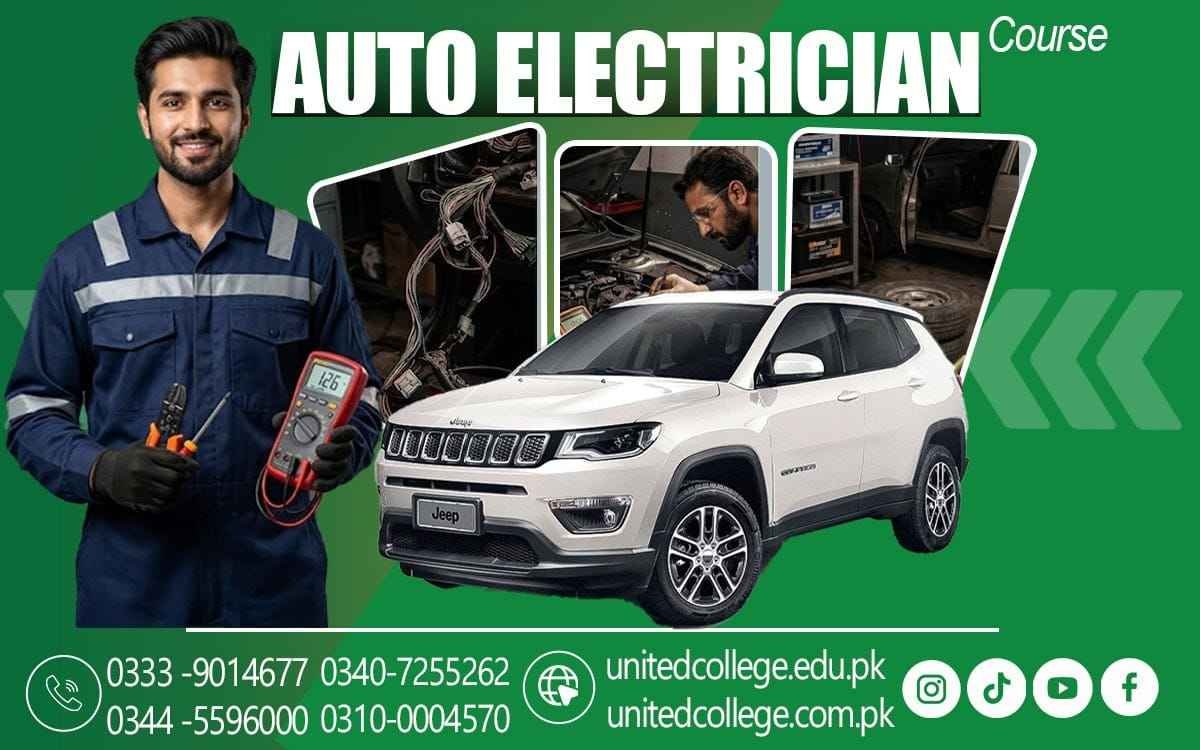

Auto Electrician Course in Kohat – Master Modern Vehicle Electrical Systems
Understanding the Role of an Auto Electrician in Modern Vehicles
A modern vehicle depends on several electrical and electronic systems to operate correctly. The battery supplies electrical power, the starter motor helps start the engine, and the alternator produces electricity while the engine is running. Other electrical components control headlights, indicators, dashboard displays, power windows, sensors, and various safety features. When one component stops working, it can affect the performance of other systems. For example, a loose battery connection may prevent a car from starting, while a damaged wire may cause a headlight to stop working or a fuse to blow repeatedly.
Instead of replacing parts without evidence, a skilled technician works to determine the actual cause of the fault. Learning automotive electrical systems helps students understand how electricity moves through a vehicle and how individual components work together. For beginners interested in technical work, this field combines practical problem-solving with an understanding of vehicle technology. It also requires patience because electrical faults are not always visible. A damaged wire may be hidden inside a protective covering, and an intermittent fault may appear only when the vehicle is moving or when a particular component is switched on.
What Students Can Learn Through Auto Electrician Training in Kohat
The Auto Electrician Course in Kohat offered by United College of Technology is relevant to learners who want to explore automotive electrical repair and develop an understanding of vehicle maintenance. Before choosing any technical course, students should understand the types of knowledge and skills involved in the trade. Auto electrician training generally introduces learners to electrical components, wiring connections, battery systems, charging circuits, starting systems, and common electrical problems. Students can also learn why technicians use different tools to test voltage, check continuity, and identify faulty connections.
A systematic approach helps a technician narrow down the possible causes rather than changing components randomly. Similarly, if a battery repeatedly loses its charge, the issue could be related to the battery's condition, the charging system, or an unwanted electrical drain when the vehicle is switched off. Training in automotive electrical systems can help learners understand how to investigate such situations. Beginners should focus on understanding the purpose of each component before attempting complicated repairs. They should also learn to follow instructions, use tools correctly, and recognise situations that require experienced supervision.
Car Batteries, Alternators, Starter Motors, and Ignition Systems
One of the most important areas of car electrical repair is understanding how the battery, alternator, starter motor, and ignition system work together. The battery stores electrical energy and supplies power when the engine is not running. It also provides the strong electrical current needed to operate the starter motor during engine starting. When a driver turns the key or presses the start button, the starting system activates the starter motor, which turns the engine so that it can begin running. Once the engine is operating, the alternator generates electricity to supply the vehicle's electrical needs and recharge the battery.
This is why car battery testing and charging-system inspection are important skills. A technician may inspect the battery terminals, measure voltage, check the charging output, and examine the starter circuit before deciding which component needs attention. The ignition system also plays an important role in petrol engines by helping create the spark needed to ignite the air-fuel mixture. Faults involving ignition coils, spark plugs, sensors, or related wiring can cause starting problems, misfiring, or poor engine performance. During automotive electrical training, understanding these systems helps learners connect symptoms with possible causes. It also teaches them why accurate testing is more reliable than replacing expensive components based on guesswork.
Vehicle Wiring, Fuses, Relays, Lights, and Electrical Connections
A vehicle's wiring system carries electrical power and signals between different components. Wires connect the battery to circuits, switches to lights, sensors to control units, and electrical devices to their power sources. Through the Auto Electrician Course in Kohat, offered by United College of Technology, learners can understand vehicle wiring and electrical troubleshooting. When a wire becomes damaged, a connector becomes loose, or corrosion develops at a terminal, the affected component may work intermittently or stop working completely. Consider a vehicle whose indicators suddenly stop operating. A technician may need to inspect the fuse, indicator switch, relay where fitted, bulbs, wiring, and connections to identify the problem.
A relay is an electrically controlled switch that allows a smaller control current to operate a circuit carrying a larger current. Relays are used in various vehicle systems, depending on the design. Learners should also understand switches, connectors, grounding points, headlights, brake lights, horns, and dashboard indicators. Sensors provide information about conditions such as temperature, speed, or engine operation, while the vehicle's control systems use that information to manage different functions. Learning to read automotive wiring diagrams helps students understand how these components are connected.
Automotive Diagnostic Tools and Electrical Fault Detection
Imagine a customer brings a car to a workshop because its battery keeps losing charge overnight. Looking at the battery alone may not reveal the real problem. The technician needs appropriate automotive diagnostic tools to collect information and test the electrical system. Through the Auto Electrician Course in Kohat, offered by United College of Technology, learners can explore the importance of diagnostic tools in automotive electrical repair. A digital multimeter is one of the most useful instruments because it can measure electrical values such as voltage, resistance, and current when used with the correct settings and connections.
Some electronic circuits can be damaged by inappropriate testing methods, so technicians must understand the tool's limitations before use. Diagnostic scanners provide another important source of information in vehicles equipped with electronic control systems. These scanners can retrieve diagnostic trouble codes from supported modules, helping technicians investigate problems involving sensors, engine management, and other electronic functions. However, a fault code does not always identify a failed component directly. It indicates that the system has detected an abnormal condition that requires further testing.
Electronic Control Units, Sensors, and Modern Car Technology
Older vehicles often rely on comparatively simple electrical circuits, while modern vehicles may contain several electronic control units, sensors, communication networks, and computer-managed systems. An electronic control unit, commonly called an ECU, is a small computer that manages specific vehicle functions. Depending on the vehicle, control units may help manage engine operation, braking, airbags, transmission behaviour, or body electronics. Sensors provide information to these systems. For instance, an engine temperature sensor reports temperature information, while other sensors monitor speed, pressure, position, or airflow.
Technicians must also recognise that electronic systems differ between manufacturers and vehicle models. Some repairs require specialised equipment, manufacturer-specific procedures, or additional training. As vehicle technology develops, auto electricians increasingly need to understand both traditional electrical circuits and computer-controlled systems. Learners exploring the Auto Electrician Course in Kohat can use this knowledge to recognise the changing demands of automotive repair. Building a strong foundation in voltage, current, resistance, wiring, and diagnostic methods makes it easier to understand more advanced electronic systems later.
Developing Practical Workshop Skills Through Vehicle Troubleshooting
Knowing the names of vehicle components is only the beginning of automotive electrical work. A technician must also know how to inspect a vehicle, identify symptoms, choose the right test, and interpret the results. Practical troubleshooting often starts by asking the driver when the problem occurs, whether it happens every time, and whether any recent repair or battery replacement took place. The technician then checks the reported symptoms and carries out a visual inspection for loose terminals, damaged insulation, corrosion, disconnected plugs, or signs of overheating. If a vehicle fails to start, the next steps depend on what happens when the driver operates the starting system.
Good automotive workshop skills also include keeping tools organised, recording test results, following repair information, and checking that a repair has solved the original problem. Students should practise these methods under appropriate supervision and gradually move from simple circuits to more complicated faults. Repeating a task carefully helps develop confidence and improves the ability to recognise patterns in electrical problems. Learners should understand that practical competence takes time, and some faults require advanced diagnostic knowledge. By building their skills step by step, beginners can develop a more reliable approach to car electrical repair and prepare for further technical learning.
Vehicle Electrical Safety and Responsible Repair Practices
Automotive electrical repair requires careful attention to safety because incorrect testing or handling can damage components, cause burns, create sparks, or lead to electrical short circuits. Vehicle batteries can supply very high current, even though their nominal voltage is relatively low. If a metal tool accidentally bridges the battery terminals, it can become extremely hot and create a serious hazard. Technicians should remove jewellery that could contact electrical terminals, use suitable insulated tools where appropriate, and follow the manufacturer's instructions when working near batteries. They must also understand correct battery disconnection and reconnection procedures, since some vehicles have systems that require special precautions or settings to be preserved.
Measuring resistance on a powered circuit can produce incorrect readings and damage equipment, so the circuit must be isolated as required by the relevant procedure. High-voltage hybrid and electric vehicle systems present additional risks and should only be handled by people with appropriate training, equipment, and authorisation. Airbag circuits also require specific precautions because careless testing may cause accidental deployment or system damage. Good vehicle electrical safety includes keeping the work area clean, preventing tools from contacting exposed terminals, replacing fuses only with the specified rating, and never bypassing safety devices as a shortcut.
Career Pathways and Continued Learning in Automotive Electrical Work
For people interested in practical technical careers, automotive electrical work offers several possible directions to explore. With suitable training, supervised practice, and further experience, learners taking the Auto Electrician Course in Kohat offered by United College of Technology may work towards roles in automotive workshops, vehicle service centres, maintenance businesses, or other settings where electrical diagnosis and repair are required. Some technicians focus on batteries and charging systems, while others develop experience in wiring faults, electronic diagnostics, vehicle accessories, or manufacturer-specific systems.
However, completing a course alone does not guarantee employment or business success. Employers and customers may also expect practical competence, good communication, safe working habits, reliability, and the ability to diagnose faults accurately. The automotive industry continues to introduce more electronic features, making ongoing learning important for anyone entering this field. Further study may cover advanced diagnostic equipment, automotive electronics, hybrid and electric vehicle technology, or specialised vehicle systems.
Frequently Asked Questions (FAQs)
An Auto Electrician Course in Kohat teaches students about vehicle electrical systems, including batteries, alternators, starter motors, wiring, fuses, sensors, and electrical fault diagnosis.
United College of Technology (UCT) offers the Auto Electrician Course for individuals interested in learning about automotive electrical systems and repair skills.
Students can learn about car battery testing, vehicle wiring, charging systems, starter motor problems, automotive diagnostic tools, and electrical troubleshooting.
Yes, beginners interested in automotive technology can explore this training. They should confirm the current admission requirements with United College of Technology.
Common tools include digital multimeters, test lamps, insulated hand tools, automotive diagnostic scanners, and wiring diagrams.
Admission Open: Start Your Professional Journey Today!
Join United College of Technology and build a career with practical training, recognized certifications, and Gulf job support. Seats are limited.
Apply Now via WhatsAppContact Information
- Address: Rawalpindi: F-272 Main New Katarian Stop, Old IJP Road | Lahore Campus: Lahore, Pakistan
- Phone/WhatsApp: 0340-7255262 / 0333-9014677 / 0301-5044340 / 0310-0004570 / 051-8770756
- Website: unitedcollege.edu.pk
















Leave a Comment