


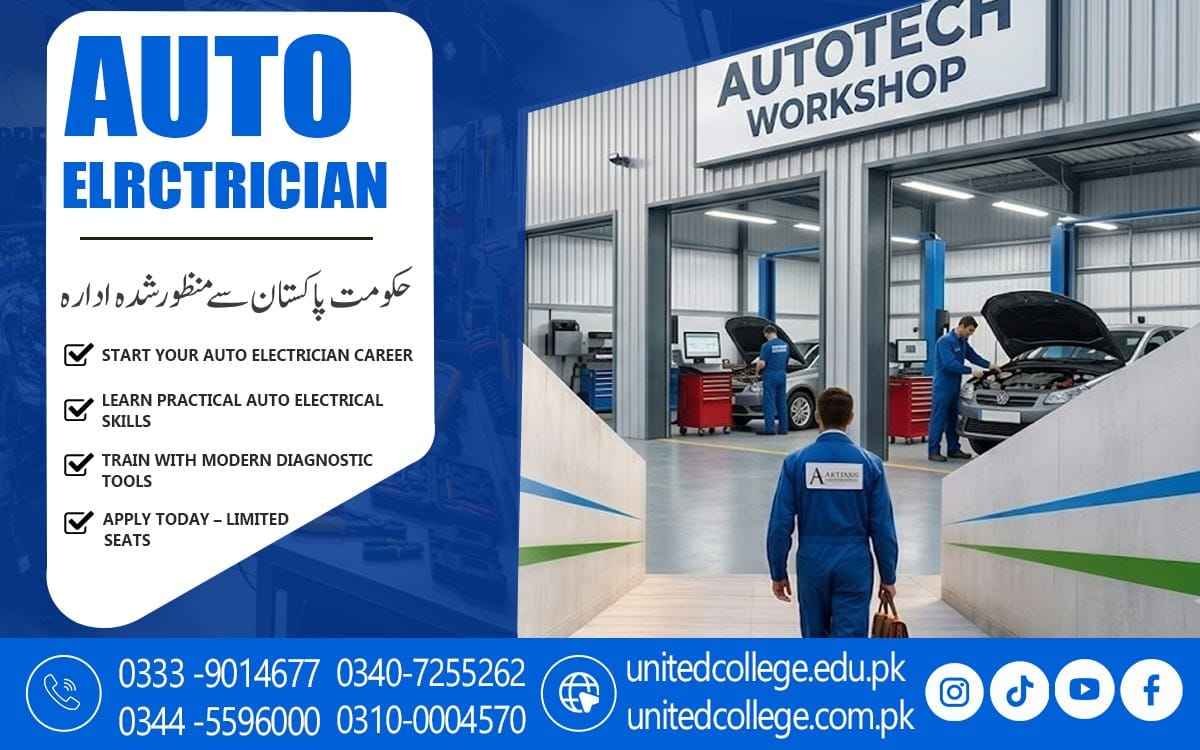

Auto Electrician Course in Kurram Agency for Skilled Learners
Common Vehicle Electrical Problems That Need Technical Attention
Imagine turning the ignition key and hearing a clicking sound, but the engine does not start. Is the battery weak, is a cable loose, or is the starter motor faulty? These questions are common in automotive workshops, and answering them requires more than guessing. Vehicles can experience many electrical problems, including dim headlights, faulty indicators, malfunctioning power windows, dashboard warning lights, damaged wiring, and repeated battery discharge. Sometimes, a vehicle works normally for several days before the same problem returns. This can make the fault difficult to identify without proper testing.
A weak battery may cause slow engine cranking, while a loose terminal can interrupt the flow of electrical current. Similarly, a blown fuse may stop a particular electrical component from working even when the rest of the vehicle operates normally. Learning about automotive electrical systems helps beginners understand why different problems can produce similar symptoms. The Auto Electrician Course in Kurram Agency is relevant to learners who want to understand these situations and explore practical vehicle electrical repair methods. By studying common faults, learners can begin to recognise the importance of checking connections, inspecting components, and following a logical troubleshooting process. Instead of replacing parts immediately, an auto electrician investigates the possible causes and uses suitable tests to narrow down the problem.
The Important Responsibilities of an Auto Electrician
An auto electrician works with the electrical and electronic systems that allow a vehicle to function correctly. These systems include the starting circuit, battery, alternator, lighting, wiring, electrical accessories, sensors, and various electronic controls. When a driver reports a problem, the technician examines the symptoms and decides which components or circuits need testing. For example, if a vehicle's headlights stop working, the cause might be a damaged bulb, blown fuse, faulty switch, loose connector, or broken wire. The technician must investigate the circuit rather than assume that one particular part is responsible. Other responsibilities may include checking battery condition, testing charging performance, inspecting electrical connections, reading wiring diagrams, and using diagnostic equipment.
Students interested in the Auto Electrician Course in Kurram Agency can explore the technical knowledge required for this type of work through United College of Technology. Attention to detail is especially important because an incorrect connection or unsuitable repair may cause further electrical problems. Communication skills also matter, as technicians may need to explain the fault and the repair process to a vehicle owner. Learning these responsibilities helps beginners understand that automotive electrical repair involves observation, testing, problem-solving, and safe working practices. Developing these skills takes time, and practical experience is an important part of becoming confident with different vehicle systems.
Understanding Car Batteries, Starter Motors, and Alternators
A vehicle's battery, starter motor, and alternator work together to support the starting and electrical charging systems. The battery stores electrical energy and supplies power when the vehicle needs it. When the driver starts the engine, the starter motor uses electrical current to turn the engine until it begins running. Once the engine is operating, the alternator generally generates electricity to power electrical equipment and recharge the battery. If one of these components develops a fault, the symptoms may look similar to problems elsewhere in the system. A weak battery may cause slow cranking or repeated starting difficulties, while a faulty alternator may fail to recharge the battery correctly. Corroded terminals and damaged cables can also prevent enough current from reaching the starter motor.
Learners studying an automobile electrical course can explore battery testing, starter motor operation, alternator performance, and the purpose of electrical connections. They can also learn that a battery warning light may indicate a charging-system problem rather than simply a defective battery. The Auto Electrician Course in Kurram Agency provides a relevant topic for people who want to understand these essential vehicle components. Testing procedures must be performed carefully with appropriate equipment because batteries can deliver high current, and incorrect connections can cause dangerous sparks. Following manufacturer instructions and using suitable safety precautions are important parts of vehicle maintenance and repair.
How Vehicle Wiring, Fuses, Relays, and Circuits Operate
Vehicle wiring carries electrical power and signals between different components, allowing systems such as headlights, indicators, horns, and dashboard displays to function. A basic electrical circuit needs a power source, a suitable path for current, a component that uses electricity, and a return path. If the circuit is interrupted, the component may stop working. For example, a headlight that does not turn on could have a damaged bulb, but the problem might also involve a fuse, relay, switch, wire, or ground connection. A fuse protects a circuit by opening when excessive current flows under the conditions for which it is designed. A relay allows a lower-current control circuit to operate another circuit that needs more current.
Beginners can learn to identify wires, connectors, switches, fuses, and grounding points while studying vehicle wiring systems. The Auto Electrician Course in Kurram Agency can help learners explore these topics and understand the importance of correct circuit connections. Damaged insulation, loose terminals, and poor-quality repairs can cause intermittent faults or short circuits. Using the correct wire size, suitable connectors, and the specified fuse rating is essential. Protective devices should never be bypassed simply to make a faulty circuit work, as doing so may increase the risk of overheating, component damage, or fire.
Learning to Use Automotive Diagnostic Tools Correctly
How can a technician check whether a battery is weak or determine if electrical power is reaching a faulty component? Automotive diagnostic tools help provide useful evidence. A digital multimeter is commonly used to measure voltage, resistance, and current when it is configured correctly for the task. A technician may measure battery voltage, investigate a power supply, or check continuity in an appropriate circuit after it has been safely isolated. Automotive test lights can help check for power in certain circuits, while diagnostic scan tools communicate with supported electronic systems and retrieve diagnostic trouble codes. However, using a tool does not automatically identify the exact cause of a fault. The technician must understand the measurement, consider the symptoms, and perform additional checks when necessary.
Learners interested in automotive diagnostic tools should understand their purpose, limitations, and correct operating procedures. Incorrect connections can damage equipment or create safety risks, so beginners should practise under appropriate supervision. The Auto Electrician Course in Kurram Agency is relevant to people who want to develop their understanding of electrical testing and diagnostic methods. Learning how to record measurements, compare them with suitable specifications, and interpret results can help beginners develop a more systematic approach to vehicle electrical repair. Careful testing is generally more useful than replacing components based on assumptions.
Practical Methods for Finding and Diagnosing Electrical Faults
A vehicle's electrical problem may appear simple while having several possible causes. Suppose a car battery repeatedly loses its charge overnight. Replacing the battery might seem like an easy solution, but the real problem could be an alternator fault, a poor connection, or an electrical component drawing power while the vehicle is parked. A systematic diagnosis begins by confirming the complaint and asking when the fault occurs. The technician then inspects the relevant components and performs suitable tests based on the symptoms. For a starting problem, checks may include battery condition, cable connections, starter operation, and the starting circuit. For a lighting problem, the technician may examine the bulb, fuse, switch, wiring, and ground connection. Each test provides information that helps narrow down the possible causes.
Car electrical fault diagnosis also requires patience because some problems appear only when the vehicle becomes hot, experiences vibration, or encounters moisture. Recording test results and comparing them with the manufacturer's specifications can help prevent incorrect decisions. Learners studying the Auto Electrician Course in Kurram Agency can explore why troubleshooting should follow a logical sequence rather than relying on guesswork. They can practise reading wiring diagrams, checking connections, and understanding electrical measurements. Beginners should also learn to recognise when a fault requires specialised equipment or an experienced technician. A careful approach helps reduce unnecessary part replacement and supports more reliable repairs. Over time, regular practice can improve a learner's ability to understand symptoms and choose appropriate tests.
Modern Vehicle Electronics, Sensors, and Electronic Control Units
Modern vehicles rely on electronic systems that monitor operating conditions and manage many functions. Sensors measure information such as temperature, speed, pressure, or position and send signals to electronic control units. An electronic control unit, commonly called an ECU, processes information and controls particular vehicle systems according to its design. When a sensor, wiring connection, power supply, or control unit develops a problem, the vehicle may display a dashboard warning light or store a diagnostic trouble code. However, a warning light or code does not always prove that the named component has failed. For example, a sensor may report an unusual value because its wiring is damaged or its electrical supply is interrupted.
Nevertheless, understanding wiring diagrams and electrical principles remains important for accurate diagnosis. The Auto Electrician Course in Kurram Agency is relevant to learners who want to explore automotive electronics and understand how vehicle technology is developing. Beginners can start by learning about sensors, connectors, electronic control units, and basic diagnostic procedures. As vehicles become more advanced, technicians need to continue updating their knowledge. Hybrid and electric vehicles also contain high-voltage systems that require specialised training, appropriate protective equipment, and manufacturer-approved procedures. Learners should never attempt high-voltage repairs without the required training and safety knowledge.
Practical Training and Workshop Safety for New Learners
Understanding electrical theory is important, but practical exercises help learners connect that knowledge with real vehicle components. Beginners can benefit from learning to identify batteries, starter motors, alternators, fuses, relays, and electrical connectors. They can also practise reading wiring diagrams, inspecting terminals, taking measurements, and explaining the results of their tests. For example, examining a loose battery connection can help a learner understand why a vehicle may struggle to start even when the battery itself is in reasonable condition. Practical training should always use appropriate equipment and follow safe procedures.
Learners should use suitable protective equipment, keep tools away from moving components, and follow manufacturer instructions before disconnecting electrical systems. Some vehicles have electronic modules and safety features that may be affected by incorrect procedures, so a technician must understand the vehicle before beginning work. United College of Technology offers the Auto Electrician Course in Kurram Agency as a relevant learning option for people interested in automotive electrical systems and repair principles. Prospective learners should contact the institution to confirm the current syllabus, practical training arrangements, and other course details. Developing safe working habits alongside technical knowledge helps beginners understand their responsibilities and recognise when a repair requires additional training or professional assistance.
Developing Automotive Skills and Exploring Work Opportunities
For people who enjoy solving technical problems, automotive electrical repair can be an interesting field to explore. Vehicles depend on electrical systems for starting, lighting, charging, electronic controls, dashboard displays, and other functions, making this knowledge relevant to many maintenance tasks. After developing suitable technical skills and gaining practical experience, learners may explore opportunities in automobile workshops, vehicle service centres, maintenance businesses, or related technical environments. The type of work available will depend on a person's ability, experience, employer requirements, and familiarity with different vehicle systems. Some learners may continue studying advanced diagnostics, automotive electronics, wiring repair, or specific vehicle technologies.
The Auto Electrician Course in Kurram Agency offered by United College of Technology provides a relevant starting point for learners who want to understand automotive electrical work and consider further technical development. Before enrolling, interested students should ask about the syllabus, practical components, entry requirements, course duration, and any relevant certification. They can also improve their understanding by studying circuit diagrams, learning the correct use of diagnostic tools, and reviewing manufacturer-approved repair procedures. Automotive technology continues to develop, which means technicians need to update their knowledge as new systems appear. With realistic expectations, regular practice, and a strong focus on safety, beginners can build a clearer understanding of automotive electrical work and make informed decisions about their next learning steps.
Frequently Asked Questions (FAQs)
The Auto Electrician Course in Kurram Agency teaches students how to understand, inspect, and repair vehicle electrical systems, including batteries, wiring, starters, and alternators.
Students learn about vehicle wiring, battery and charging systems, fuses, relays, electrical components, diagnostic tools, and common automotive electrical faults.
Students, beginners, fresh learners, and individuals interested in automotive electrical repair can consider joining. Basic technical knowledge may be helpful, but it is not always required.
Practical training may include identifying electrical components, using diagnostic tools, checking wiring connections, and understanding common vehicle electrical problems. The exact practical work depends on the training program.
The course duration depends on the institute's schedule, syllabus, and training level. Contact United College of Technology (UCT) for current duration details.
Admission Open: Start Your Professional Journey Today!
Join United College of Technology and build a career with practical training, recognized certifications, and Gulf job support. Seats are limited.
Apply Now via WhatsAppContact Information
- Address: Rawalpindi: F-272 Main New Katarian Stop, Old IJP Road | Lahore Campus: Lahore, Pakistan
- Phone/WhatsApp: 0340-7255262 / 0333-9014677 / 0301-5044340 / 0310-0004570 / 051-8770756
- Website: unitedcollege.edu.pk
















Leave a Comment