


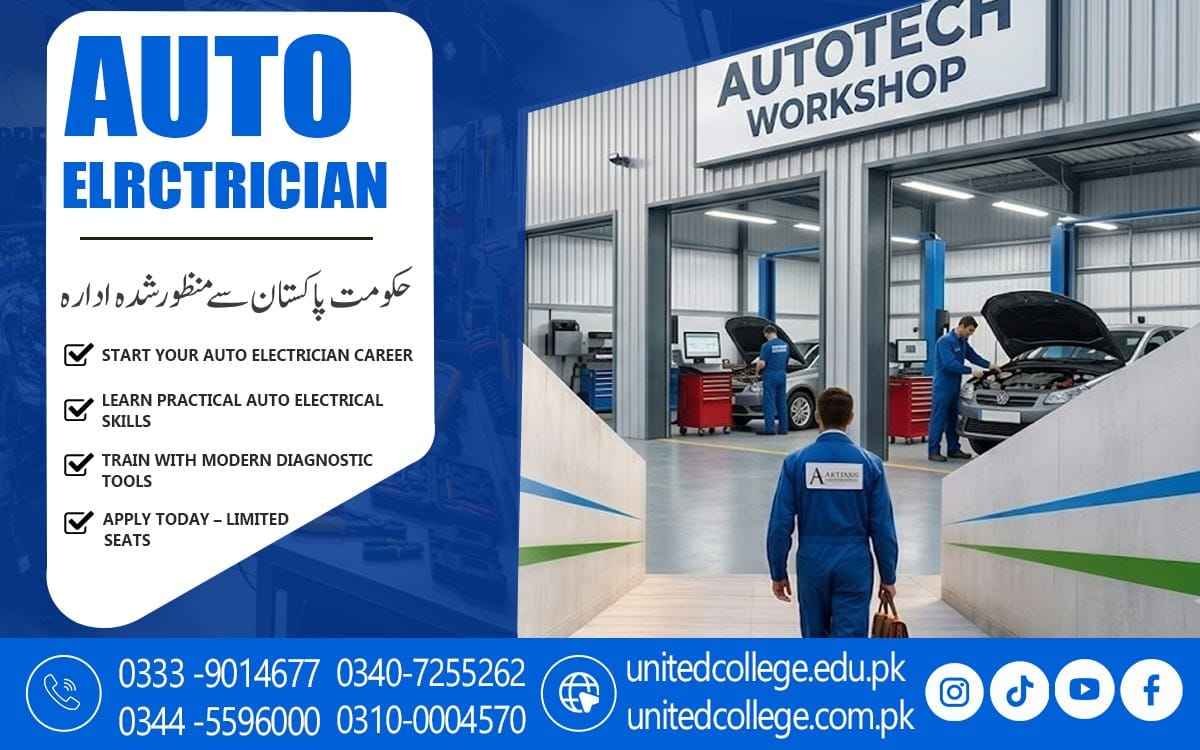

Auto Electrician Course in Shangla for Practical Skills Training
Understanding the Role of an Auto Electrician in Modern Vehicles
Modern vehicles depend on much more than engines, tyres, and mechanical parts. They contain electrical circuits that control lighting, starting, charging, warning indicators, sensors, and several other functions. An auto electrician works with these systems to identify faults, inspect connections, test electrical components, and help restore proper operation. For example, when a car’s headlights become dim, or its dashboard displays a warning light, the problem could involve a weak battery, a damaged wire, a faulty connection, or a charging-system issue.
An automotive electrical technician must investigate the symptoms instead of replacing parts without checking the actual cause. Auto electrician training introduces learners to this problem-solving approach and helps them understand the relationship between different vehicle components. For beginners in Shangla, learning about automotive electrical systems can provide useful technical knowledge for understanding the maintenance needs of cars, motorcycles, and other vehicles. As vehicles become more dependent on electronics, the ability to recognise electrical problems and follow a logical diagnostic process remains an important part of automotive maintenance.
How Auto Electrician Training in Shangla Builds Technical Knowledge
Learning a technical skill becomes easier when students understand how it applies to everyday problems. A person who has never studied vehicle wiring may find it difficult to understand why a car fails to start even when the engine appears to be in good condition. Training can help explain how the battery supplies electrical energy, how the starter motor turns the engine, and how the charging system replenishes the battery while the vehicle runs. The Auto Electrician Course in Shangla offered by United College of Technology provides a relevant training option for learners interested in developing knowledge of automobile electrical systems.
Students considering an automobile electrician course should look for learning that connects technical explanations with practical examples, safe tool handling, and systematic fault identification. It is also helpful to understand the difference between mechanical and electrical faults because similar symptoms can have different causes. For example, an engine that does not start might have a weak battery, a damaged starter circuit, or a mechanical issue. Developing the ability to recognise these possibilities helps learners approach vehicle problems more carefully. Before enrolling, students should confirm the available practical activities, course content, duration, and admission requirements directly with the institution rather than assuming that every topic is covered in the same way.
Diagnosing Car Batteries, Alternators, and Starter Motors
A vehicle’s battery, alternator, and starter motor work together to support starting and electrical power. When a driver turns the ignition key or presses the start button, the battery supplies the energy needed by the starting system. The starter motor then helps turn the engine until it can run independently. Once the engine is running, the alternator generally supplies electrical power and helps recharge the battery. A problem in any of these components can lead to starting difficulties or other electrical symptoms. For instance, clicking sounds when starting a car may indicate a weak battery, poor terminal connections, or a starter-related fault, although further testing is needed to identify the actual cause.
During car electrician training, learners can develop an understanding of battery terminals, charging-system operation, and the purpose of testing voltage and connections. They can also learn why corrosion, loose terminals, damaged cables, and worn components may interfere with electrical performance. Starter motor and alternator repair requires careful inspection because replacing a component without confirming the fault can waste time and money. Students should understand that battery testing and charging-system diagnosis must follow appropriate safety procedures.
Learning Vehicle Wiring, Fuses, Relays, and Lighting Circuits
Have you ever seen a vehicle indicator stop working while the other lights continue to operate normally? A problem like this may involve a bulb, fuse, switch, connector, relay, or damaged wire. Vehicle wiring connects electrical components and allows power to reach the systems that need it. A fuse protects a circuit by breaking the connection when excessive current flows, while a relay uses a control signal to switch a circuit on or off. Switches allow drivers to operate functions such as headlights, indicators, and other electrical equipment. The Auto Electrician Course in Shangla helps learners understand these components and develop knowledge of vehicle wiring and electrical fault diagnosis.
Learners should also understand the purpose of live, neutral where applicable, ground, and vehicle earth connections, recognising that automotive circuits commonly use positive and negative connections rather than household wiring arrangements. Incorrect wiring can damage equipment, create short circuits, or cause a fire. Practical auto electrician training should therefore emphasise circuit diagrams, correct wire connections, fuse ratings, and safe working practices. These skills are useful for understanding electrical faults in vehicle lighting, horns, dashboard indicators, and other common automotive circuits.
Exploring Ignition Systems, Sensors, and Electronic Control Units
Electrical knowledge becomes even more important when working with modern vehicles because many functions depend on electronic controls. An ignition system helps produce the spark needed to ignite the air-fuel mixture in a petrol engine, while sensors provide information about conditions such as engine temperature, crankshaft position, and airflow. An electronic control unit, commonly called an ECU, receives information from relevant sensors and uses programmed instructions to manage certain vehicle functions. If a sensor sends incorrect information or a circuit develops a fault, the vehicle may run poorly, display a warning light, or experience starting problems. However, a warning light does not automatically mean that a particular sensor needs replacement.
Learners studying automotive electrical systems can benefit from understanding basic sensor functions, ignition components, electrical connectors, and the relationship between electronic controls and engine performance. They can also become familiar with the purpose of diagnostic trouble codes, which help indicate areas that require further investigation. These codes are useful clues rather than final answers because several different faults can produce similar symptoms. Developing this understanding prepares beginners to approach modern vehicle electronics with greater care and to recognise when specialist diagnostic equipment or advanced training is required.
Using Multimeters and Automotive Diagnostic Tools Correctly
Imagine a vehicle’s battery appears fully charged, yet the engine still struggles to start. Guessing the cause may lead to unnecessary parts replacement, but testing can provide more useful information. A multimeter is an instrument used to measure electrical values such as voltage, resistance, and current when the correct settings and connections are used. A test lamp can help check whether power is present in a suitable circuit, while automotive scan tools can retrieve diagnostic information from compatible electronic systems. Each tool has a different purpose, and using the wrong setting or connecting probes incorrectly can produce misleading results or damage equipment.
They should also learn that resistance measurements generally require the circuit to be safely de-energised, and current measurements may require a different connection method from voltage testing. Automotive diagnostic tools can assist with car electrical fault diagnosis, but accurate results depend on the technician’s knowledge and the quality of the testing process. For beginners, learning how to record observations, compare readings with suitable specifications, and test one possibility at a time can make troubleshooting more organised. These habits are valuable in a vehicle electrical workshop, where careful diagnosis helps reduce avoidable repairs and supports consistent technical work.
Finding Common Electrical Faults Through Practical Troubleshooting
Electrical faults often begin with small warning signs. A battery may repeatedly lose charge, headlights may become dim, an indicator may stop flashing, or a vehicle’s dashboard may display an unfamiliar warning. In other cases, electrical accessories may work intermittently because a connector is loose or a wire has been damaged. The challenge is to identify the underlying cause instead of treating every symptom as a separate problem. A systematic approach begins by asking when the fault occurs, checking the vehicle’s reported symptoms, and visually inspecting accessible components for corrosion, damage, loose connections, or signs of overheating.
A lighting fault may require checking the bulb, fuse, switch, wiring, and earth connection. Learners exploring the Auto Electrician Course in Shangla can use these examples to understand why logical troubleshooting is an essential automotive maintenance skill. They should also recognise their limits: complex electronic faults, high-voltage hybrid or electric vehicle systems, and damaged safety-related circuits may require specialised equipment and advanced training. Learning to identify when a problem needs expert attention is part of responsible technical practice, not a sign of failure.
Developing Workshop Skills and Following Electrical Safety Procedures
Working with vehicle electrical systems requires patience, attention to detail, and respect for safety procedures. Even a small mistake can damage a component, cause a short circuit, or expose a technician to injury. Before inspecting a circuit, a learner should understand the relevant vehicle instructions, identify potential hazards, and use suitable protective equipment and tools. Battery terminals must be handled carefully because accidental contact between the positive terminal and a grounded metal object can create dangerous sparks and high current. Damaged insulation, exposed conductors, hot components, and moving engine parts also require attention.
Practical auto electrician training should help learners develop safe habits alongside technical knowledge, including keeping tools organised, inspecting leads before testing, avoiding guesswork, and reporting unfamiliar hazards. Where supervised workshop practice is available, students can learn to approach tasks step by step and understand why a test must be performed in a particular order. Anyone considering training through United College of Technology should confirm the nature of the practical instruction and supervision provided. Strong safety habits support reliable work and help learners understand the responsibilities involved in automotive electrical repair.
Applying Auto Electrical Skills in Shangla and Future Technical Learning
For learners in Shangla, understanding vehicle electrical systems can be a practical way to explore a technical field connected with vehicle maintenance and repair. Cars, motorcycles, commercial vehicles, and other transport equipment depend on electrical components that may require inspection, testing, or replacement during their working life. After developing suitable knowledge and supervised practical experience, learners may explore entry-level opportunities in garages, automobile workshops, service centres, or businesses that handle vehicle electrical maintenance. Some may choose to continue learning about engine diagnostics, automotive electronics, vehicle air-conditioning systems, or specialised diagnostic equipment.
The Auto Electrician Course in Shangla offered by United College of Technology can be considered by students who want to learn about this field, but their next steps should depend on the course content, practical ability, and the experience they develop over time. Employment requirements differ between employers, and completing a course alone does not guarantee a job or a particular income. Learners should focus on building reliable skills, understanding electrical diagrams, using tools correctly, communicating clearly with customers and colleagues, and following safe repair procedures.
Frequently Asked Questions (FAQs)
An Auto Electrician Course in Shangla teaches learners about vehicle electrical systems, including batteries, wiring, starter motors, alternators, lighting circuits, and electrical fault diagnosis.
Beginners, students, fresh learners, and individuals interested in vehicle repair can consider this training. Contact United College of Technology (UCT) to confirm the current admission requirements.
You can develop knowledge of automotive wiring, battery testing, charging systems, electrical components, diagnostic tools, and common vehicle electrical problems.
The course duration depends on the training programme. Contact United College of Technology for the latest information about course duration and schedule.
Battery and charging-system testing are important parts of automotive electrical knowledge. Ask UCT about the specific practical activities included in its course.
Admission Open: Start Your Professional Journey Today!
Join United College of Technology and build a career with practical training, recognized certifications, and Gulf job support. Seats are limited.
Apply Now via WhatsAppContact Information
- Address: Rawalpindi: F-272 Main New Katarian Stop, Old IJP Road | Lahore Campus: Lahore, Pakistan
- Phone/WhatsApp: 0340-7255262 / 0333-9014677 / 0301-5044340 / 0310-0004570 / 051-8770756
- Website: unitedcollege.edu.pk
















Leave a Comment