


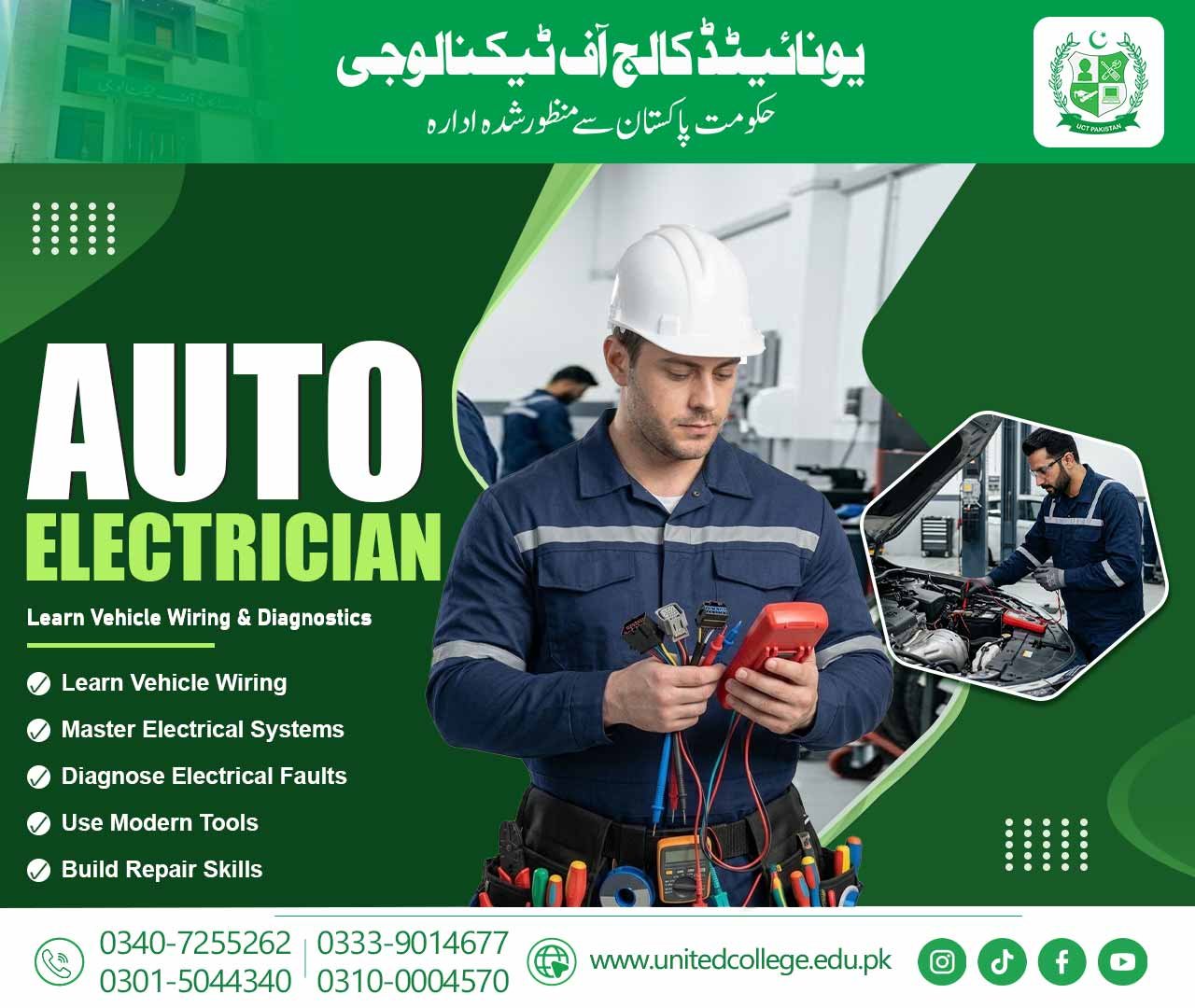

Auto Electrician Course in Swat – Learn Practical Vehicle Repair Skills
When a Vehicle Fails to Start, Electrical Skills Matter
Imagine turning your car key in the morning and hearing only a clicking sound. The engine won't start, the dashboard lights behave strangely, or the battery weakens again after charging. These problems can interrupt daily travel and create difficulties for vehicle owners. In many cases, the cause may involve the battery, starter motor, alternator, wiring, or another electrical component. Knowing how to identify these faults is an important skill in automotive repair.
The Auto Electrician Course in Swat, offered by United College of Technology (UCT), is a relevant training option for individuals who want to learn about vehicle electrical systems and explore this technical field. Students, fresh learners, and job seekers can develop an understanding of how automotive electrical components work, how technicians inspect faults, and why proper repair methods are important. Learning these skills requires patience, attention to detail, and an interest in practical work. With suitable instruction and regular practice, beginners can gradually build the knowledge needed to understand common vehicle electrical problems and their possible solutions.
Understanding the Responsibilities of an Auto Electrician
An auto electrician is a technician who works with the electrical and electronic systems found in vehicles. These systems help vehicles start, run, provide lighting, display information, and operate different electrical features. An automobile electrical technician may inspect a weak battery, investigate a faulty headlight, repair damaged wiring, or identify why a vehicle's charging system is not working correctly. The work is not limited to replacing damaged parts because the technician must also understand how different components connect and operate together.
For example, if a vehicle repeatedly loses battery power, simply installing a new battery may not solve the problem. The alternator, wiring connections, or an electrical component that continues using power when the vehicle is switched off could be responsible. Auto electricians use observation, testing, and logical troubleshooting to find the actual cause. Through an auto electrician Course in Swat, interested learners can begin understanding these responsibilities and the importance of careful diagnosis. Developing this knowledge helps students appreciate that successful electrical repair depends on identifying the fault accurately rather than changing parts without checking them.
Learning How Batteries, Alternators, and Starter Motors Work
A vehicle may contain several electrical components, but the battery, alternator, and starter motor are among the most important systems for starting and operating it. The battery supplies electrical energy needed for starting and supports electrical equipment when required. The starter motor uses electrical power to turn the engine during the starting process. Once the engine is running, the alternator helps generate electricity and recharge the battery, depending on the vehicle's design and operating conditions. When one of these components develops a fault, the driver may experience slow engine cranking, repeated battery discharge, dim lights, or starting difficulties.
During an Auto Electrician Course in Swat, learners can study the purpose of these components and understand how their performance is checked. Battery testing may involve inspecting terminals, checking voltage, and looking for loose or corroded connections. Alternator testing focuses on whether the charging system operates within the manufacturer's specifications, while starter motor inspection may involve checking electrical connections and other relevant components. Students should also learn that a low battery does not always mean the battery itself is defective. Understanding the relationship between the battery and charging system provides a useful foundation for vehicle electrical repair and more accurate troubleshooting.
Identifying Wiring Faults, Blown Fuses, and Relay Problems
A vehicle's wiring system carries electrical power and signals between different components. Damaged insulation, loose connections, corrosion, incorrect wiring, or broken conductors can interrupt this flow and cause equipment to stop working. Consider a situation where the headlights suddenly stop operating even though the bulbs appear undamaged. The problem could involve a blown fuse, a faulty relay, a damaged switch, or a wiring connection. An auto electrician must inspect the circuit methodically to determine which part is responsible. Fuses protect electrical circuits by opening the circuit when excessive current flows under specified conditions. Relays use a control circuit to operate another electrical circuit, allowing suitable switching of electrical equipment.
During automotive workshop training, learners can study these components and understand how to interpret basic vehicle wiring diagrams. These diagrams show electrical connections and help technicians follow a circuit from its power source to the equipment being operated. Practical car wiring and troubleshooting also require care because incorrect connections can damage components or create fire risks. Students should learn to use the correct fuse rating, follow manufacturer guidance, and avoid bypassing protective devices. Such knowledge is useful when investigating faulty indicators, interior lights, horn circuits, power windows, and other electrical features.
Using Multimeters and Diagnostic Tools to Find Electrical Faults
Guessing is rarely a reliable way to repair a complicated electrical problem. A vehicle may show the same symptom for several different reasons, so technicians need suitable testing methods to narrow down the possibilities. A multimeter is an important tool that can measure electrical values such as voltage, resistance, and current when used in the correct mode and within its rated limits. For example, a technician may use voltage measurements to investigate a battery problem or check for an unexpected voltage drop across a connection. Automotive diagnostic scanners can also help identify certain electronic faults by reading diagnostic trouble codes from compatible vehicle systems.
However, a fault code does not always identify a defective part directly; further testing may be necessary to confirm the cause. Learners interested in an Auto Electrician Course in Swat should understand the importance of selecting the correct tool, interpreting its readings, and following a logical testing process. They can also learn why recording observations and comparing results with reliable specifications are valuable habits. Modern automotive diagnostic tools can support fault diagnosis, but they do not replace technical understanding. A careful technician combines the information provided by the tools with knowledge of circuit operation, symptoms, and the vehicle's service information.
Exploring Ignition Systems, Sensors, and Modern Vehicle Electronics
Modern vehicles depend on more than basic wiring and a traditional starting system. Depending on the vehicle, electronic components may control ignition, fuel delivery, engine performance, safety features, comfort systems, and dashboard information. Sensors collect information about different operating conditions and send signals to electronic control units. These units process the information and control particular functions according to the vehicle's design. If a sensor or its wiring develops a fault, the vehicle may show a warning light, run poorly, or store a diagnostic code. Ignition systems also vary between vehicle types, so learners need to understand the relevant system rather than assume every vehicle uses the same arrangement.
Car electrical technician training can introduce students to these concepts and help them understand why modern vehicle repair increasingly involves electrical testing and electronic diagnosis. Beginners may initially find wiring diagrams, sensor signals, and diagnostic codes difficult to understand, but studying one circuit at a time makes the process more manageable. Students should also learn that some electronic components require manufacturer-specific procedures and specialized equipment. Building a foundation in automotive electrical systems can help learners understand these developments and prepare them to continue learning as vehicle technology changes.
Developing Practical Repair Skills Through Safe Workshop Learning
Reading about an electrical system is useful, but practical experience helps learners understand how components behave in real situations. A workshop-based learning approach may involve identifying tools, examining electrical parts, practising basic measurements, interpreting wiring diagrams, and observing fault-finding procedures. Students can gradually learn to inspect terminals, recognize damaged insulation, identify common connector problems, and organize tools correctly. Safety must remain part of every task. Vehicle batteries can deliver very high current, and incorrect connections may cause sparks, burns, equipment damage, or fire.
Hybrid and electric vehicles may contain high-voltage systems that require specialized training and safety procedures; beginners should never handle these systems independently without proper authorization and preparation. The Auto Electrician Course in Swat offered by United College of Technology can be explored by learners interested in developing knowledge relevant to this type of technical work. Before enrolling, prospective students should confirm the available practical training, workshop arrangements, equipment, and course content directly with the institution.
Understanding Automotive Repair Needs in Swat
Vehicles are used for personal travel, business activities, transportation, and other everyday purposes throughout Swat. Cars, motorcycles, and commercial vehicles may require electrical inspection and maintenance as they age or experience regular use. Battery problems, damaged lighting circuits, poor connections, faulty charging systems, and starter issues are examples of faults that can affect vehicle operation. Weather, moisture, dust, vibration, and general wear may also contribute to certain electrical problems, depending on the vehicle and its operating conditions. These situations demonstrate why practical automotive repair skills can be relevant to people interested in technical work in the region.
Someone learning vehicle electrical repair may begin by understanding simple circuits and gradually progress to more complicated diagnosis under suitable supervision. Familiarity with common vehicle systems can also improve communication with workshop staff and help learners understand the difference between a symptom and its underlying cause. For example, headlights that become dim while driving may indicate a charging issue, a poor connection, or another fault that requires proper testing. Learning to investigate such symptoms systematically is more useful than immediately replacing a component.
Exploring Career Directions After Auto Electrician Training
Learning automotive electrical systems can introduce students to several possible directions within the vehicle repair industry. Depending on their skills, practical experience, and local opportunities, learners may consider assisting an experienced auto electrician, working in a suitable automotive workshop, supporting vehicle maintenance activities, or developing more advanced diagnostic abilities. Some may eventually consider self-employment after gaining sufficient experience, learning how to manage repair work responsibly, and understanding the costs of tools and equipment. However, completing a course alone does not guarantee a job or immediate expertise.
Beginners can improve their readiness by practising under supervision, learning from experienced technicians, maintaining records of the tasks they perform, and becoming familiar with different vehicle models. They should also continue learning because electronic systems, diagnostic methods, and vehicle designs change over time. The Auto Electrician Course in Swat can be considered a starting point for people who want to explore this field and build a foundation in automotive electrical work. Before making career decisions, students should research local workshop requirements and confirm which qualifications or additional training may be needed for their preferred role.
Frequently Asked Questions (FAQs)
An Auto Electrician Course in Swat teaches students about vehicle electrical systems, including batteries, alternators, starter motors, wiring, fuses, relays, and electrical fault diagnosis.
Students, beginners, fresh learners, and job seekers interested in automotive electrical repair can explore this course. Specific eligibility requirements should be confirmed with United College of Technology.
Students can learn about vehicle wiring, battery testing, charging systems, starter motors, automotive diagnostic tools, and methods for identifying common electrical faults.
Auto electrician training can help learners understand vehicle maintenance and repair needs, including common electrical problems in cars and motorcycles.
Common tools include multimeters, diagnostic scanners, test lights, insulated tools, wiring diagrams, and appropriate hand tools.
Admission Open: Start Your Professional Journey Today!
Join United College of Technology and build a career with practical training, recognized certifications, and Gulf job support. Seats are limited.
Apply Now via WhatsAppContact Information
- Address: Rawalpindi: F-272 Main New Katarian Stop, Old IJP Road | Lahore Campus: Lahore, Pakistan
- Phone/WhatsApp: 0340-7255262 / 0333-9014677 / 0301-5044340 / 0310-0004570 / 051-8770756
- Website: unitedcollege.edu.pk
















Leave a Comment