


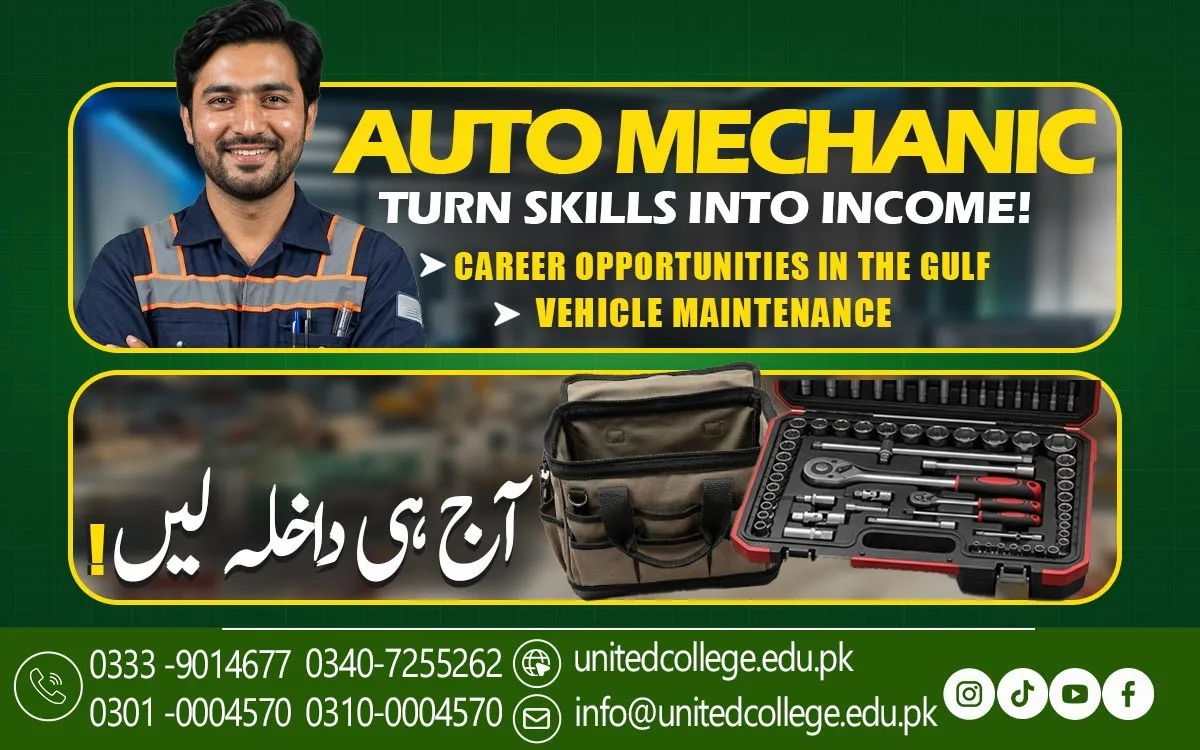

Auto Mechanic Course in Balakot: Learn Vehicle Repair Skills
When a Vehicle Breaks Down, Skilled Auto Mechanics Make a Difference
Imagine you are driving to work or travelling with your family when your car suddenly stops in the middle of the road. You turn the key, but the engine refuses to start. Perhaps you notice smoke coming from under the bonnet, hear an unusual engine noise, or see the temperature gauge rising quickly. These problems can turn an ordinary journey into a stressful experience. A skilled auto mechanic can inspect the vehicle, identify possible faults, and recommend suitable repairs. This is why automotive repair and maintenance skills are important for keeping vehicles safe and reliable. For students and fresh learners interested in this field, the Auto Mechanic Course in Balakot offers a useful starting point for understanding how vehicles work and how common mechanical problems can be addressed.
Offered by United College of Technology (UCT), this training opportunity is relevant to people who want to develop practical knowledge of automobile repair and vehicle maintenance. Learning about engines, brakes, batteries, cooling systems, and other vehicle components can help beginners understand the work performed in automotive workshops. Instead of depending entirely on guesswork, trained learners can develop a more systematic approach to identifying faults. Automotive knowledge also helps people understand the importance of regular servicing and responsible driving. With suitable instruction, supervised practice, and continued learning, students can gradually build the skills needed to understand everyday vehicle problems and explore different areas of the automotive repair industry.
Understanding What an Auto Mechanic Does in a Modern Workshop
An auto mechanic performs several important tasks that help vehicles operate properly. These responsibilities include inspecting mechanical components, identifying faults, replacing damaged parts, carrying out routine servicing, and checking vehicle performance after repairs. Modern vehicles contain different systems that work together, so mechanics need to understand how these systems affect one another. For example, a vehicle that struggles to start might have a weak battery, a faulty starter motor, a fuel delivery problem, or another issue. Replacing a part without checking the actual cause can waste time and money. Vehicle fault diagnosis teaches mechanics to investigate symptoms before deciding which repair is appropriate.
During an auto mechanic Course in Balakot, learners can become familiar with the different responsibilities associated with automotive repair and maintenance. They can study automobile engineering basics, including the purpose of major engine components, transmission systems, braking mechanisms, and electrical connections. Mechanics may work on cars, vans, motorcycles, and other vehicles, depending on their training and specialization. Their daily work can also involve changing engine oil, inspecting filters, checking fluid levels, examining tyres, and looking for signs of wear. Good communication is another useful skill because customers need clear explanations of vehicle problems and recommended repairs.
Developing Practical Automotive Skills Through Structured Training
Learning automotive repair involves more than memorizing the names of vehicle components. Students need to understand how parts function, recognize common warning signs, and learn the correct procedures for inspecting and maintaining them. An automotive repair course can introduce beginners to essential workshop activities, including identifying engine components, checking fluid levels, inspecting belts and hoses, and understanding basic maintenance schedules. For example, if a vehicle owner reports poor fuel efficiency or rough engine performance, a mechanic needs to consider several possible causes instead of immediately blaming one component.
Similarly, a car that makes a clicking sound when starting may have a battery or electrical connection problem, although further inspection is necessary to confirm the fault. Through appropriate instruction and supervised exercises, learners can develop a logical approach to these situations. The Auto Mechanic Course in Balakot is a relevant option for people who want to explore this technical field and develop a foundation in vehicle servicing and repair. At United College of Technology, students can inquire about the available training content and practical learning arrangements to understand how the course matches their learning goals. Useful skills in this field include recognizing common tools, following maintenance instructions, understanding workshop terminology, and learning when a problem requires more advanced diagnosis.
Learning How Engines Work and How Common Mechanical Faults Develop
The engine is one of the most important parts of a vehicle because it produces the power needed for movement. Understanding engine repair and maintenance begins with learning about components such as pistons, cylinders, valves, spark plugs in petrol engines, and fuel injectors. Students can also explore the roles of the fuel system, lubrication system, and engine cooling system. Each system performs a different function, but all must work correctly for the engine to operate reliably. The lubrication system circulates oil to reduce friction between moving components, while the cooling system helps prevent excessive engine temperatures. If the engine overheats, possible causes may include low coolant, a leaking hose, a faulty thermostat, or a problem with the radiator.
However, these symptoms do not always point to the same fault, so proper inspection is essential. Car engine troubleshooting involves checking available evidence, considering possible causes, and carrying out suitable tests before recommending repairs. Learners can also study common signs of engine trouble, such as unusual noises, excessive exhaust smoke, difficult starting, and reduced performance. Understanding these warning signs helps mechanics recognize when further investigation is necessary. In a vehicle maintenance course, beginners may learn the importance of following manufacturer recommendations for oil changes, filter replacement, and other servicing tasks. They should also understand that modern engines can contain complex electronic controls that require additional knowledge and diagnostic equipment.
Understanding Brakes, Steering, Suspension, and Vehicle Electrical Systems
A vehicle depends on several systems beyond its engine to operate safely and comfortably. The braking system allows the driver to slow down or stop, while the steering system helps control the vehicle's direction. The suspension system supports the vehicle and helps reduce the effect of bumps and uneven road surfaces. Tyres provide contact with the road, making their condition and inflation important for handling and braking performance. During the Auto Mechanic Course, students can learn about the functions of brake pads, brake discs, suspension springs, shock absorbers, steering components, and wheel assemblies. They can also explore common warning signs, such as squealing brakes, unusual vibrations, uneven tyre wear, or difficulty steering.
These symptoms require careful inspection because several different faults can produce similar effects. The vehicle electrical system is another important area of automotive knowledge. A battery supplies electrical power for starting and other functions, while the alternator generally helps recharge the battery when the engine is running. If dashboard lights appear dim or the vehicle repeatedly struggles to start, the problem may involve the battery, charging system, wiring, or electrical connections. Automotive diagnostic tools can help technicians investigate certain faults more accurately. Learners should also understand that braking, steering, suspension, and electrical repairs can affect vehicle safety. Problems involving these systems must be checked carefully, and road testing should only take place when the vehicle is safe to operate.
Why Hands-On Workshop Practice Matters for New Auto Mechanics?
Reading about automotive components is useful, but practical experience helps learners understand how those components look, fit together, and function in real situations. A person may know the purpose of a spanner or socket set from a textbook, yet still need practice to use the tool correctly. Automotive workshop training allows students to become familiar with common equipment, workshop organization, basic inspection procedures, and appropriate handling techniques. Under suitable supervision, beginners may practise identifying vehicle components, checking fluid levels, inspecting air filters, examining battery connections, and learning routine servicing procedures.
These activities help connect classroom knowledge with real automotive work. For example, a learner studying a vehicle's cooling system may understand why coolant is important, but practical demonstrations can make it easier to recognize hoses, reservoirs, radiators, and possible signs of leakage. Students can also learn why mechanics should consult service information rather than relying on assumptions. Different vehicles may require different tools, fluid specifications, tightening procedures, and maintenance intervals. The Auto Mechanic Course in Balakot can be considered by learners seeking an introduction to this field through United College of Technology.
Preventing Costly Breakdowns Through Regular Vehicle Inspection
Many vehicle problems become more serious when early warning signs are ignored. A small coolant leak, worn tyre, damaged belt, or deteriorating battery connection may appear unimportant at first, but it can eventually affect vehicle reliability or safety. Preventive vehicle maintenance focuses on checking a vehicle regularly and addressing developing problems before they lead to larger failures. Auto mechanics often inspect engine oil, coolant levels, air filters, belts, hoses, tyres, lights, and other components according to the vehicle manufacturer's recommendations. They may also review service records to understand when particular maintenance tasks were last completed.
For example, if a customer reports that the engine temperature rises during traffic, a mechanic may inspect the cooling system, check for leaks, and carry out appropriate tests to identify the cause. Simply adding coolant without investigating a recurring loss may leave the underlying problem unresolved. Car servicing and inspection also involve listening carefully to customer concerns, recording symptoms, and explaining which checks are necessary. They can learn to distinguish routine servicing from repairs that require more detailed diagnosis. Vehicle fault diagnosis should follow a clear process: understand the complaint, inspect relevant components, use suitable testing methods, identify the likely cause, and verify that the repair has addressed the problem.
Following Workshop Safety Rules During Automotive Repair Work
An automotive workshop contains tools, moving equipment, hot surfaces, heavy components, batteries, oils, fuels, and other materials that can cause injuries if handled incorrectly. Workshop safety must therefore be part of every learner's training from the beginning. Before inspecting a vehicle, mechanics should understand how to secure it properly, select suitable tools, and keep the working area organized. Vehicles must be supported with appropriate equipment whenever work requires access underneath them; a hydraulic jack alone should never be treated as sufficient support. Engines and exhaust components can remain hot after a vehicle has been switched off, so learners must understand the need to avoid unsafe contact.
Cooling systems can also remain pressurized, which means opening a hot radiator cap can release scalding coolant. Battery work requires care because incorrect connections can create sparks or damage electrical components. Protective equipment, such as safety glasses, suitable gloves, and protective footwear, should be used when appropriate for the task. Good ventilation is important when working around vehicle exhaust, fuel vapours, and certain cleaning products. Automotive workshop safety also includes correct storage of tools, proper handling of used oil, and responsible disposal of waste materials according to applicable requirements. During practical training, beginners should follow their instructor's directions and avoid carrying out unfamiliar procedures without supervision.
Exploring Automotive Learning and Career Paths After the Course
After gaining suitable knowledge and practical experience, learners may explore opportunities in vehicle workshops, local garages, service centres, maintenance facilities, or businesses that provide automotive repair services. Some may prefer routine servicing, while others may gradually develop an interest in engine repair, vehicle electrical systems, diagnostics, or particular vehicle types. The direction a learner takes will depend on their interests, technical ability, available training, and local employment requirements. Completing a course does not automatically guarantee a job or a particular salary, because employers may also consider practical performance, previous experience, reliability, and the ability to follow workshop procedures.
Continued learning is especially important as vehicle technology develops. Modern vehicles increasingly use electronic control units, sensors, computerized diagnostic systems, and advanced safety features. Mechanics who want to work with these systems may need further technical education and specialized practice. For students considering the Auto Mechanic Course in Balakot, United College of Technology can be a starting point for exploring structured automotive learning. Interested applicants should contact UCT to confirm admission requirements, course duration, training facilities, practical components, and any available certification details before making a decision. Learners should also develop communication skills, time management, honesty, and attention to detail because these qualities matter in professional workshops.
Frequently Asked Questions (FAQs)
The Auto Mechanic Course in Balakot helps learners understand vehicle maintenance, engine components, car servicing, and common automotive repair techniques.
You can contact United College of Technology (UCT) to learn about course availability, admission requirements, and training arrangements for students interested in automotive repair.
Students can develop knowledge of engine maintenance, brake systems, vehicle inspections, basic troubleshooting, and automotive workshop safety.
Yes, automotive training can be suitable for beginners who want to understand how vehicles work and gradually develop practical repair skills.
Depending on their skills and experience, learners may explore opportunities in vehicle workshops, garages, service centres, and automotive maintenance businesses.
Admission Open: Start Your Professional Journey Today!
Join United College of Technology and build a career with practical training, recognized certifications, and Gulf job support. Seats are limited.
Apply Now via WhatsAppContact Information
- Address: Rawalpindi: F-272 Main New Katarian Stop, Old IJP Road | Lahore Campus: Lahore, Pakistan
- Phone/WhatsApp: 0340-7255262 / 0333-9014677 / 0301-5044340 / 0310-0004570 / 051-8770756
- Website: unitedcollege.edu.pk
















Leave a Comment