


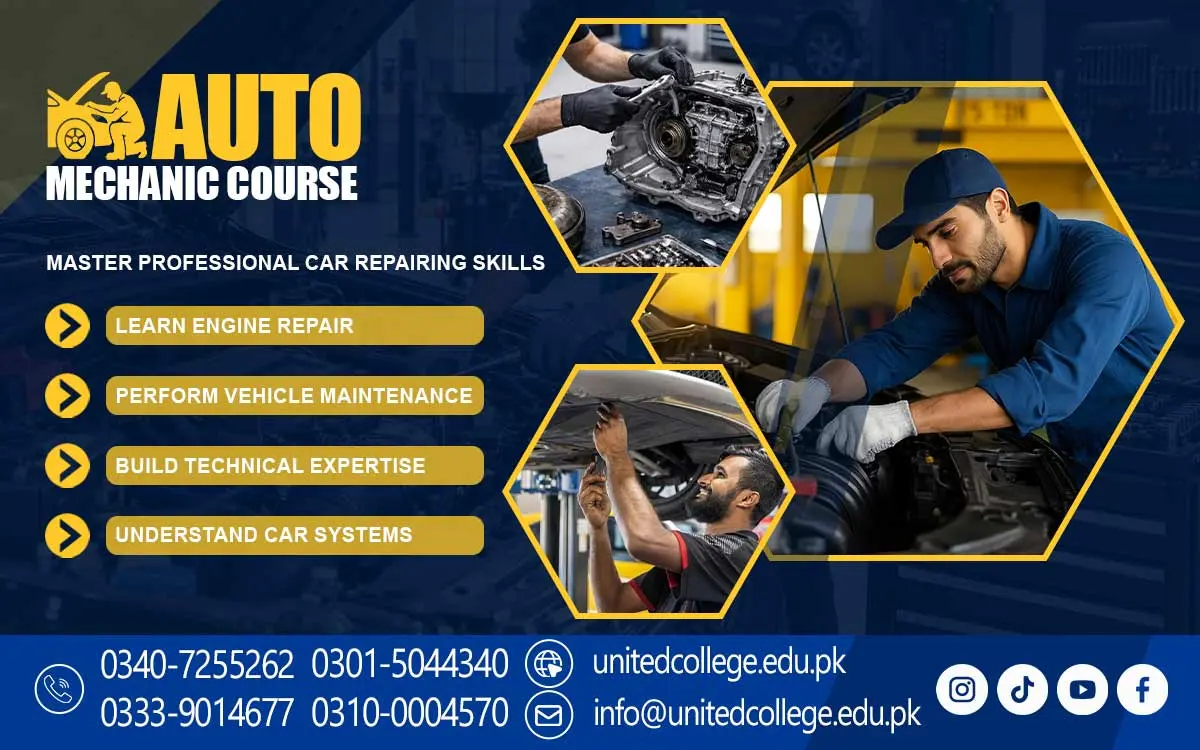

Auto Mechanic Course in Chitral for Gearbox Service
Understanding Manual and Automatic Gearboxes
The Auto Mechanic Course in Chitral offered by United College of Technology introduces students to manual and automatic gearboxes and their importance in vehicle operation. A gearbox helps transfer engine power to the wheels while providing different gear ratios for changing speed and torque. Learners can explore how manual transmissions require the driver to select gears, while automatic transmissions use mechanisms that change gears with less direct driver involvement. Understanding these differences helps students develop a foundation in automotive technology.
Students can learn about the basic components found in different transmission systems, including gears, shafts, bearings, and transmission housings. They can also explore how gear ratios affect acceleration, pulling power, and vehicle speed. Manual and automatic gearboxes operate differently, but both must transfer engine power effectively to support vehicle movement. Understanding their functions helps learners recognize why proper maintenance and correct operation are important.
Knowledge of gearbox types can prepare students for further automotive training and practical workshop experience. Mechanics need to understand how transmissions work before inspecting components or investigating performance problems. By studying manual and automatic gearboxes, learners can build useful technical knowledge for future opportunities in automobile workshops, garages, and vehicle service centers.
Exploring Transmission Components and Functions
The Auto Mechanic Course in Chitral helps learners understand the main components of automotive transmission systems. These components work together to transfer power from the engine to the wheels. Students can explore gears, shafts, bearings, synchronizers, transmission cases, and other parts commonly associated with manual gearboxes. They can also become familiar with important components of automatic transmissions, including torque converters and planetary gear sets.
Each transmission component performs a particular function. Gears provide different ratios, shafts transmit rotational movement, and bearings support moving parts. In manual transmissions, synchronizers help match gear speeds during shifting, allowing smoother engagement. Automatic transmissions use additional hydraulic and electronic systems to control gear changes. Learning about these functions helps students understand how transmission components interact during normal vehicle operation.
Students can also explore how component wear or damage may affect transmission performance. Unusual noises, vibration, fluid leakage, and difficulty changing gears can indicate problems that require further inspection. Understanding the purpose of individual components helps learners follow diagnostic procedures more effectively. This knowledge provides a foundation for studying transmission maintenance and developing practical automotive skills.
Learning Gear Shifting Mechanisms
The Auto Mechanic Course in Chitral introduces students to gear shifting mechanisms and their role in controlling vehicle speed and engine power. Gear shifting allows a vehicle to operate under different driving conditions, including starting, accelerating, climbing slopes, and maintaining speed. Learners can understand how changing gear ratios helps the engine operate within a suitable speed range. This knowledge is useful for understanding the relationship between engine performance and transmission operation.
Students can explore how manual gear shifting involves the gear lever, clutch, and internal transmission mechanisms. They can study how the clutch temporarily disconnects engine power from the gearbox to support gear changes. Automatic transmissions use different systems to select gears according to vehicle speed, engine load, and other operating conditions. Understanding these differences helps learners recognize the basic principles behind both transmission types.
Learning about gear shifting can also help students identify problems related to transmission operation. Difficulty selecting gears, delayed engagement, grinding sounds, or unexpected shifting may indicate a mechanical, hydraulic, or electronic issue. Learners can study the importance of identifying symptoms and following suitable inspection procedures. With additional practical training, they can develop a better understanding of gear selection and transmission troubleshooting.
Identifying Common Transmission Problems
The Auto Mechanic Course in Chitral helps students understand common transmission problems and the symptoms associated with them. Transmission faults can affect vehicle movement, acceleration, driving comfort, and overall performance. Learners can explore issues such as slipping gears, delayed engagement, unusual noises, fluid leakage, and difficulty shifting. Recognizing these warning signs helps students understand when a vehicle requires further mechanical inspection.
Different transmission problems can have different causes. For example, slipping gears may be associated with worn internal components, incorrect fluid levels, or hydraulic problems, depending on the transmission type. Unusual noises may result from damaged bearings, worn gears, or other mechanical issues. Students can learn why symptoms should be examined carefully instead of assuming that one particular component has failed. Accurate diagnosis often requires a combination of visual inspection, testing, and manufacturer-specific information.
Understanding transmission faults can help learners build useful troubleshooting knowledge. They can study how mechanics inspect transmission fluid where applicable, examine external components, check for leaks, and use diagnostic equipment when necessary. Serious transmission symptoms should be assessed by a qualified technician to avoid further damage. These learning areas can support students interested in automotive maintenance and transmission servicing.
Understanding Clutch Operation and Adjustment
The Auto Mechanic Course in Chitral introduces learners to clutch operation and its relationship with manual transmission systems. A clutch connects and disconnects engine power from the gearbox, allowing the driver to start moving and change gears smoothly. Students can explore major clutch components, including the clutch plate, pressure plate, release bearing, and flywheel. Understanding these parts helps learners recognize how the clutch supports vehicle operation.
Learners can study common clutch problems, such as slipping, unusual noises, difficult gear engagement, and changes in pedal feel. They can explore how wear, incorrect adjustment in applicable systems, or problems with hydraulic components may affect clutch performance. Different vehicles use different clutch designs, so inspection and adjustment procedures must follow manufacturer specifications. Understanding these differences helps students avoid applying the same procedure to every vehicle.
Clutch knowledge is important for anyone interested in manual transmission maintenance. Students can learn why correct installation, suitable adjustment where applicable, and careful inspection contribute to reliable operation. They can also explore the relationship between clutch condition and gearbox performance. Through supervised practical training, learners can develop a foundation for further study of clutch servicing and automotive mechanical systems.
Studying Gearbox Inspection Procedures
The Auto Mechanic Course in Chitral helps students understand gearbox inspection procedures used to assess transmission condition. Regular inspection can help identify visible damage, fluid leakage, unusual noises, and other signs of possible problems. Learners can study the importance of checking external components, mounting points, seals, and related systems. They can also understand why transmission inspection methods differ between manual and automatic gearboxes.
Students can explore the role of transmission fluid in systems that require it. Fluid condition and level can affect lubrication, cooling, and hydraulic operation, depending on the gearbox design. Learners can understand why the correct fluid specification and manufacturer-recommended checking procedure are essential. Some transmissions require specific temperature conditions or electronic procedures for accurate fluid-level checks, making technical guidance important during servicing.
Inspection also involves recording observations and deciding whether further testing is necessary. Students can learn how mechanics use vehicle information, diagnostic equipment, and suitable testing methods to investigate transmission concerns. Safe working procedures are particularly important when a vehicle is lifted or when hot components and fluids are involved. These inspection principles help learners build a foundation for responsible gearbox maintenance and automotive troubleshooting.
Learning Transmission Care and Maintenance
The Auto Mechanic Course in Chitral introduces students to transmission care and maintenance practices that support reliable vehicle operation. Gearboxes contain moving components that must operate under changing loads, speeds, and temperatures. Appropriate maintenance can help reduce unnecessary wear and identify potential problems. Learners can explore the importance of following the vehicle manufacturer's service schedule and using recommended parts and fluids.
Students can study routine maintenance requirements, including checking for fluid leaks, examining external components, and monitoring changes in transmission performance. They can learn why unusual noises, delayed gear engagement, or unexpected shifting should not be ignored. Different transmission types have different servicing needs, and not every gearbox uses the same fluid or maintenance interval. Following the correct technical information helps prevent mistakes during inspection and servicing.
Proper transmission care also involves responsible driving and timely professional assessment when problems appear. Learners can understand how harsh operation, neglected maintenance, and continued driving with serious symptoms may contribute to additional damage. By studying these principles, students can develop useful knowledge of transmission servicing and prepare for further practical learning in automotive workshops and vehicle maintenance centers.
Exploring Careers in Automotive Transmission Services
The Auto Mechanic Course in Chitral can help learners explore career pathways related to gearbox maintenance and automotive transmission services. Transmissions are essential vehicle systems, and their inspection and servicing require knowledge of mechanical components and operating principles. Students can develop a foundation in gearbox types, gear shifting, clutch operation, transmission faults, and routine maintenance. These subjects can support their preparation for further technical education.
After gaining appropriate training and practical experience, learners may explore entry-level opportunities in automobile workshops, garages, transmission service centers, and general vehicle maintenance facilities. Some may choose to specialize further in manual gearboxes, automatic transmissions, clutch systems, or electronic transmission diagnostics. Career opportunities depend on individual qualifications, practical ability, experience, and local employer requirements.
Students who want to develop in this field should combine theoretical knowledge with supervised workshop practice. Familiarity with mechanical tools, inspection procedures, technical manuals, and workplace safety is valuable for transmission-related work. Careful observation and systematic troubleshooting can also help learners improve their understanding of gearbox problems. Continued training and experience can support their progress toward more specialized automotive service roles.
Frequently Asked Questions (FAQs)
The course introduces students to manual and automatic gearboxes, transmission components, gear shifting mechanisms, clutch operation, and maintenance procedures.
A gearbox transfers engine power to the wheels and provides different gear ratios to support suitable speed and torque.
Common signs include slipping gears, delayed engagement, unusual noises, fluid leakage, and difficulty changing gears.
Clutch maintenance helps support smooth gear changes, proper power transfer, and reliable transmission operation.
After gaining suitable training and experience, learners may explore opportunities in automobile workshops, garages, transmission service centers, and vehicle maintenance facilities.
Admission Open: Start Your Professional Journey Today!
Join United College of Technology and build a career with practical training, recognized certifications, and Gulf job support. Seats are limited.
Apply Now via WhatsAppContact Information
- Address: Rawalpindi: F-272 Main New Katarian Stop, Old IJP Road | Lahore Campus: Lahore, Pakistan
- Phone/WhatsApp: 0340-7255262 / 0333-9014677 / 0301-5044340 / 0310-0004570 / 051-8770756
- Website: unitedcollege.edu.pk
















Leave a Comment