


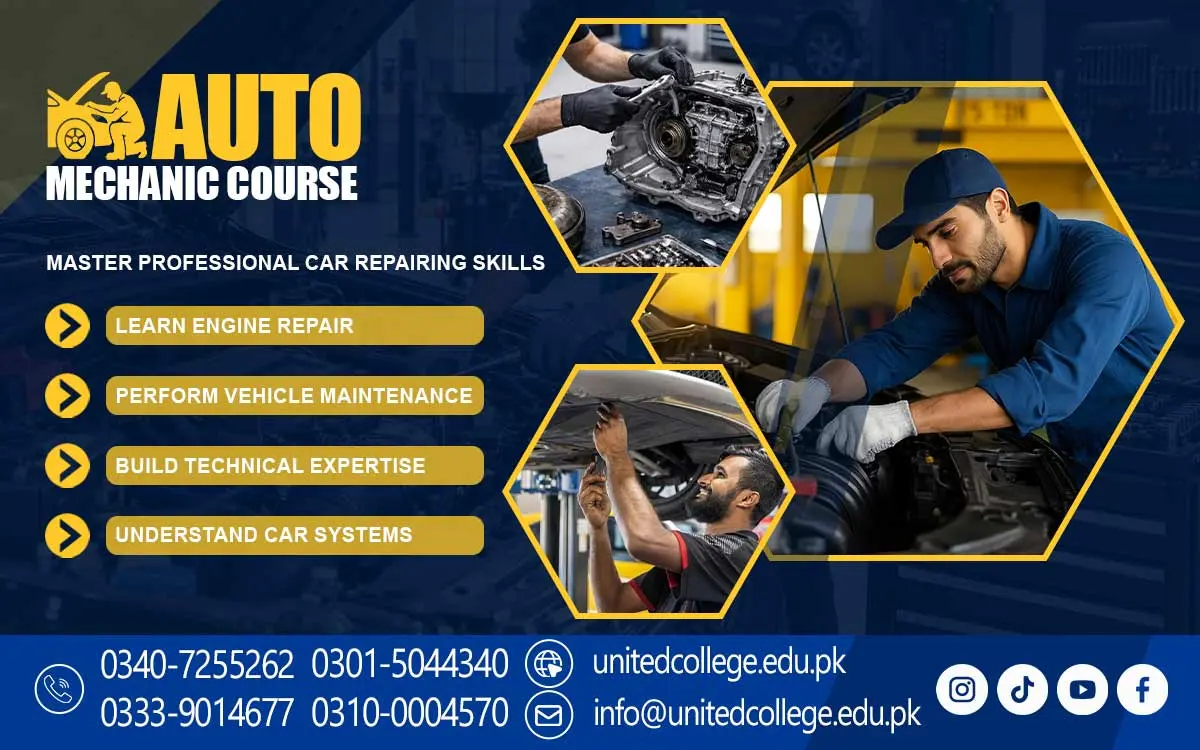

Auto Mechanic Course in Gilgit-Baltistan for Car Maintenance
Understanding Routine Automobile Maintenance
The Auto Mechanic Course in Gilgit-Baltistan offered by United College of Technology introduces students to routine automobile maintenance and its importance in keeping vehicles in suitable working condition. Regular maintenance helps identify developing problems, supports vehicle reliability, and reduces the likelihood of unexpected breakdowns. Students can learn about essential vehicle systems, including the engine, cooling system, braking system, battery, tires, and transmission. Understanding these components provides a foundation for learning how automobiles operate and why they require regular care.
Learners can explore common maintenance activities such as checking fluid levels, inspecting hoses and belts, examining tires, and monitoring engine performance. They can also understand why vehicle manufacturers recommend particular service intervals for different models. Maintenance requirements may vary according to vehicle age, mileage, operating conditions, and driving habits. Following the correct service schedule helps ensure that important components receive appropriate attention.
Routine maintenance knowledge is useful for people interested in automotive technology and mechanical work. Students can develop an understanding of how mechanics inspect vehicles and identify parts that may require servicing. They can also learn about workshop safety, proper tool handling, and the importance of maintaining accurate service records. These foundational skills can support further technical training and future opportunities in automobile workshops and vehicle service centers.
Learning Vehicle Inspection Techniques
The Auto Mechanic Course in Gilgit-Baltistan helps students understand vehicle inspection techniques used to assess the condition of automobiles. Inspections allow mechanics to identify visible damage, worn components, fluid leaks, and other signs of possible mechanical problems. Learners can explore basic checks involving tires, lights, mirrors, brakes, steering components, engine compartments, and fluid reservoirs. These procedures help students understand how a systematic inspection contributes to vehicle safety and reliability.
Students can learn to examine vehicle components carefully and record their observations. For example, uneven tire wear may indicate alignment problems, while damaged hoses or fluid stains may suggest a leak requiring further investigation. Learners can also understand the importance of checking dashboard warning indicators and listening for unusual noises. Each observation provides useful information, but additional testing may be necessary to confirm the actual cause of a problem.
Vehicle inspection requires attention to detail and an understanding of safe working practices. Students can explore how mechanics use suitable tools, follow inspection checklists, and consult manufacturer guidelines when assessing specific components. They can also learn why inspections should be performed under appropriate conditions and why safety-related faults need prompt professional attention. Developing these abilities can help learners prepare for practical automotive work and further technical education.
Exploring Engine Oil and Filter Replacement
The Auto Mechanic Course in Gilgit-Baltistan introduces students to engine oil and filters and their role in maintaining engine performance. Engine oil lubricates moving components, helps reduce friction, and assists with heat management. The oil filter captures contaminants that could otherwise circulate through the lubrication system. Learners can understand why using the correct oil specification and a suitable filter is important for protecting engine components and supporting reliable operation.
Students can explore the general steps involved in an oil and filter change, including preparing the vehicle, identifying the correct service requirements, draining used oil, replacing the filter, and filling the engine with the recommended oil. They can also learn why the oil level must be checked using the manufacturer's specified procedure. Correct tightening, leak inspection, and proper disposal of used oil are important parts of responsible servicing. Safety precautions are essential because engine oil and nearby components may be hot.
Understanding oil and filter replacement helps learners develop knowledge of one of the most common automobile maintenance tasks. They can study how oil condition, mileage, and service intervals influence maintenance decisions. Students can also learn that different engines require different oil grades and capacities, so specifications should never be guessed. With supervised practical training, learners can improve their familiarity with routine engine servicing and workshop procedures.
Studying Tire Condition and Pressure Checks
The Auto Mechanic Course in Gilgit-Baltistan helps learners understand tire condition and pressure checks as essential parts of automobile maintenance. Tires provide contact between a vehicle and the road, influencing traction, braking, steering, and overall driving stability. Students can explore tire tread, sidewalls, inflation pressure, and common signs of wear or damage. Understanding these features helps learners recognize why tire condition should be checked regularly.
Learners can study how to use a suitable pressure gauge and compare readings with the vehicle manufacturer's recommended pressure. They can also examine tread wear patterns and identify issues such as cuts, bulges, uneven wear, and embedded objects. Tire pressure can affect vehicle handling, fuel consumption, and tire lifespan. Incorrect pressure may also increase safety risks, particularly during long journeys or when carrying heavy loads.
Students can further explore the importance of regular tire rotation when recommended, wheel alignment, balancing, and checking the spare tire where applicable. They can understand why damaged tires require professional assessment and why pressure should be measured under the conditions specified by the manufacturer. This knowledge can help learners develop useful inspection habits and build a foundation for automotive maintenance work.
Understanding Battery and Charging Maintenance
The Auto Mechanic Course in Gilgit-Baltistan introduces learners to vehicle batteries and charging systems. A vehicle battery supplies electrical power for starting and supports electrical equipment when required. The alternator generally recharges the battery while the engine is running and supplies power to electrical systems. Students can learn about battery terminals, cables, charging components, and the basic relationship between the battery and the vehicle's electrical system.
Learners can explore common signs of battery or charging problems, including slow engine cranking, dim lights, difficulty starting, and battery warning indicators. They can understand why these symptoms may have different causes, such as a weak battery, loose connections, a faulty alternator, or damaged wiring. Basic testing methods can help mechanics assess battery condition and charging performance. Students should also learn to follow suitable safety precautions when handling batteries and electrical equipment.
Battery maintenance may include checking terminal condition, ensuring secure connections, and inspecting the battery housing for visible damage. Learners can study why corrosion should be addressed using appropriate procedures and why damaged batteries need professional attention. Understanding charging systems can help students investigate common electrical issues and prepare for further training in automotive diagnostics and maintenance.
Identifying Signs of Vehicle Component Wear
The Auto Mechanic Course in Gilgit-Baltistan helps students recognize signs of wear in different automobile components. Vehicle parts gradually deteriorate through normal use, friction, heat, vibration, and exposure to environmental conditions. Learners can study wear patterns affecting belts, hoses, brake components, tires, suspension parts, bearings, and other mechanical systems. Understanding these signs helps students appreciate the importance of regular inspections and timely maintenance.
Students can explore how worn components may produce unusual noises, vibrations, fluid leaks, reduced performance, or changes in vehicle handling. For example, a cracked belt may require replacement, while damaged suspension components can affect ride comfort and stability. Learners can also understand that some faults are not immediately visible and may require diagnostic equipment or detailed testing. Proper identification helps mechanics determine which components need closer inspection.
The ability to recognize component wear is useful in preventive maintenance and vehicle servicing. Students can learn to compare inspection findings with manufacturer guidelines and understand why replacement decisions should be based on the condition and service requirements of individual parts. They can also study the importance of maintaining service records to track recurring issues. These skills can support future work in automotive workshops and maintenance facilities.
Learning Preventive Automotive Servicing
The Auto Mechanic Course in Gilgit-Baltistan introduces students to preventive automotive servicing and its role in maintaining vehicle reliability. Preventive servicing involves checking important systems and carrying out recommended maintenance before minor issues develop into more serious problems. Learners can explore maintenance schedules, fluid inspections, tire checks, battery testing, filter replacement, and other routine service activities. These practices help mechanics monitor vehicle condition and identify potential concerns.
Students can understand how preventive servicing differs from corrective repairs. Corrective repairs address faults that have already developed, while preventive maintenance focuses on reducing the likelihood of avoidable failures through regular inspections and scheduled work. Learners can study how mileage, vehicle age, driving conditions, and manufacturer recommendations influence maintenance plans. They can also explore the importance of documenting completed tasks and noting any components that require follow-up.
Preventive servicing knowledge can be useful for both personal vehicle care and professional automotive work. Students can develop an understanding of service checklists, maintenance records, workshop organization, and responsible tool use. They can also learn why mechanics should explain inspection findings clearly and recommend appropriate maintenance based on evidence. Through further training and supervised practice, learners can strengthen their understanding of automobile servicing procedures.
Exploring Opportunities in Car Maintenance Services
The Auto Mechanic Course in Gilgit-Baltistan can help learners explore opportunities related to car maintenance and automotive servicing. Vehicle owners need routine inspections, oil and filter changes, tire checks, battery testing, and other maintenance services to keep their automobiles in suitable condition. Students who develop foundational knowledge of these tasks can prepare for further technical education and supervised practical experience.
After gaining appropriate training and experience, learners may explore entry-level opportunities in automobile workshops, garages, vehicle service centers, and maintenance facilities. Some may choose to develop specialized knowledge in engine servicing, battery and charging systems, tire maintenance, or automotive diagnostics. Others may eventually consider establishing a small vehicle maintenance business, depending on their qualifications, practical abilities, resources, and local requirements.
Building a career in automotive maintenance requires more than theoretical knowledge. Students can benefit from developing practical skills, careful observation, problem-solving abilities, and an understanding of workplace safety. Familiarity with automotive tools, service schedules, and manufacturer recommendations is also important. Continued learning and hands-on experience can help learners improve their technical competence and explore different career pathways in the automotive industry.
Frequently Asked Questions (FAQs)
The course introduces students to routine car maintenance, vehicle inspections, engine oil and filter replacement, tire checks, battery maintenance, and preventive servicing.
Routine maintenance helps identify potential problems, reduce unnecessary wear, and keep vehicles in suitable working condition.
Mechanics can inspect tires, brakes, lights, fluid levels, battery connections, hoses, belts, and other important vehicle components.
Engine oil lubricates moving engine parts, reduces friction, and helps manage heat, while the oil filter captures contaminants.
After gaining suitable training and experience, learners may explore opportunities in automobile workshops, garages, vehicle service centers, and automotive maintenance businesses.
Admission Open: Start Your Professional Journey Today!
Join United College of Technology and build a career with practical training, recognized certifications, and Gulf job support. Seats are limited.
Apply Now via WhatsAppContact Information
- Address: Rawalpindi: F-272 Main New Katarian Stop, Old IJP Road | Lahore Campus: Lahore, Pakistan
- Phone/WhatsApp: 0340-7255262 / 0333-9014677 / 0301-5044340 / 0310-0004570 / 051-8770756
- Website: unitedcollege.edu.pk
















Leave a Comment