


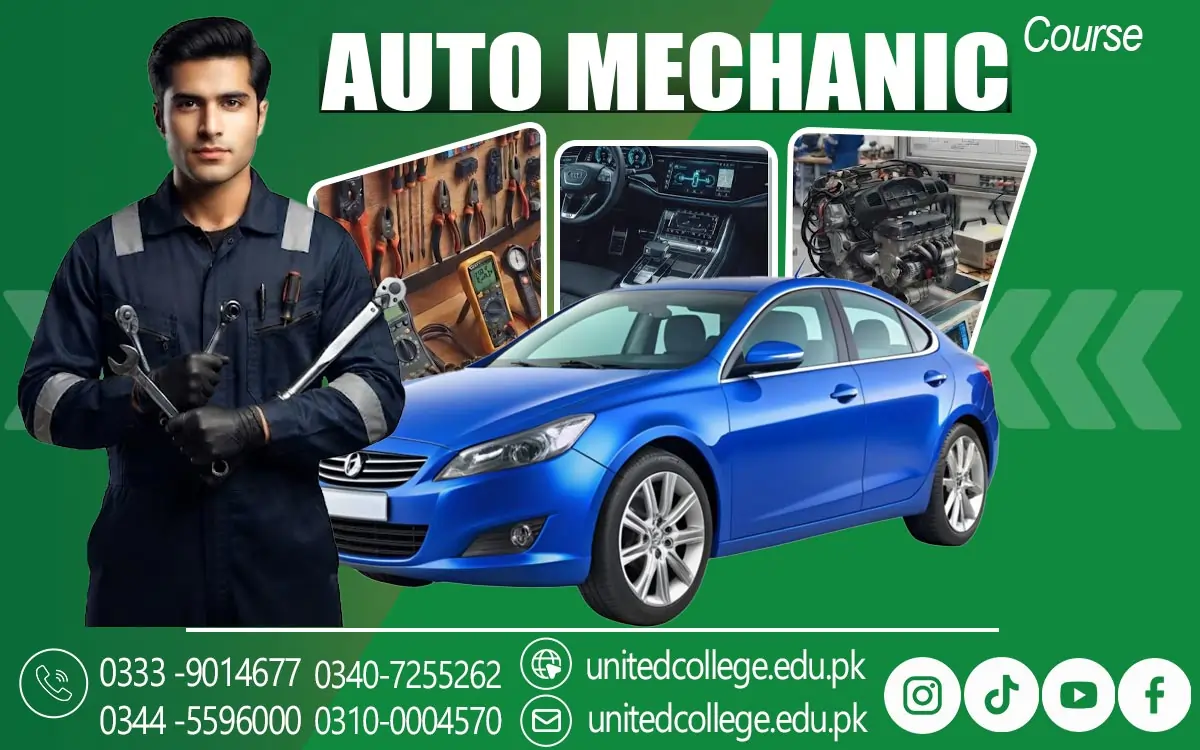

Auto Mechanic Course in Hafizabad – Gain Skills for Auto Repair
Turn Mechanical Interest Into Practical Career Skills
A car can stop working without warning, but finding the real reason behind the problem takes knowledge, observation, and practical ability. Someone who understands vehicles can look beyond a simple warning light or unusual sound and begin searching for the actual cause. For students and beginners in Hafizabad, learning automobile repair can turn an interest in cars into a useful technical skill.
The Auto Mechanic Course in Hafizabad offered by United College of Technology is designed to introduce learners to vehicle systems, servicing methods, repair work, and workshop practices in an easy and practical way. Rather than focusing only on classroom concepts, the learning journey can help students understand how automotive components work and how mechanics approach everyday vehicle problems.
Start With the Parts That Give a Car Its Strength
Before learning repairs, students need to understand what makes a vehicle function. An automobile contains several connected systems, and each one performs an important job. The engine creates power, the transmission transfers it, brakes control movement, while steering and suspension help the vehicle move safely. During the Auto Mechanic Course in Hafizabad, beginners can explore these systems and learn the basic purpose of their main components.
This foundation is important because a mechanic needs to understand the relationship between different parts rather than treating every component as an isolated object. A properly structured automobile repair course can make these concepts easier by connecting explanations with practical examples. This gives learners a starting point from which they can gradually develop their automotive repair skills.
Follow the Engine From Routine Service to Repair Work
Engine maintenance is one of the most important areas for anyone entering automotive repair. Students can learn how an engine operates and become familiar with components involved in its performance. Engine repair training can introduce areas such as lubrication, cooling, filters, belts, inspection, and routine servicing.
These activities may seem simple, but they teach students how regular maintenance can help identify problems at an early stage. As their knowledge develops, they can begin to understand the difference between ordinary servicing and situations that require more detailed inspection. This practical approach helps beginners build confidence without expecting them to master complicated repairs immediately.
Learn How Mechanics Read the Signs of a Fault
A vehicle often gives signs before a problem becomes serious. Difficult starting, unusual noises, poor acceleration, overheating, warning lights, or changes in handling can all provide useful information. Students can learn how to examine such symptoms and think about possible causes through vehicle troubleshooting. A car diagnostics course can introduce basic methods for checking a vehicle systematically instead of replacing parts based on assumptions.
Learners can practice identifying what needs to be inspected and how observations can guide the next step. Fault finding is not simply about discovering a damaged component; it is about understanding why the problem occurred and deciding what should be checked first. Developing this habit can strengthen logical thinking and make students more careful when approaching real workshop situations.
Understand the Systems That Keep the Vehicle Moving Safely
An Auto Mechanic Course in Hafizabad becomes more complete when students explore systems beyond the engine. Brakes, clutch, transmission, steering, and suspension all affect how a vehicle performs safely on the road. Learners can study the purpose of brake components and understand the basic principles involved in brake servicing.
The suspension system and steering system introduce students to components that influence stability, comfort, and control. These lessons develop broader mechanical repair skills and show beginners why a mechanic must inspect a vehicle as a complete machine. Understanding these areas also helps learners appreciate the importance of careful servicing when dealing with safety-related components.
Add Electrical Skills to the Modern Mechanic's Toolkit
Automotive repair is no longer limited to mechanical parts. Modern vehicles use electrical systems for starting, charging, lighting, ignition, sensors, and many other functions. Students can develop basic knowledge of automotive electrical systems and learn about components such as batteries, starters, alternators, fuses, and wiring. These concepts can be explained through simple practical examples.
Understanding this difference can help learners approach problems more intelligently. As automotive technology continues to develop, mechanics also need to become familiar with basic diagnostic thinking and newer vehicle systems. Adding electrical knowledge to mechanical training can therefore give learners a broader technical foundation.
Make Workshop Practice the Place Where Confidence Grows
Real understanding becomes stronger when students get the opportunity to apply what they learn. Practical mechanical training can introduce learners to common automotive tools, workshop equipment, inspection methods, and guided repair activities. Instead of only reading about a spanner, jack, measuring tool, or other workshop equipment, students can learn why and when such tools are used.
Hands-on practice can also teach learners to work in an organized manner, follow instructions, and handle vehicle components carefully. United College of Technology supports practical skill development by connecting technical learning with workshop-based activities. This kind of auto workshop training can be particularly useful for beginners because it allows them to gain familiarity with real tasks and gradually become more comfortable working around vehicles.
Build Professional Habits Before Stepping Into a Workshop
Technical ability is only one part of becoming a dependable mechanic. A professional must also know how to work safely and responsibly. Students can learn the importance of workshop safety, correct tool handling, proper working procedures, and keeping the workspace organized. These habits matter because automotive workshops contain heavy equipment, moving parts, electrical components, oils, and other materials that require care.
Training can also encourage students to inspect their work instead of assuming a task is complete as soon as a component is installed. Developing these habits early can improve accuracy and responsibility. With regular practice, learners can move from simply following instructions toward performing basic tasks with greater confidence and awareness.
Let Your First Technical Skill Become a Larger Career Journey
Automotive knowledge can support several directions as a learner gains experience. After training and further practical exposure, a person may explore work as an auto mechanic, automobile technician, workshop assistant, vehicle maintenance worker, car service technician, or auto repair technician. The Auto Mechanic Course in Hafizabad can provide a foundation in vehicle servicing, inspection, mechanical systems, electrical basics, diagnostics, and workshop practices.
United College of Technology offers this type of practical learning for people who want to develop useful automotive career skills. The field also requires continuous learning because vehicles are changing with newer electronics and diagnostic systems. For students and job seekers in Hafizabad, starting with practical training can be a sensible way to build skills, gain workshop experience, and prepare for continued growth as a professional auto mechanic.
Frequently Asked Questions (FAQs)
Automobile mechanics combines practical work with problem-solving. Learners can spend time understanding machines, examining vehicle components, and discovering how different parts contribute to the overall performance of a vehicle.
Training schedules can vary by institute. Students should check the available class timings and course structure to see whether they can manage the program alongside their existing educational or personal commitments.
Advanced mathematics is generally not the main focus of beginner-level mechanic training. Students mainly need basic practical understanding, careful observation, and the ability to follow measurements and instructions correctly.
Regular workshop practice is one of the best ways to improve. Working with experienced technicians, observing different vehicle problems, studying newer systems, and taking additional technical training can support continued development.
Beginners should avoid rushing, using tools incorrectly, skipping inspections, or attempting unfamiliar repairs without proper guidance. Careful work and following recommended procedures are important for developing reliable professional habits.
Yes. Knowledge of vehicle systems can be useful in maintenance-related workplaces, service centers, transport operations, and other settings where vehicles need regular inspection and care. Further experience can expand the range of possible work environments.
Admission Open: Start Your Professional Journey Today!
Join United College of Technology and build a career with practical training, recognized certifications, and Gulf job support. Seats are limited.
Apply Now via WhatsAppContact Information
- Address: Rawalpindi: F-272 Main New Katarian Stop, Old IJP Road | Lahore Campus: Lahore, Pakistan
- Phone/WhatsApp: 0333-9014677 / 0344-5596000 / 0310-0004570 / 0301-5044340 / 0340-7255262
- Website: unitedcollege.edu.pk
















Leave a Comment