


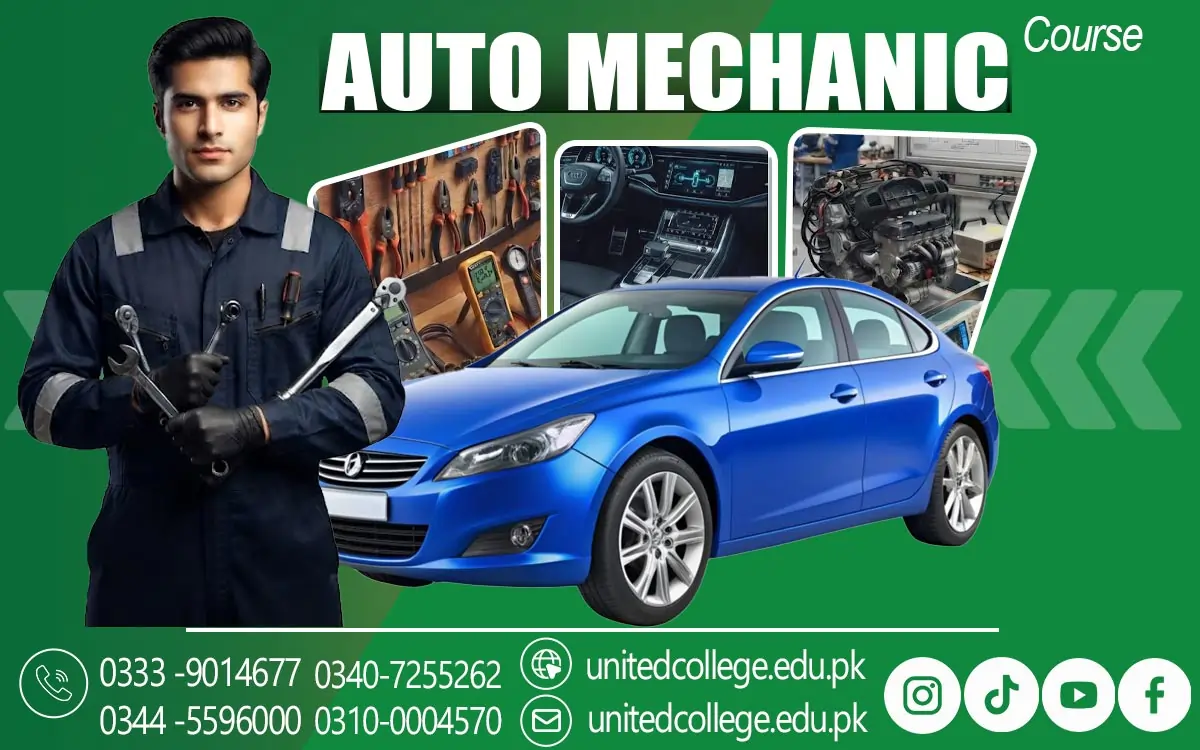

Auto Mechanic Course in Narowal – Learn Skills for a Better Career
Auto Mechanic Course in Narowal – Build Practical Automotive Skills
A car can look perfectly fine from the outside and still have a problem hidden under the bonnet. Maybe the engine is making an unusual sound, the brakes are not responding as they should, or the vehicle suddenly refuses to start. For someone who loves cars, learning how to understand and fix these problems can turn an interest into a valuable practical skill. The Auto Mechanic Course in Narowal offered by United College of Technology is designed for beginners, students, job seekers, and car enthusiasts who want to learn automobile repair.
The training can introduce learners to vehicle maintenance, engine repair, electrical systems, troubleshooting, workshop practices, and safe handling of tools. With proper practice and technical guidance, students can gradually develop the confidence needed to understand common vehicle problems and prepare for different opportunities in the automotive field.
Turn Your Interest in Cars Into a Real Technical Skill
Many people enjoy driving or learning about cars, but there is a big difference between using a vehicle and understanding how it works. When a car develops a problem, knowing what may be wrong can be extremely useful. An Auto Mechanic Course in Narowal can give beginners a structured way to develop this knowledge instead of learning only through trial and error. Students can become familiar with the main parts of a vehicle and understand how different systems work together.
Automobile mechanic training can cover areas such as engine maintenance, vehicle servicing, brakes, clutch systems, steering, suspension, electrical components, and basic troubleshooting. The purpose is not to make learners experts overnight but to give them a practical foundation that they can continue developing through experience. For someone looking for automotive career skills, this type of training can be a useful starting point for entering workshops, garages, service centers, or other vehicle-related workplaces.
Learn What Is Really Happening Inside a Car Engine
When an engine starts making a strange noise or the vehicle begins losing power, a mechanic needs to look beyond the symptoms and understand what may be happening inside the engine. The engine contains many parts that work together to produce the power needed to move the vehicle. Learning the purpose of these components can help beginners understand why regular maintenance and proper repair are important.
During a Car Mechanic Course, students can learn about common engine components, engine maintenance, and basic car engine repair practices. They can become familiar with common engine problems and understand how mechanics inspect different areas when diagnosing an issue. Rather than simply memorizing component names, practical mechanic training can help learners connect what they study with actual workshop tasks. This knowledge can become particularly useful as students gain more experience and start working with different vehicles and repair situations.
Keep Vehicles Running With Proper Maintenance and Servicing
A vehicle does not always need a major repair to require a mechanic's attention. Regular servicing can help identify problems before they become more difficult to handle. Simple tasks such as checking fluids, changing engine oil, inspecting components, and carrying out routine servicing are common parts of vehicle maintenance. A Vehicle Maintenance Course can help learners understand why these tasks matter and how they fit into the overall care of a vehicle. Students can learn about oil changes and vehicle servicing while becoming familiar with routine maintenance procedures.
Engine maintenance is also important because problems that are ignored for too long may affect the vehicle's performance. Through auto repair training, beginners can develop a better understanding of how mechanics inspect vehicles and identify areas that may need attention. This practical knowledge can be useful for anyone who wants to work in an auto workshop or provide vehicle maintenance services after gaining sufficient experience.
Understand Brakes, Clutch, Steering, and Suspension
Imagine driving a vehicle and suddenly noticing that the brakes feel different or the steering does not feel normal. These are situations where proper mechanical knowledge matters. A vehicle's braking, clutch, steering, and suspension systems all play important roles in its operation, and mechanics need to understand their basic functions when inspecting or repairing a vehicle. An auto mechanic course can introduce learners to these important systems and explain how common problems are identified. Students can develop knowledge related to brake system repair, clutch maintenance, steering components, and suspension and steering repair.
Practical learning can help beginners understand how mechanics inspect these areas and determine whether a component requires adjustment, maintenance, or repair. These skills are valuable because vehicle problems can vary from one situation to another. Learning the fundamentals gives students a stronger base from which they can continue developing their abilities through workshop experience and regular practice.
Discover the Electrical Problems Hidden in Modern Vehicles
Modern cars depend on more than mechanical parts. Electrical systems are also involved in starting the vehicle, lighting, charging, and operating various electrical components. When a car refuses to start, or an electrical feature stops working, the problem may require careful inspection rather than a simple replacement. During an Automobile Technician Course, learners can become familiar with basic car electrical systems and common electrical faults found in vehicles. They can learn how electrical components relate to the vehicle's overall operation and develop basic troubleshooting skills.
Understanding vehicle electrical systems can make an auto mechanic more versatile because many modern repair situations involve both mechanical and electrical knowledge. The Auto Mechanic Course in Narowal can help learners explore these areas alongside engine and maintenance training. As their knowledge grows, students can become better prepared to investigate different vehicle problems and understand when additional technical expertise may be required.
Learn to Troubleshoot Instead of Guessing
A customer may bring a car to a workshop and simply say, “The vehicle is not running properly.” The mechanic then has to investigate the problem instead of guessing. This is where vehicle troubleshooting becomes an important automotive skill. A good mechanic needs to observe symptoms, inspect relevant components, ask useful questions, and follow a logical process to identify the possible cause. Electrical repair training and mechanical troubleshooting practice can help learners develop this way of thinking.
During practical training, students can work through common vehicle problems and learn why careful inspection is important before starting repairs. United College of Technology can provide technical guidance and practical learning opportunities that help beginners connect classroom knowledge with workshop situations. With continued practice, learners can become more comfortable identifying problems and deciding what needs to be checked. Troubleshooting skills often become stronger through real experience, making workplace exposure an important part of an automotive career.
Get Comfortable With Tools and Workshop Practices
A mechanic spends a large part of the working day using tools, equipment, and workshop facilities. For a beginner, even common tools can take time to understand properly. Learning how to select, handle, and care for electrical tools and equipment and mechanical workshop tools is therefore an important part of practical mechanic training. Students can become familiar with the tools used for servicing, inspection, repair, and maintenance while learning the importance of keeping a workspace organized.
Proper workshop practices can make tasks easier and help reduce careless mistakes. Safety is equally important because mechanics work around moving parts, heavy components, fluids, electrical systems, and other potential hazards. The Auto Mechanic Course in Narowal can help learners develop awareness of workshop safety while building practical confidence. With repeated hands-on work, beginners can gradually become more comfortable using tools and performing common tasks under suitable guidance.
Build a Career Around Skills, Experience, and Hard Work
Learning automobile repair can lead to different career paths, but success in the automotive field depends on practical ability and continued improvement. After completing training and gaining workplace experience, learners may explore roles such as auto mechanic, automobile technician, car repair technician, vehicle maintenance technician, workshop assistant, or auto service technician. They may find opportunities in auto workshops, garages, service centers, construction or transport-related maintenance departments, businesses, and other workplaces that depend on vehicles. Some experienced mechanics may eventually choose independent work or start a small automobile repair business.
The Auto Mechanic Course in Narowal offered by United College of Technology can help beginners develop a foundation in engine maintenance, servicing, repair, troubleshooting, workshop practices, and automotive technician skills. Career growth takes time and depends on work quality, practical experience, communication, safety awareness, and continued learning. By improving these areas and gaining experience with different vehicles, a learner can gradually build a stronger and more practical automotive career in Pakistan.
Frequently Asked Questions (FAQs)
An Auto Mechanic Course in Narowal is designed to teach practical skills for maintaining, inspecting, troubleshooting, and repairing different types of vehicles.
Students, beginners, job seekers, and anyone interested in learning car repair and automotive technical skills can consider this type of course.
Training can cover engine maintenance, oil changes, vehicle servicing, brake repair, clutch systems, steering and suspension, car electrical systems, troubleshooting, and workshop practices.
Yes. A practical mechanic course can introduce beginners to automotive tools, vehicle components, common problems, and repair procedures step by step.
Depending on skills and experience, learners may work as an Auto Mechanic, Automobile Technician, Vehicle Maintenance Technician, Workshop Assistant, or Auto Service Technician.
Admission Open: Start Your Professional Journey Today!
Join United College of Technology and build a career with practical training, recognized certifications, and Gulf job support. Seats are limited.
Apply Now via WhatsAppContact Information
- Address: Rawalpindi: F-272 Main New Katarian Stop, Old IJP Road | Lahore Campus: Lahore, Pakistan
- Phone/WhatsApp: 0340-7255262 / 0333-9014677 / 0301-5044340 / 0310-0004570 / 051-8770756
- Website: unitedcollege.edu.pk
















Leave a Comment