


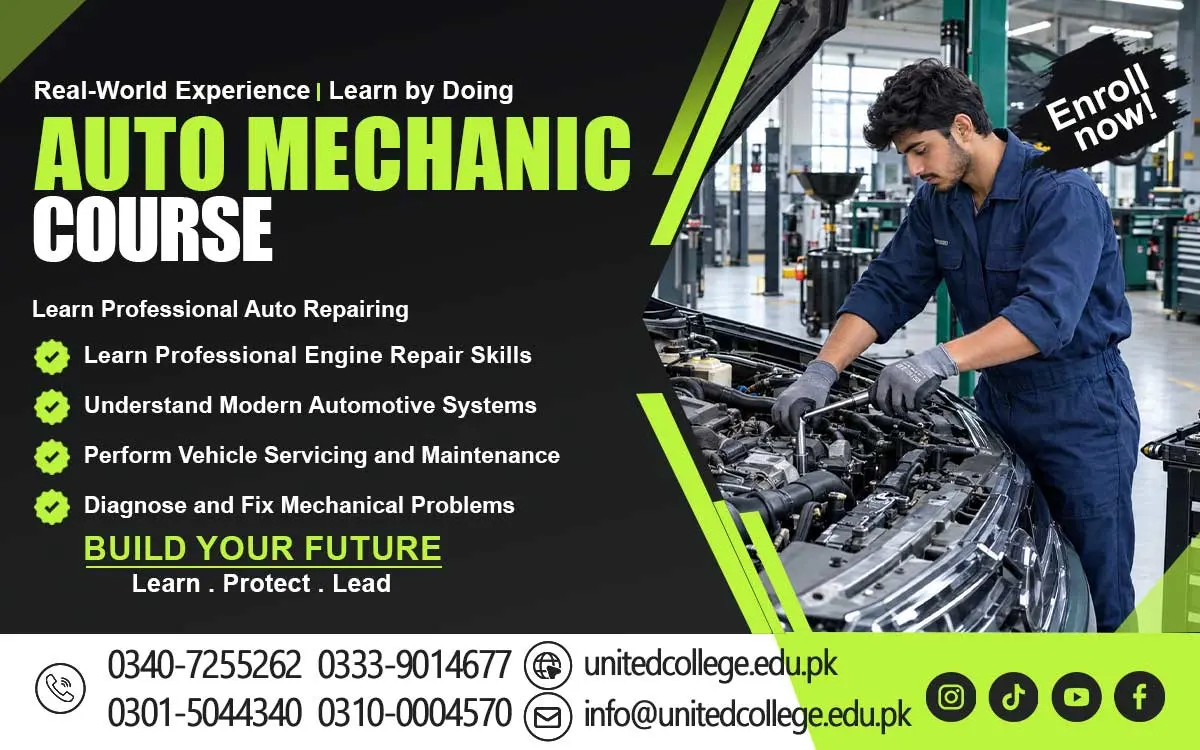

Auto Mechanic Course in Sawat – Learn Practical Repair Skills
When a Car Breaks Down, Skilled Auto Mechanics Make a Difference
Imagine driving along a road in Sawat when your car suddenly loses power, the engine starts making unusual noises, or the vehicle refuses to start. These problems can cause stress, especially when the nearest repair workshop is far away. In many cases, the vehicle needs someone who understands how its different systems work and can identify the actual cause of the fault. This is where trained auto mechanics become important. They inspect vehicles, identify mechanical problems, perform repairs, and help drivers maintain their cars in good condition. For students and beginners interested in technical work, learning automobile repair can be a practical way to develop useful skills.
The Auto Mechanic Course in Sawat provides a relevant learning path for people who want to understand vehicle maintenance, engine repair, and automotive troubleshooting. Through suitable technical training, learners can begin understanding how engines, brakes, steering systems, and electrical components operate. These skills are useful because vehicles require regular servicing as well as occasional repairs. A person who learns to recognize common faults and understand repair procedures can gradually develop confidence in workshop tasks. United College of Technology (UCT) offers technical education for learners interested in developing practical knowledge.
What Students Can Learn Through Automotive Repair Training
Have you ever wondered why one car starts immediately while another struggles to start, even when both vehicles appear to be in good condition? Understanding such differences requires knowledge of automotive systems and the ability to inspect components carefully. An automotive repair course introduces students to the main parts of a vehicle and explains how these components work together. During auto mechanic training in Sawat, learners can study engine operation, transmission systems, braking components, steering, suspension, and vehicle electrical systems. They can also learn about routine servicing, common mechanical faults, and the tools used for vehicle maintenance. Practical mechanical training is particularly important because reading about a repair is different from performing it.
For example, a student may learn how a battery supplies electrical power, but inspecting battery connections under supervision provides a clearer understanding of how electrical faults can affect starting. Similarly, studying engine components can help learners understand why regular oil changes and proper maintenance matter. The Auto Mechanic Course in Sawat is relevant to beginners who want to build a foundation before progressing to more advanced repair tasks. Students should aim to understand not only how to replace a faulty component but also how to identify the reason it failed. This problem-solving approach can reduce unnecessary part replacement and improve repair quality.
Understand Engine Components and Identify Common Mechanical Faults
A vehicle engine may look complicated when its bonnet is opened, but understanding its main components makes the system easier to learn. The engine produces the power needed to move a vehicle, and different parts work together to make this possible. Pistons move inside cylinders, while the crankshaft converts their movement into rotational force. Valves control the flow of air and exhaust gases, and the cooling system helps prevent excessive engine temperature. The lubrication system circulates engine oil to reduce friction between moving components. Through an automobile technician course, learners can study these parts and understand how they contribute to engine performance.
For example, an engine that overheats may have a cooling-system leak, a faulty thermostat, a damaged radiator, or another problem that requires proper inspection. Students learning automobile engine repair should therefore follow a logical diagnostic process instead of guessing. They can begin by observing the symptoms, checking available information, and understanding which components may be involved. Practical demonstrations can make these concepts easier to remember, while supervised exercises help learners become familiar with engine parts and maintenance procedures. The Auto Mechanic Course in Sawat can be a starting point for students who want to understand engine servicing and mechanical troubleshooting.
Learn Brake, Steering, Suspension, and Transmission Systems
A car may have a powerful engine, but it cannot operate safely without properly maintained brakes, steering, suspension, and transmission systems. Imagine pressing the brake pedal and noticing that the vehicle takes longer than usual to stop. Another driver may experience excessive bouncing over uneven roads or difficulty changing gears. These symptoms can indicate problems that need professional inspection. During automotive repair training, students can learn how these systems function and why their maintenance is essential. The braking system slows or stops the vehicle through components such as brake pads, discs, drums, and hydraulic parts, depending on the design.
The steering system allows drivers to control direction, while the suspension system helps maintain stability and absorb road impacts. Transmission and clutch systems transfer engine power to the wheels and support smooth changes in speed and driving conditions. A car mechanic course in Sawat can introduce students to these systems through theory, demonstrations, and supervised practical exercises. For example, learners may study signs of worn suspension components or understand why a slipping clutch needs inspection. They should also recognize that brake repairs and other safety-critical work demand correct procedures and careful testing.
Explore Vehicle Electrical Systems and Automotive Troubleshooting
A car that produces no sound when the key is turned can leave its driver wondering whether the battery, starter motor, or another component has failed. Electrical problems can be confusing because several different faults may produce similar symptoms. Learning basic vehicle electrical systems helps beginners understand how to investigate these problems systematically. A vehicle battery stores electrical energy and supplies power for starting and other electrical functions. The starter motor turns the engine during startup, while the alternator generally supplies electrical power and recharges the battery when the engine is running. Wiring, fuses, relays, switches, and connections also play important roles.
Through an automotive repair course, learners can study these components and understand common symptoms such as dim lights, repeated starting difficulties, blown fuses, or malfunctioning electrical accessories. Automotive diagnostic skills involve collecting information, inspecting relevant components, and testing possible causes rather than replacing parts without evidence. They should also understand electrical safety, especially when dealing with damaged wiring, high-current circuits, or modern vehicle systems. The Auto Mechanic Course in Sawat can provide a foundation for understanding these topics and preparing for further technical learning. As vehicle technology continues to develop, mechanics may need additional training in electronic control units, sensors, computerized diagnostics, and hybrid or electric vehicle systems.
Develop Practical Skills in Vehicle Inspection and Routine Maintenance
Regular vehicle maintenance can prevent some problems from becoming more serious and expensive. Consider a car owner who ignores an oil leak for several weeks. What begins as a small issue may eventually lead to insufficient lubrication and serious engine damage. This example shows why routine inspection is an important part of automotive maintenance. Students learning vehicle servicing can become familiar with checking engine oil, coolant levels, tyre condition, visible leaks, lights, and other maintenance items according to the vehicle manufacturer's recommendations. They can also learn about oil and filter replacement, air-filter inspection, battery checks, and scheduled servicing.
They may also practise using spanners, socket sets, screwdrivers, and pliers for appropriate tasks under supervision. Learning to select the correct tool is important because using the wrong size or applying excessive force can damage components. A vehicle inspection should be systematic, with attention given to both visible symptoms and the manufacturer's recommended maintenance schedule. Students should understand that preventive maintenance does not eliminate every possible fault, but it can help identify developing problems early. The Auto Mechanic Course in Sawat is relevant to beginners who want to learn these essential servicing skills. With consistent practice, careful observation, and feedback from experienced instructors, learners can improve their ability to carry out basic maintenance tasks responsibly.
Use Workshop Tools Correctly and Follow Safe Repair Procedures
Working inside an automotive workshop requires more than knowing which component needs repair. A mechanic must also understand how to use tools correctly, protect themselves from hazards, and prevent damage to the vehicle. Imagine a car raised on a jack while someone works underneath it without suitable support. This creates a serious risk because a jack alone should not be relied upon to support a vehicle during underbody repairs. Safe workshop practices begin with understanding the correct equipment and following established procedures. Students can become familiar with hand tools, torque wrenches, multimeters, tyre-pressure gauges, and diagnostic scanners.
Before beginning work, the vehicle should be secured appropriately, the engine should be switched off when required, and relevant safety instructions should be followed. Special care is necessary when handling air-conditioning refrigerants, high-voltage systems, or pressurized components. These jobs may require specific qualifications, equipment, and additional training. Through an automotive repair course, beginners can develop an understanding of responsible workshop behaviour alongside their technical knowledge. The Auto Mechanic Course in Sawat can help learners recognize why careful inspection, correct tool selection, and proper repair procedures are essential parts of automotive work.
Build Technical Knowledge Through United College of Technology
Choosing a suitable training path is an important step for anyone who wants to learn a practical trade. Beginners often have questions about where to start, which mechanical concepts to study first, and how to gain confidence with unfamiliar tools. United College of Technology (UCT) provides technical education for people interested in developing practical knowledge and exploring skill-based learning. For students considering the Auto Mechanic Course in Sawat, understanding the importance of structured instruction and practical experience can help them make informed decisions about their learning journey. Automotive education generally involves studying vehicle components, learning maintenance procedures, recognizing common faults, and understanding the correct use of tools.
Students should ask relevant questions, follow safety instructions, practise suitable tasks, and learn from corrections. They should also understand that becoming a competent mechanic takes time because different vehicles use different engine designs, electrical systems, and diagnostic methods. When exploring a course offered by UCT, prospective students should confirm current details about the syllabus, practical training arrangements, duration, fees, and admission requirements directly with the institution. This helps them understand what the course includes before enrolling. An effective learning approach combines theoretical knowledge with supervised practice, regular revision, and responsible workshop habits.
Explore Automotive Career Paths and Continue Improving Your Skills
Learning automobile repair can open several possible directions for further skill development, although actual opportunities depend on experience, technical ability, location, and employer requirements. Someone who enjoys diagnosing mechanical faults may eventually seek work in a vehicle repair workshop, while another learner may prefer routine servicing at a maintenance centre. With suitable experience and additional training, some mechanics progress toward specialized work involving engine repair, automotive electrical systems, computerized diagnostics, or particular vehicle types. Others may explore self-employment after developing sufficient practical ability, understanding business costs, and learning how to manage customers responsibly.
The Auto Mechanic Course in Sawat can serve as an initial step for people who want to explore these possibilities. However, completing a course does not automatically guarantee employment or establish expertise in every type of vehicle repair. Employers and customers generally value practical competence, honesty, reliability, safe working habits, and the ability to identify faults accurately. New learners should therefore focus on mastering basic tasks before attempting complicated repairs independently. Keeping notes about different vehicle systems, reviewing service manuals, learning from experienced mechanics, and practising under supervision can support steady improvement.
Frequently Asked Questions (FAQs)
The Auto Mechanic Course in Sawat is a technical training program designed to help students understand vehicle maintenance, engine repair, automotive systems, and common mechanical problems.
Students can learn about engine components, brake systems, steering, suspension, vehicle electrical systems, routine servicing, and automotive troubleshooting.
Beginners, students, fresh learners, and individuals interested in automotive repair can explore this course. Contact United College of Technology (UCT) to confirm the current admission requirements.
Practical training is important for learning automotive repair. Students should confirm the available hands-on activities and workshop training arrangements with United College of Technology (UCT).
The course may introduce learners to engine components, common engine faults, maintenance procedures, and repair techniques. Advanced engine repairs require additional practice and suitable supervision.
Admission Open: Start Your Professional Journey Today!
Join United College of Technology and build a career with practical training, recognized certifications, and Gulf job support. Seats are limited.
Apply Now via WhatsAppContact Information
- Address: Rawalpindi: F-272 Main New Katarian Stop, Old IJP Road | Lahore Campus: Lahore, Pakistan
- Phone/WhatsApp: 0340-7255262 / 0333-9014677 / 0301-5044340 / 0310-0004570 / 051-8770756
- Website: unitedcollege.edu.pk
















Leave a Comment