


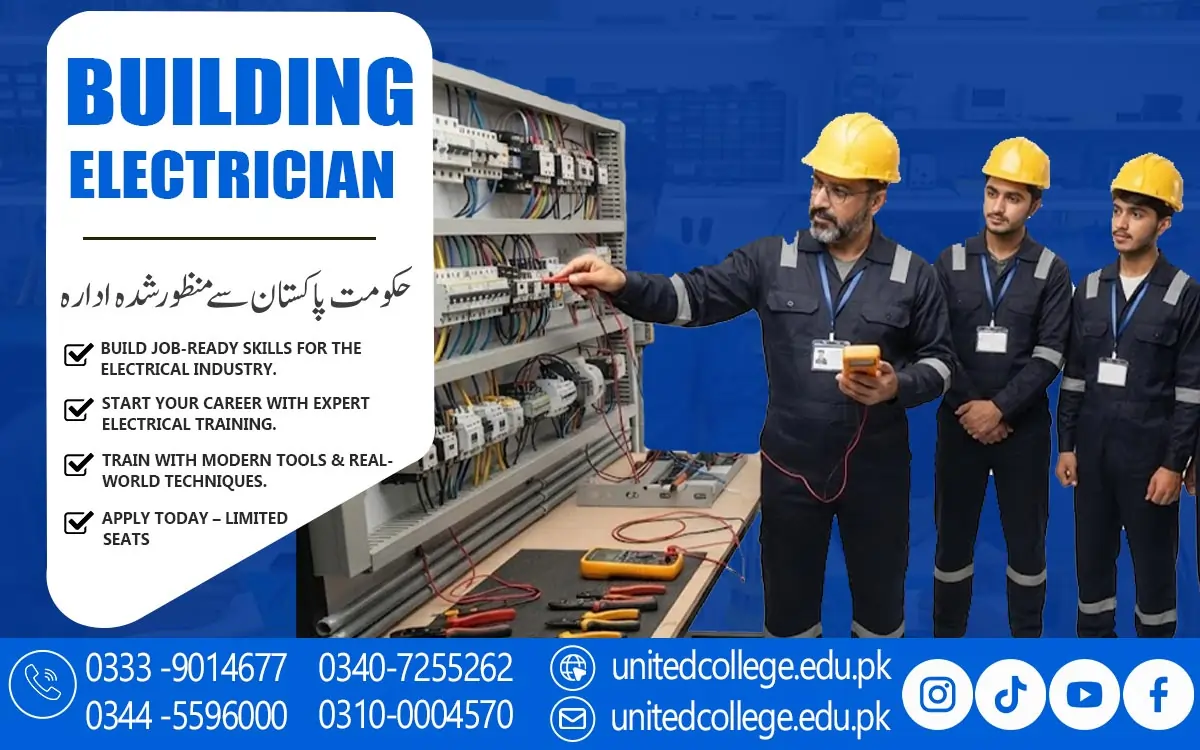

Building Electrician Course in Bagh AJK: Start Your Skill Journey
Turn Wiring Skills Into a Practical Career
Electricity is part of almost every modern building, but behind every working light, socket, fan, and electrical system is someone who knows how to install and maintain it safely. From houses and shops to offices, schools, workshops, and construction projects, skilled electricians are needed to make electrical systems work properly. This makes practical electrical knowledge a valuable skill for people who want to enter a technical field. The Building Electrician Course in Bagh AJK gives beginners an opportunity to learn the basic and practical skills needed for building electrical work.
Instead of depending only on theoretical information, students can develop an understanding of wiring, installation, tools, circuits, safety, and troubleshooting. For students, job seekers, beginners, and individuals interested in technical work, this type of vocational electrical course can provide a useful foundation for starting a career in the electrical field.
The Work Behind Every Working Light and Socket
A building electrician does much more than simply connect wires. Their work begins with understanding how an electrical system should be arranged inside a building and continues through installation, checking, maintenance, and fault identification. An electrician may install cables, switches, sockets, lighting points, fans, distribution boards, and other electrical components according to the requirements of a building.
Through a Building Electrician Course in Bagh AJK, learners can become familiar with the type of work performed on actual building projects. This understanding helps students see how electrical installation works as a complete system rather than treating every wire or component as a separate task. Learning these practical details can make it easier for beginners to develop confidence before entering professional work.
From House Wiring Basics to Complete Electrical Installations
One of the most important parts of building electrician training is learning how wiring is planned and installed. House wiring may involve connecting lighting points, switches, sockets, fans, and other electrical loads through properly arranged circuits. Students can learn about different types of cables, connections, electrical accessories, and the purpose of individual components.
The training can also introduce learners to distribution boards and the basic way circuits are organized and protected. As students progress, they can develop an understanding of residential wiring and the requirements that can differ in larger buildings. Learning electrical installation and maintenance gives students a broader view of building electrical work because installation is only one part of an electrician's responsibility.
Small Tools, Real Practice, and Skills You Can Actually Use
Electrical work becomes much easier to understand when students can see and handle the tools used by electricians. A practical program should give learners opportunities to become familiar with common electrical tools and equipment and understand how each tool is used for a specific purpose. Students can practice basic connections, cable preparation, switch and socket installation, wiring arrangements, and other tasks under appropriate supervision.
This kind of hands-on electrical training helps connect classroom concepts with practical work. Instead of simply remembering the names of electrical components, learners can understand where and why they are used. Repeated practice can also help students improve their accuracy and develop better working habits. The aim is not to make beginners experts overnight but to give them a practical foundation that they can continue improving through experience.
Safety Is the Skill That Comes Before Every Connection
Working with electricity requires responsibility because an incorrect connection or unsafe procedure can create serious risks. That is why electrical safety training should be an important part of professional electrician training. Students need to understand safe working practices, the importance of switching off power before suitable work, proper handling of tools, and the need to identify electrical hazards.
A good Building Electrician Course in Bagh AJK should therefore help learners develop safety awareness alongside technical knowledge. This combination can help students understand that successful electrical work means completing a task correctly while also protecting themselves, other workers, and the people who will use the building.
Residential Projects Teach the Basics, Commercial Work Expands the Picture
Once learners understand basic wiring and installation, they can begin to see how electrical requirements change from one building to another. A small home may have a simpler electrical arrangement, while shops, offices, workshops, and other commercial spaces can involve more circuits, equipment, lighting points, and maintenance requirements. Exposure to both residential and commercial electrical wiring can help students understand these differences.
Training can introduce learners to wiring and troubleshooting, allowing them to think about what might cause a light, socket, or circuit to stop working and how an electrician approaches the problem. This does not mean every trainee will immediately handle complex faults independently. Rather, it builds the foundation for developing electrical technician skills through practice and future field experience.
Choosing Training That Gives More Than a Certificate
A certificate can show that a learner completed a course, but practical ability is what becomes useful when facing real electrical tasks. Anyone searching for an Electrical Installation Course in Bagh AJK should therefore look beyond the name of the program and consider what students actually get to learn and practice. Important areas include wiring techniques, electrical components, tool handling, safety procedures, installation methods, basic troubleshooting, and maintenance practices.
Learners should also consider whether the training is suitable for beginners and whether practical exercises are included rather than relying completely on classroom theory. United College of Technology offers skill-focused technical training designed to help learners gain practical knowledge in vocational fields. For students interested in electrical work, the training environment can provide a structured way to learn essential concepts and practice relevant tasks.
A Practical Skill Can Open More Than One Working Path
Learning electrical work can provide several possible directions for future development. After gaining suitable training and experience, a learner may look toward construction projects, electrical installation work, residential wiring, commercial projects, building maintenance, or other technical roles where electrical skills are required. Some people may eventually prefer working with an electrical contractor, while others may build enough experience to explore self-employment or independent service work where appropriate.
The path will depend on a person's practical ability, experience, further training, and local opportunities. What matters is that electrical training gives learners a skill they can continue developing instead of depending only on academic qualifications. In Pakistan, practical trades remain relevant wherever buildings need installation and maintenance. A Building Electrician Course in Bagh AJK can therefore be a useful starting point for someone who wants to develop a trade, gain field experience, and work toward becoming a skilled electrician.
Start With the Skill You Can Keep Building
A career in electrical work is developed step by step. First comes the understanding of basic electrical concepts, followed by practice with tools, wiring, installations, safety procedures, and troubleshooting. With continued practice and real-world experience, these foundations can become stronger electrical maintenance skills and more advanced technical abilities.
The goal of joining a Building Electrician Course in Bagh AJK is not simply to complete a classroom program but to begin developing a useful trade that can grow with experience. For anyone in Bagh AJK who wants to learn building electrical work, practical training can be the first step toward understanding how electrical systems are installed, maintained, and repaired.
Frequently Asked Questions (FAQs)
Yes. Beginners can start with basic electrical concepts and gradually understand more practical building-related tasks through structured training.
Training can help learners recognize basic wiring problems and understand the correct approach to checking connections and circuits safely.
Yes. Students can become familiar with commonly used components and learn how their functions fit into a building's electrical system.
Yes. Electrical knowledge can complement construction-related skills because modern construction projects require properly planned electrical systems.
Patience, attention to detail, willingness to practice, and respect for safety are important qualities for anyone developing technical electrical skills.
Absolutely. Field experience, advanced training, and regular practice can help learners expand their abilities and handle more demanding electrical tasks over time.
Admission Open: Start Your Professional Journey Today!
Join United College of Technology and build a career with practical training, recognized certifications, and Gulf job support. Seats are limited.
Apply Now via WhatsAppContact Information
- Address: Rawalpindi: F-272 Main New Katarian Stop, Old IJP Road | Lahore Campus: Lahore, Pakistan
- Phone/WhatsApp: 0340-7255262 / 0333-9014677 / 0301-5044340 / 0310-0004570 / 051-8770756
- Website: unitedcollege.edu.pk
















Leave a Comment