


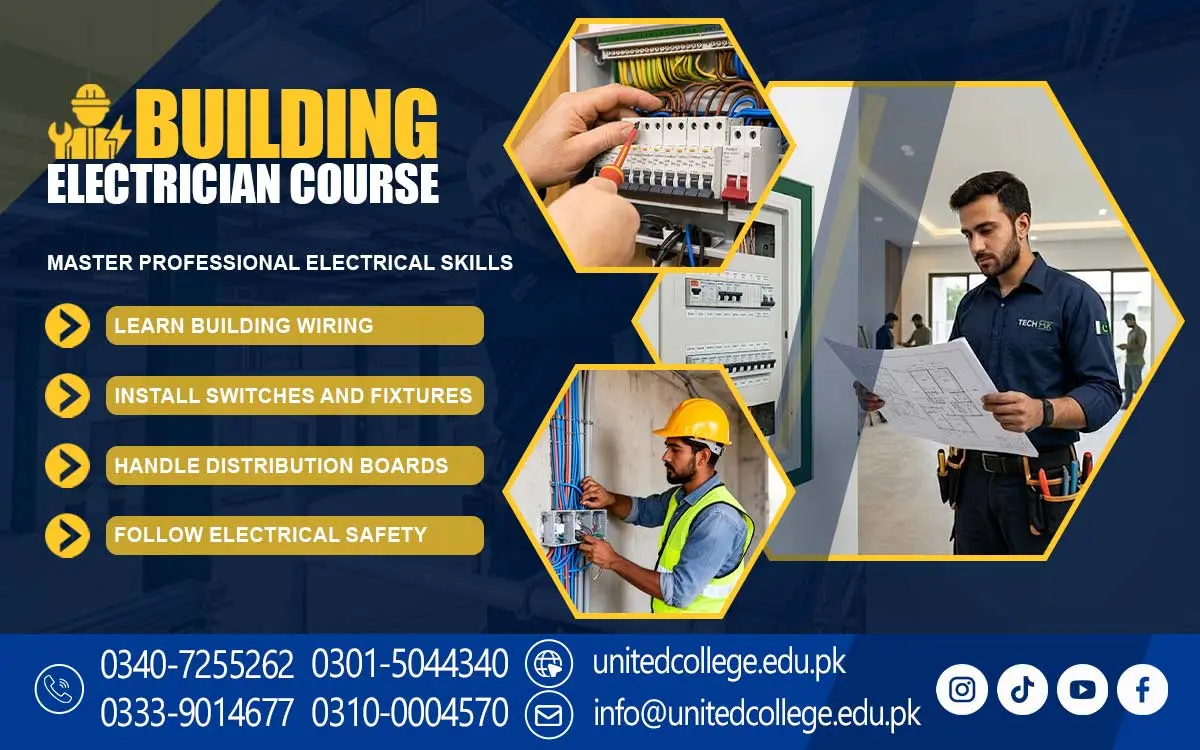

Building Electrician Course in Balakot – Learn Practical Skills
Why Building Electrical Problems Require Skilled Electricians
Electrical problems may appear small at first, but ignoring them can lead to equipment damage, power interruptions, or electrical fires. For example, a loose connection inside a switchboard can cause overheating, while damaged insulation may expose wires and increase the risk of electric shock. In some buildings, poorly planned wiring can also make it difficult to operate multiple appliances safely. A trained electrician understands how to recognize these problems and determine the appropriate solution. Through a Building Electrician Course in Balakot, learners can begin understanding common electrical faults and the importance of correct installation methods.
They can learn why electrical connections must be secure, why wires need suitable insulation, and why protective devices are important in a building. This knowledge is useful for anyone interested in residential electrical wiring or commercial electrical installation. Students also need to understand that electrical faults should never be handled carelessly, especially when the source of a problem is unknown. Learning under qualified supervision helps beginners develop safe habits before attempting practical tasks. By understanding the reasons behind common electrical problems, learners can appreciate the value of proper training and the responsibilities that come with working on building electrical systems.
How Building Electricians Keep Homes and Commercial Buildings Working
A building electrician does much more than connect wires or replace a damaged switch. Their responsibilities may include installing lighting systems, connecting sockets, arranging electrical cables, maintaining distribution boards, and checking whether electrical equipment operates correctly. In residential buildings, electricians help provide power for lights, fans, kitchen appliances, water pumps, and other household equipment. In offices, shops, and commercial spaces, they may work with larger lighting arrangements, electrical panels, and systems designed for different equipment requirements. The Building Electrician Course helps learners understand these responsibilities and develop knowledge of building electrical systems.
During an electrician course in Balakot, beginners can develop an understanding of these responsibilities and learn how electrical systems are arranged in different settings. They can also explore the relationship between building plans and electrical installation work. For example, a lighting point must be positioned appropriately, and a socket must be installed where it is practical and safe to use. Electricians may work alongside construction workers, supervisors, and other technicians to complete projects. Good communication, attention to detail, and the ability to follow instructions are therefore important.
Learn House Wiring and Electrical Installation Through Practical Skills
House wiring is an important part of building electrician training because it provides the connections needed to distribute electricity throughout a property. A typical installation may include switches, sockets, lighting points, protective devices, and wiring routes that connect different parts of the building. Before installation begins, an electrician must understand the layout and determine how the electrical components will be arranged. Incorrect connections or unsuitable materials can create problems later, so each stage requires careful attention. A house wiring course introduces learners to the purpose of common components and the principles behind electrical installation.
For example, students may learn how a switch controls a light, how a socket supplies power to an appliance, and why electrical cables must have suitable ratings for their intended use. They can also learn about the importance of neat cable routing and properly fitted electrical accessories. The Building Electrician Course in Balakot can be relevant to beginners who want to explore these practical skills and understand how electrical systems are installed in residential buildings. Practical activities should be completed with suitable equipment and qualified supervision. Learners must not experiment with live electrical connections.
Understand Electrical Tools and Equipment Before Starting Any Job
Using the wrong tool can damage electrical components, waste time, and increase the risk of injury. Building electricians work with different tools depending on the task, the materials involved, and the type of installation. Common examples include insulated screwdrivers, wire strippers, cable cutters, pliers, measuring tapes, and suitable electrical testing instruments. Each tool has a specific purpose. Wire strippers, for instance, help remove insulation without unnecessarily damaging the conductor, while screwdrivers are used to tighten or loosen compatible screws. Measuring tools help workers check dimensions and plan cable routes accurately.
During electrical installation training, beginners should learn how to identify tools, understand their limitations, and inspect them before use. A damaged handle, worn insulation, or unsuitable testing instrument should never be ignored. Learners also need to understand that insulated tools do not make every electrical task safe, especially when working near energized equipment. The Building Electrician Course in Balakot is a useful topic for students exploring technical education because it highlights the importance of practical familiarity with electrical tools and equipment.
Read Wiring Diagrams and Understand Circuit Breakers
Imagine an electrician arriving at a building where several lights are not working, but the reason for the problem is unclear. Instead of checking random wires, the electrician needs a systematic way to understand the electrical arrangement. Wiring diagrams help show how components are connected, while circuit diagrams explain the relationships between electrical parts. Learning to interpret these diagrams can help beginners understand where switches, lighting points, protective devices, and other components fit into a system. Another important component is the distribution board, which organizes electrical circuits and contains protective devices for different parts of a building.
Circuit breakers are designed to interrupt current when certain fault conditions occur, while fuses provide protection by breaking the circuit when their rated operating conditions are exceeded. These devices must be correctly selected and installed according to the electrical system's requirements. Through building electrician training in Balakot, learners can explore how electrical circuits are arranged and why protective equipment matters. They should also learn that a breaker that repeatedly trips may indicate an overload, a short circuit, or another fault that requires proper investigation. Resetting it repeatedly without identifying the cause is not a safe solution.
Identify Electrical Faults and Learn the Right Maintenance Methods
However, similar symptoms may have different causes, so an electrician should not assume that every fault has the same solution. A loose connection, damaged cable, overloaded circuit, faulty accessory, or defective appliance may contribute to a problem. Electrical fault finding involves collecting information, checking the symptoms, reviewing the circuit arrangement, and using suitable testing methods to identify the cause. Routine electrical maintenance also helps identify signs of deterioration before they become more serious. For example, unusual heat, visible damage, burning smells, or repeated interruptions should be treated as warning signs that require appropriate attention.
In an electrical maintenance training environment, learners can study common faults and understand why systematic inspection is more effective than guesswork. The Building Electrician Course in Balakot is relevant to those who want to develop an understanding of troubleshooting and maintenance responsibilities. Beginners should know their limits and avoid opening electrical panels or testing energized circuits without the necessary competence and supervision. Electrical systems must be isolated safely before work whenever required, and isolation must be verified using appropriate procedures.
Follow Electrical Safety Procedures to Prevent Accidents
Electrical safety is essential whenever a person works with wiring, switches, sockets, distribution boards, or electrical equipment. Even a simple task can become dangerous if the power supply is not isolated correctly or the worker does not understand the risks. Electric shock, burns, electrical fires, and injuries caused by faulty equipment are among the hazards that proper safety procedures aim to prevent. Learners should understand the importance of switching off and isolating the relevant supply, securing it against accidental reconnection, and verifying that the circuit is de-energized with an appropriate tester before beginning work.
However, protective equipment does not replace safe isolation or correct working methods. Students also need to learn about damaged cables, wet working conditions, overloaded sockets, and the importance of keeping work areas organized. During professional electrician training, safety should be treated as a normal part of every activity rather than an optional extra. United College of Technology (UCT) is the training provider for the Building Electrician Course in Balakot, and learners considering this option should confirm the practical safety arrangements and supervised training available.
Develop Practical Electrical Skills Through Structured Training at UCT
Reading about electricity is helpful, but practical learning allows students to connect technical concepts with real tasks. A beginner may understand what a switch does but still need guided practice to recognize its components, follow a wiring diagram, and understand the precautions required before installation. Structured training can help learners approach these tasks step by step instead of attempting unfamiliar work without guidance. The Building Electrician Course in Balakot, offered by United College of Technology (UCT), is relevant to people who want to explore building electrical work as a technical skill.
Before enrolling, prospective students should confirm the current course outline, available practical facilities, duration, fees, and admission requirements directly with the college. Useful learning activities may include identifying electrical accessories, understanding basic circuits, studying wiring diagrams, and becoming familiar with tools and safety procedures. The amount of practical work and the specific skills covered depend on the actual course arrangements, so these details should be verified rather than assumed. Students can make better progress by asking questions, following instructions, reviewing mistakes, and practicing under qualified supervision.
Explore Where Building Electrician Skills Can Be Used
Building electrician skills can be relevant in several working environments, including residential construction, commercial buildings, property maintenance, renovation projects, and electrical service businesses. New construction projects may require electricians to install wiring routes, lighting points, sockets, and distribution equipment according to approved plans. Existing buildings may need maintenance, replacement of damaged accessories, or investigation of recurring electrical problems. Some workers develop their experience by assisting qualified electricians, while others pursue further technical training before taking on more demanding responsibilities.
The type of work a person can perform depends on their competence, practical experience, employer requirements, and any applicable licensing or regulatory rules. Completing a course does not automatically guarantee employment or authorize someone to perform every kind of electrical work. For learners in Balakot, building electrician training can be a starting point for understanding the trade and deciding whether to pursue additional learning. The Building Electrician Course in Balakot offered by United College of Technology may be worth exploring for those interested in developing technical knowledge related to building electrical systems.
Frequently Asked Questions (FAQs)
The Building Electrician Course in Balakot helps learners understand electrical wiring, lighting installation, switches, sockets, electrical maintenance, and safety procedures.
United College of Technology (UCT) is the training provider associated with this course. Contact the institute to confirm current course details and availability.
Yes, building electrician training can be suitable for beginners who want to learn electrical concepts and develop practical skills under qualified supervision.
Students may learn about house wiring, electrical tools, wiring diagrams, circuit breakers, electrical fault finding, and safe installation practices, depending on the course curriculum.
Electrical safety helps prevent electric shocks, burns, fires, and equipment damage. Electricians must follow proper isolation procedures and applicable safety standards.
Admission Open: Start Your Professional Journey Today!
Join United College of Technology and build a career with practical training, recognized certifications, and Gulf job support. Seats are limited.
Apply Now via WhatsAppContact Information
- Address: Rawalpindi: F-272 Main New Katarian Stop, Old IJP Road | Lahore Campus: Lahore, Pakistan
- Phone/WhatsApp: 0340-7255262 / 0333-9014677 / 0301-5044340 / 0310-0004570 / 051-8770756
- Website: unitedcollege.edu.pk
















Leave a Comment