


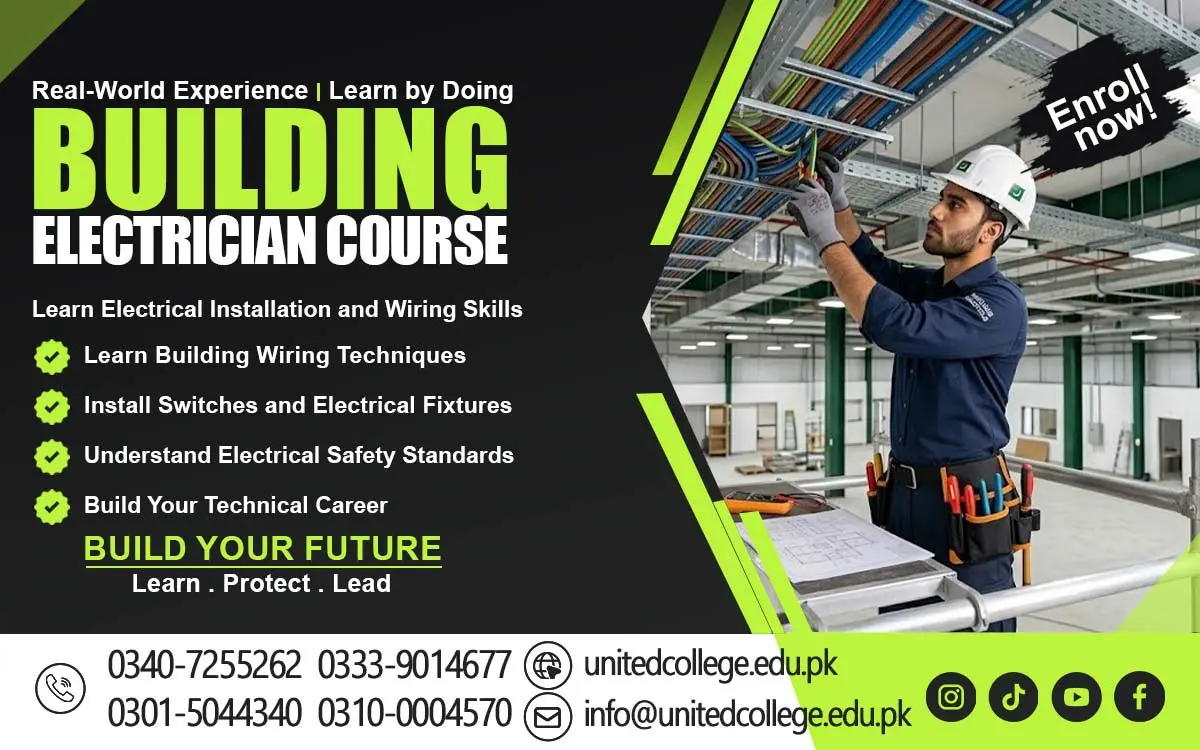

Building Electrician Course in Kohat – Practical Skills Training
When a Small Electrical Fault Becomes a Serious Problem
Imagine switching on a room light and noticing that it does not work, or plugging in an appliance and finding that the circuit breaker keeps tripping. These problems may seem small, but they can indicate faulty wiring, damaged electrical components, or unsafe connections. Buildings depend on reliable electrical systems for lighting, appliances, ventilation, and everyday activities. When something goes wrong, a trained electrician needs to understand the possible causes and follow safe procedures to identify the problem. The Building Electrician Course in Kohat, offered by United College of Technology (UCT), is relevant to learners who want to develop practical knowledge of building electrical systems and installation work.
This type of training introduces students to electrical wiring, switches, sockets, lighting systems, circuit breakers, and basic maintenance practices. Beginners can gradually learn how electrical components work together and why correct installation matters in residential and commercial buildings. Building electrician training in Kohat can be a useful starting point for students, fresh learners, and job seekers interested in technical skills. Rather than relying on guesswork, learners can develop a better understanding of electrical faults, proper tool handling, and workplace safety. These skills require patience, regular practice, and guidance from qualified instructors.
How Electrical Wiring Connects Every Part of a Building
Behind every working light, ceiling fan, socket, and electrical appliance is a system designed to distribute electricity safely throughout a building. Electrical cables carry current from the supply to different circuits, while switches control lights and other compatible devices. Sockets provide connection points for appliances, and circuit breakers help protect electrical circuits when certain faults or overload conditions occur. These components are usually arranged through a distribution board, which separates the electrical supply into individual circuits. During the Building Electrician Course in Kohat, offered by United College of Technology (UCT), learners can explore the purpose of these components and understand how they work together in houses, shops, offices, and other properties.
For example, a kitchen may require circuits suitable for its appliances, while bedrooms and living rooms need appropriate lighting and socket arrangements. The correct design depends on the building, connected loads, applicable electrical standards, and the requirements of qualified professionals. Students can also learn to recognize wiring diagrams, which use symbols and lines to show electrical connections before installation begins. Understanding these diagrams helps learners follow a planned arrangement instead of making random connections. Building electrical installations involves more than connecting wires; it requires suitable materials, careful planning, proper protection, and inspection.
Practical Wiring Skills That Help Beginners Learn Electrical Work
An electrical wiring course can introduce learners to measuring cable routes, identifying suitable tools, understanding wiring diagrams, and recognizing the purpose of different electrical accessories. Students may learn how switches, sockets, lighting points, and distribution boards are arranged in a planned installation. For example, installing a light point involves understanding its position, the required wiring arrangement, and the appropriate protective measures. Learners also need to understand cable identification, correct termination methods, and the importance of using components that meet the requirements of the installation.
Each area may have different electrical demands and safety considerations, so the same arrangement should not be used without checking its suitability. Under qualified supervision, practical exercises can help beginners develop hand skills, follow instructions, and become familiar with common installation procedures. Students can also practice reading simple wiring diagrams and matching electrical symbols with actual components. Mistakes during supervised practice can become valuable learning opportunities when instructors explain what went wrong and how to prevent similar errors. The purpose is not to encourage beginners to perform independent electrical work before they are ready.
Why Electrical Safety Must Come Before Every Installation Task
Electricity can cause severe injuries, fires, and property damage when electrical systems are installed or maintained incorrectly. A damaged cable, overloaded circuit, exposed conductor, or loose connection can create hazards that may not be obvious at first glance. For this reason, electrical safety training is an essential part of learning building electrician skills. Students need to understand that electrical work must begin with proper planning and risk assessment, not simply picking up a tool and starting a repair. A key safety measure is isolating the relevant electrical supply and verifying that the circuit is de-energized using an appropriate testing method. Turning off a wall switch alone does not make electrical wiring safe to handle.
Learners should also understand the purpose of suitable protective equipment, insulated tools, warning signs, and safe working procedures. During training, instructors can explain the risks associated with wet environments, damaged insulation, exposed connections, and unsuitable electrical accessories. Another important subject is circuit protection. Students should learn why damaged equipment must be reported and why a circuit breaker that trips repeatedly should never be bypassed. Electrical work should comply with applicable standards and be completed by appropriately qualified people. The Building Electrician Course in Kohat can provide a starting point for understanding these responsibilities. Developing safe habits early helps learners appreciate that protecting people and property is more important than completing a task quickly.
Identifying Electrical Faults Without Guessing the Cause
A light that suddenly stops working does not always have the same cause. The problem might involve a failed lamp, a defective switch, a loose connection, a damaged cable, or an issue elsewhere in the circuit. Similarly, a circuit breaker that trips repeatedly may indicate an overload, a short circuit, an earth fault, or another condition requiring professional investigation. Electrical troubleshooting is the process of identifying a fault through a systematic inspection and appropriate testing rather than replacing components without understanding the problem. During building electrician training, learners can study common electrical faults and explore how trained technicians approach diagnosis.
Students may also be introduced to testing instruments used to check electrical conditions, with their use limited to tasks appropriate to the learner's training and supervision. A multimeter, for example, can measure selected electrical quantities when used correctly, but incorrect settings or handling can create serious hazards. Beginners should not open energized equipment or investigate dangerous faults independently. If a circuit breaker continues to trip, a socket shows signs of burning, or a wire appears damaged, the affected circuit should be treated as potentially unsafe and assessed by a qualified electrician. Learning electrical fault detection helps students understand the importance of gathering evidence, following a logical process, and recognizing when specialist assistance is necessary.
Choosing and Using the Right Electrical Tools and Equipment
Electrical work requires suitable tools because the wrong equipment can damage components, produce unreliable results, or increase the risk of injury. Beginners studying building electrical installation can become familiar with common tools such as insulated screwdrivers, pliers, wire strippers, measuring tapes, and appropriate electrical testing instruments. Each tool has a particular purpose. Wire strippers help remove insulation without unnecessarily damaging the conductor, while pliers assist with gripping and handling suitable materials. Measuring tapes help learners mark positions and estimate cable routes, and insulated screwdrivers are designed for certain electrical tasks when used within their specified ratings and limitations.
A multimeter can measure voltage, resistance, and current under appropriate conditions, although each measurement requires the correct setting, connection method, and safety precautions. Students should also learn that a tool's appearance alone does not prove it is safe. Equipment must be inspected for damage, used according to the manufacturer's instructions, and replaced when defective. Testing instruments need to be suitable for the electrical environment and verified as required by safe working procedures. Organizing tools before beginning a supervised task can also improve accuracy and reduce unnecessary movement around a work area. After use, tools should be cleaned when appropriate and stored safely to prevent damage.
Applying Electrical Installation Skills to Real Building Projects
Electrical installation work changes according to the type and purpose of a building. A small house may require lighting circuits, socket outlets, and connections for household appliances, while a commercial property may have more complex electrical demands and additional safety requirements. Renovation projects can introduce different challenges because existing wiring may be old, damaged, or unsuitable for the building's current needs. Building electrician training helps learners understand the planning involved in these situations. Before an installation begins, electrical professionals need to consider the building layout, expected electrical loads, cable routes, protective devices, and applicable standards.
Learners can explore how electrical accessories are positioned, why connections must be secure, and how an installation is inspected before being put into service. They should also understand the importance of keeping work areas organized and coordinating with other construction workers when electrical routes pass through walls, ceilings, or floors. In maintenance situations, the priority may be identifying deterioration or replacing unsuitable components rather than installing a completely new system. These tasks require careful assessment because hidden faults may exist beyond the immediately visible problem. The Building Electrician Course in Kohat can help interested learners begin understanding the practical demands of building electrical work.
Learning Building Electrician Skills at United College of Technology
Choosing suitable training is an important step for anyone who wants to understand electrical installation and maintenance. United College of Technology (UCT) offers the Building Electrician Course in Kohat for learners interested in developing knowledge related to building electrical systems. For beginners, a structured learning approach can make unfamiliar technical subjects easier to understand by introducing concepts gradually and connecting them with practical examples. Electrical theory explains ideas such as voltage, current, resistance, and electrical power, while practical learning shows how these concepts relate to wiring, switches, sockets, lighting points, and protective devices.
Students also need to understand why electrical components have specific ratings and why unsuitable substitutions can create safety risks. A useful training experience should encourage learners to ask questions, follow instructions, identify components, and understand the purpose of each installation step. Practical demonstrations can help explain how tools are handled, how wiring diagrams are interpreted, and how safety procedures are followed during electrical tasks. Another important part of learning is recognizing personal limitations. Beginners may understand a basic concept without yet having the experience required to apply it independently in a real building.
Building Technical Skills for Future Electrical Work
Learning building electrical skills can provide a useful starting point for people interested in technical education and practical work. Students who understand wiring principles, electrical components, tool handling, safety procedures, and basic troubleshooting may be better prepared to continue developing their abilities through supervised practice and further training. Electrical installation and maintenance skills are relevant to many settings, including residential buildings, shops, offices, workshops, and commercial properties. However, the work performed in each setting depends on the person's training, experience, competence, and the requirements of the project. Completing a course does not automatically make someone qualified to undertake every type of electrical installation or repair.
Learners can strengthen their progress by reviewing wiring diagrams, studying electrical symbols, practicing on suitable training equipment, and understanding the purpose of protective devices. They should also develop professional habits such as arriving prepared, following instructions, keeping tools organized, communicating clearly, and reporting unsafe conditions. These habits matter because electrical work requires both technical knowledge and responsible decision-making. The Building Electrician Course in Kohat offered by United College of Technology can be a starting point for learners who want to explore this field and build a foundation for continued skill development.
Frequently Asked Questions (FAQs)
The Building Electrician Course in Kohat teaches learners about electrical wiring, lighting installation, switches, sockets, circuit breakers, electrical maintenance, and safety procedures.
United College of Technology (UCT) offers the Building Electrician Course in Kohat for individuals interested in learning building electrical installation and maintenance skills.
You can learn about domestic wiring, electrical tools, wiring diagrams, lighting systems, fault identification, electrical troubleshooting, and safe working practices.
Yes, the course topic is relevant to beginners who want to develop electrical knowledge and practical skills. Students should follow the training requirements and practice under appropriate supervision.
Domestic electrical wiring involves installing and arranging electrical cables, switches, sockets, lighting points, and protective devices in houses and other residential buildings.
Admission Open: Start Your Professional Journey Today!
Join United College of Technology and build a career with practical training, recognized certifications, and Gulf job support. Seats are limited.
Apply Now via WhatsAppContact Information
- Address: Rawalpindi: F-272 Main New Katarian Stop, Old IJP Road | Lahore Campus: Lahore, Pakistan
- Phone/WhatsApp: 0340-7255262 / 0333-9014677 / 0301-5044340 / 0310-0004570 / 051-8770756
- Website: unitedcollege.edu.pk
















Leave a Comment