


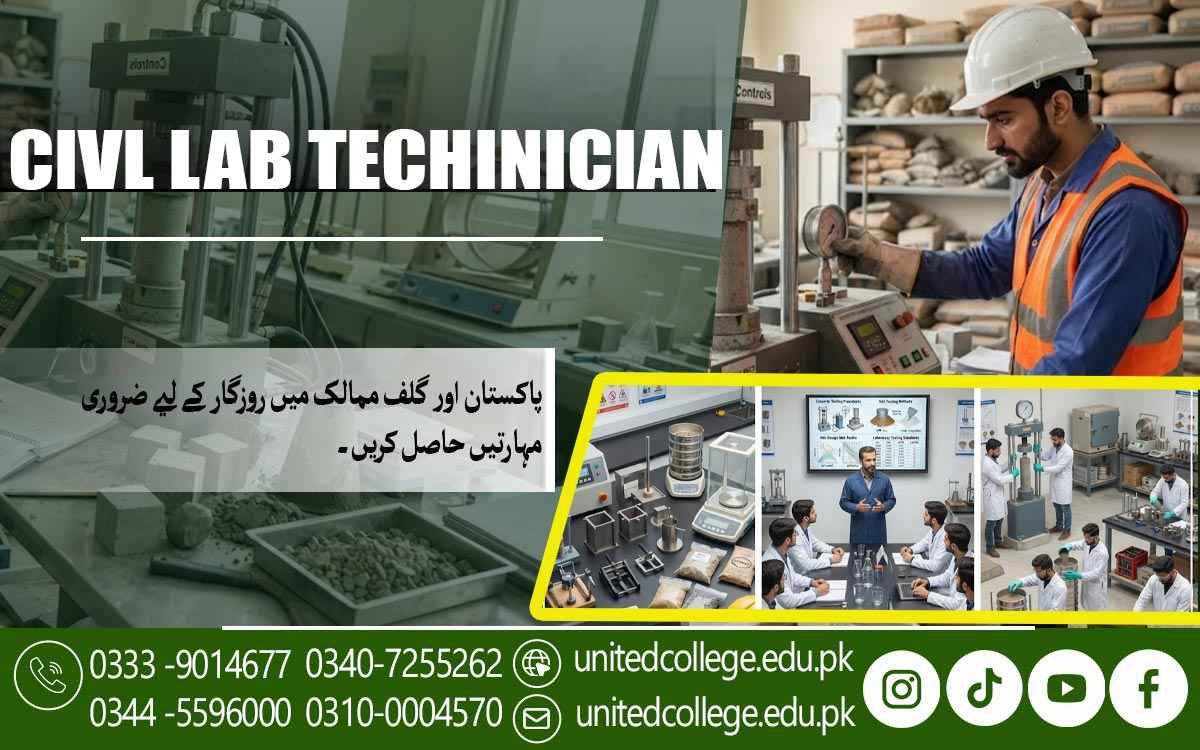

Civil Lab Technician Course in Mandi Bahauddin – Learn Testing Skills
Civil Lab Technician Course in Mandi Bahauddin for Practical Skills That Strengthen Construction Quality
A construction project can only perform as well as the materials used to build it. Before concrete is placed, foundations are developed, or roads are constructed, materials often need careful examination. Cement, soil, aggregates, sand, concrete, and other construction materials can behave differently under different conditions. This is why laboratory testing has an important place in civil engineering.
For beginners and students, learning these activities can create a practical connection between classroom knowledge and real construction work. The Civil Lab Technician Course in Mandi Bahauddin, offered by United College of Technology, introduces learners to basic material testing, laboratory procedures, sample handling, measurements, safety practices, and construction quality control. It can help fresh learners understand the technical side of construction in a structured and practical way.
Quality Construction Often Begins Before Materials Reach the Site
A construction team cannot judge every material simply by looking at it. Some important properties can only become clear through proper testing and measurement. Civil laboratory work helps examine materials before or during construction activities. A technician may prepare samples, follow testing methods, operate suitable equipment, record observations, and organize results for technical review.
This work can support engineers, contractors, and quality control teams. Through a Civil Lab Technician Course in Mandi Bahauddin, learners can develop an understanding of laboratory procedures and how testing supports construction quality. When material information is available, technical staff can better understand the characteristics of the materials being used in a construction project.
Cement, Concrete, and Aggregates Need Their Own Testing Approach
Different materials require different testing methods. Cement, for example, has properties that need to be examined according to suitable laboratory procedures. Concrete testing focuses on characteristics that can help assess concrete quality and strength. Aggregate testing is another important area because aggregates form a major part of many concrete mixes.
Students can learn why aggregate size, condition, and other characteristics matter when materials are prepared for construction use. Through practical civil laboratory training, learners can see how individual material tests connect with the larger construction process. Instead of memorizing technical terms, they can begin to understand why a particular test is performed and what type of information it can provide.
Soil Testing Helps Explain the Ground Beneath a Structure
Strong construction depends not only on materials above the ground but also on the condition of the soil below it. Soil can differ from one location to another, making soil analysis an important part of many construction activities. During training, learners can explore basic soil testing concepts such as moisture content and compaction. These tests help students understand how soil properties can influence construction decisions.
Sample collection and preparation are also important. A technician needs to handle soil samples carefully so that testing can provide useful information. This connects laboratory activities with construction site quality control and basic soil investigation.
From Sample Preparation to Test Results: Every Step Matters
Testing does not begin when a machine is switched on. It starts with proper sample identification, collection, preparation, and handling. Learners can develop an understanding of how samples are prepared according to the testing procedure. They can also become familiar with laboratory equipment used for different construction material tests. Accurate measurements are equally important.
A technician needs to observe, follow instructions, and record information without unnecessary errors. These small habits can make laboratory testing more organized and reliable. The Civil Lab Technician Course in Mandi Bahauddin can give learners an opportunity to explore these processes through practical learning. With suitable guidance, beginners can gradually become more comfortable with laboratory tools and testing procedures.
Accurate Records Turn Laboratory Work Into Useful Quality Information
A test result becomes more valuable when it is recorded clearly. Laboratory records may contain sample details, measurements, observations, test conditions, and other information related to the procedure. Good documentation helps technical teams review what was tested and how the findings were produced.
It also supports organized material inspection during construction projects. This is where laboratory testing connects with construction quality control and quality assurance in construction. A technician may not make the final engineering decision, but accurate technical information can give engineers and other professionals useful evidence to consider.
Safety Belongs in Every Testing Procedure
Laboratory safety is another essential part of civil lab technician training. Students may work around testing equipment, construction materials, samples, and different laboratory procedures. They should learn to follow instructions, handle equipment responsibly, maintain an organized workspace, and use appropriate safety practices.
These habits help create a disciplined approach to technical work. United College of Technology can provide a learning environment where students explore technical concepts alongside practical activities. This combination can help beginners understand that accuracy and safety are equally important in laboratory work.
Where Civil Laboratory Skills Meet Real Construction Work
Civil lab knowledge can support activities across several construction-related environments. Material testing laboratories, building projects, road development, infrastructure work, and quality control departments may all involve some form of testing or inspection. A civil lab technician may assist with sample handling, assigned tests, measurements, documentation, and laboratory equipment.
Exact responsibilities depend on the workplace and the nature of the project. For beginners, these skills can also complement other civil construction knowledge. Understanding how materials are tested can make it easier to see the connection between laboratory findings, construction materials, and work carried out on site.
Give Your Construction Knowledge a Practical Technical Direction
Civil laboratory training offers learners a chance to look at construction from a technical perspective. It combines material knowledge, testing methods, measurements, equipment handling, documentation, and safety into practical learning. The Civil Lab Technician Course in Mandi Bahauddin can be a suitable learning option for students, beginners, fresh learners, and others interested in developing civil construction skills.
Offered by United College of Technology, the course can help learners build a foundation in civil laboratory practices while developing greater familiarity with construction material testing. For anyone interested in the technical side of construction, a Civil Lab Technician Course in Mandi Bahauddin can provide useful exposure to how construction materials are examined and tested. Learning these practical skills can be a valuable next step toward stronger technical knowledge.
Frequently Asked Questions (FAQs)
A laboratory can provide measurements and observations about construction materials. Depending on the test, this information may relate to material condition, composition, behavior, or other technical properties.
Using a consistent testing approach makes results easier to compare. It also helps technical staff identify differences between samples without introducing unnecessary changes in the testing process.
Equipment practice can help students understand how testing instruments are handled and why specific tools are selected for particular tasks. It also develops familiarity with careful measurement.
Yes. Testing skills can relate to roads, infrastructure, material laboratories, and other construction activities. The exact testing requirements depend on the type of project and materials involved.
Correct labeling helps identify a sample and keeps its testing information organized. Without clear identification, it can become difficult to connect measurements with the correct material or project.
A beginner can expect to encounter construction materials, basic testing concepts, laboratory tools, measurements, documentation, and safety practices. The learning process can gradually move from simple concepts toward practical tasks.
Admission Open: Start Your Professional Journey Today!
Join United College of Technology and build a career with practical training, recognized certifications, and Gulf job support. Seats are limited.
Apply Now via WhatsAppContact Information
- Address: Rawalpindi: F-272 Main New Katarian Stop, Old IJP Road | Lahore Campus: Lahore, Pakistan
- Phone/WhatsApp: 0340-7255262 / 0333-9014677 / 0301-5044340 / 0310-0004570 / 051-8770756
- Website: unitedcollege.edu.pk
















Leave a Comment