


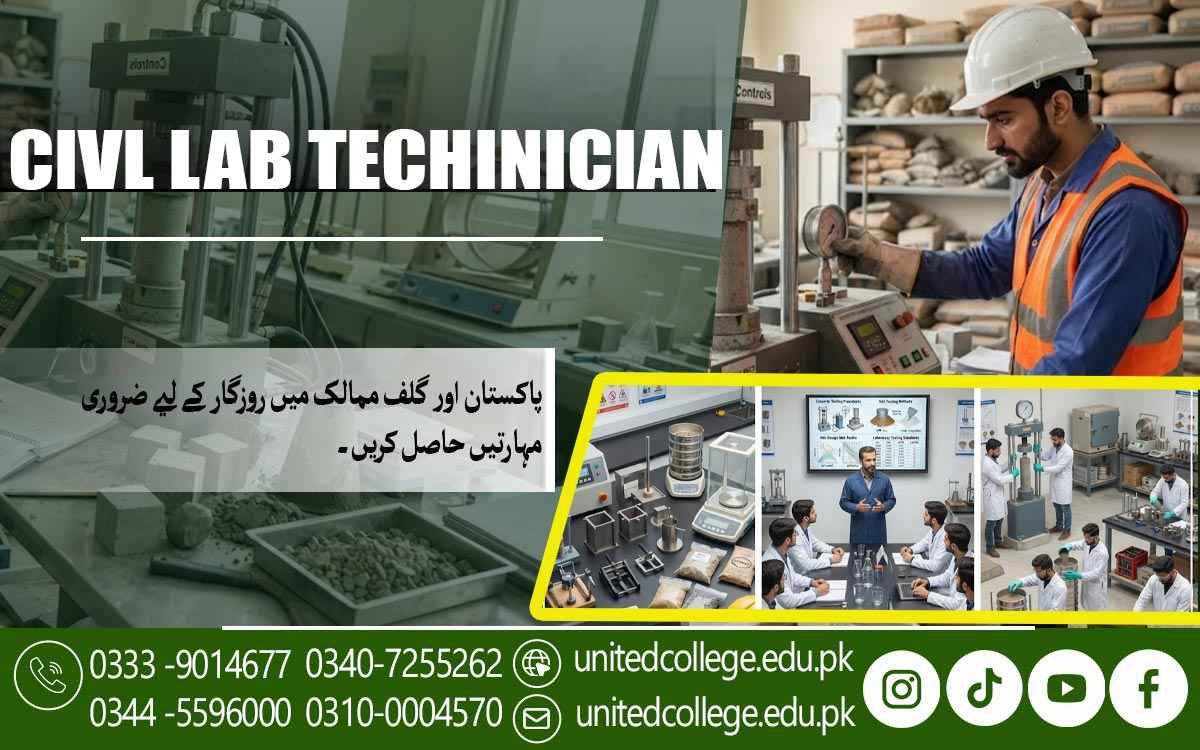

Civil Lab Technician Course in Sheikhupura – Enter Civil Lab Work
Civil Lab Technician Course in Sheikhupura for Practical Skills Behind Quality Construction
A strong building is not created by appearance alone. Before concrete is poured or materials become part of a structure, they often need careful checking and testing. Soil, cement, concrete, sand, and aggregates can have different properties, and understanding those properties helps technical teams make better construction decisions. This is where civil laboratory work becomes valuable.
The Civil Lab Technician Course in Sheikhupura gives beginners an opportunity to explore this technical area through practical learning. Offered by United College of Technology, the course can help students, fresh learners, and job seekers understand construction material testing, laboratory procedures, measurements, and basic quality control in a simple and practical way.
The Hidden Work That Helps Keep Construction on Track
Much of the important work in construction happens before a material is placed into a building. Testing helps technical teams learn more about the materials they plan to use. A civil laboratory technician may work with different samples and perform specific checks according to established procedures. The results can provide useful information for engineers, contractors, and quality-control teams.
Through a Civil Lab Technician Course in Sheikhupura, learners can understand how laboratory activities support construction projects. They also begin to see why accurate measurements and proper testing matter when dealing with foundations, roads, buildings, and other civil works.
Behind Every Test Is a Technician Who Watches the Details
A civil lab technician needs more than the ability to operate equipment. The work involves receiving or collecting samples, preparing them correctly, following testing steps, taking measurements, and recording observations. Each stage requires concentration because careless handling can affect the reliability of a result.
Students exploring civil laboratory skills can learn these basic responsibilities through practical exercises. They can also understand how technical staff communicate their findings to other members of a construction team. This creates a useful foundation for learners who want to understand the practical side of civil engineering without starting with highly complicated concepts.
Cement, Concrete, Soil and Aggregates Each Tell a Different Story
Construction materials do not all behave in the same way, so they require different types of checks. Soil testing can help learners understand the condition and characteristics of ground materials. Cement testing introduces students to basic checks related to an important ingredient used in concrete. Concrete testing helps them explore how prepared concrete is examined, including basic concepts related to concrete strength.
Meanwhile, aggregate testing focuses on materials commonly used in concrete and other construction applications. Learning about these materials gives students a broader understanding of building material testing and shows why material selection and checking are important parts of civil construction practices.
Practical Training Makes Technical Knowledge Easier to Understand
Reading about a testing procedure is different from seeing how it works in practice. Practical civil lab training allows learners to connect instructions with real tasks such as sample preparation, measurement, equipment handling, observation, and documentation. Students can become familiar with the purpose of different laboratory tools and learn how to use them carefully.
They can also develop basic laboratory safety habits while working with samples and equipment. The Civil Lab Technician Course in Sheikhupura can therefore give beginners a structured learning environment where they can gradually build confidence with laboratory testing techniques instead of relying only on theoretical information.
From a Sample on the Bench to Quality Decisions on Site
Civil laboratory work has a direct connection with construction site activities. A sample tested in a laboratory can provide information that technical teams may consider when reviewing construction materials. This creates a link between laboratory testing and construction site testing, where field conditions and material performance are observed during actual project work.
Through a Civil Lab Technician Course in Sheikhupura, learners can understand how testing contributes to material inspection and construction quality control. They can also learn that quality assurance in construction depends on several connected activities rather than one single test. This broader view helps students understand the responsibility involved in producing and recording reliable technical information.
A Learning Environment Built Around Practical Civil Skills
For someone starting from the beginning, a structured learning approach can make civil laboratory concepts easier to follow. United College of Technology offers the Civil Lab Technician Course in Sheikhupura for learners interested in developing practical knowledge related to construction testing and laboratory work. Students can focus on understanding materials, testing procedures, laboratory equipment handling, measurements, observations, and basic quality-control practices.
Guided learning can also help them identify areas where they need more practice. Instead of simply memorizing testing terms, learners can work toward understanding what a procedure does and how its results relate to construction activities.
Where Civil Laboratory Knowledge Can Become Useful?
Civil laboratory skills can be relevant in several technical environments connected with construction. These may include material-testing laboratories, construction projects, quality-control departments, civil engineering laboratories, infrastructure developments, road projects, and building work. The exact responsibilities can vary from one workplace to another, but an understanding of testing procedures can provide useful technical knowledge.
For students and fresh learners, developing these skills can also improve their awareness of how engineers and construction teams evaluate materials. It gives them a practical area to explore within the wider construction industry without making unrealistic promises about employment or income.
A Practical Starting Point for Learners in Sheikhupura
You do not need to know everything about civil engineering before exploring laboratory work. Beginners can start by understanding basic materials, learning how samples are handled, becoming familiar with measurements, and gradually practicing different procedures. Attention to detail is especially important because laboratory work depends on careful observation and accurate records.
For learners in Sheikhupura, the Civil Lab Technician Course in Sheikhupura offered by United College of Technology can provide a way to explore these construction-related technical skills in a structured setting. Consistent practice can help learners develop a better understanding of laboratory work and its role in construction quality.
Take the Next Step Toward Technical Construction Knowledge
Modern construction relies on more than skilled workers and good materials. It also depends on testing, measurement, inspection, and informed quality-control practices. Learning civil laboratory techniques can help students understand this less visible but important side of construction. If you are interested in material testing, technical work, or civil engineering support activities, exploring the Civil Lab Technician Course in Sheikhupura offered by United College of Technology can be a practical next step.
With focused learning and regular practice, you can build knowledge that supports your understanding of construction materials, laboratory procedures, and the technical processes behind quality construction.
Frequently Asked Questions (FAQs)
Learners can develop an understanding of how technical checks are carried out on materials used in construction. The training can also improve their familiarity with basic laboratory practices.
Depending on the practical activities, learners may work with samples related to soil, concrete, cement, aggregates, sand, and other commonly used construction materials.
Material properties are not always visible through simple observation. Testing provides measurable information that can help technical teams assess materials more carefully.
No. The field combines technical concepts with practical procedures. Learners can understand how measurements, samples, instruments, and written observations work together during testing.
Students should focus on correct steps, accurate measurements, proper equipment use, and clear documentation. Developing these habits can make practical laboratory tasks easier to manage.
It can add a testing perspective to general construction knowledge. Learners can better understand how technical teams check materials rather than focusing only on how those materials are used on site.
Admission Open: Start Your Professional Journey Today!
Join United College of Technology and build a career with practical training, recognized certifications, and Gulf job support. Seats are limited.
Apply Now via WhatsAppContact Information
- Address: Rawalpindi: F-272 Main New Katarian Stop, Old IJP Road | Lahore Campus: Lahore, Pakistan
- Phone/WhatsApp: 0340-7255262 / 0333-9014677 / 0301-5044340 / 0310-0004570 / 051-8770756
- Website: unitedcollege.edu.pk
















Leave a Comment