


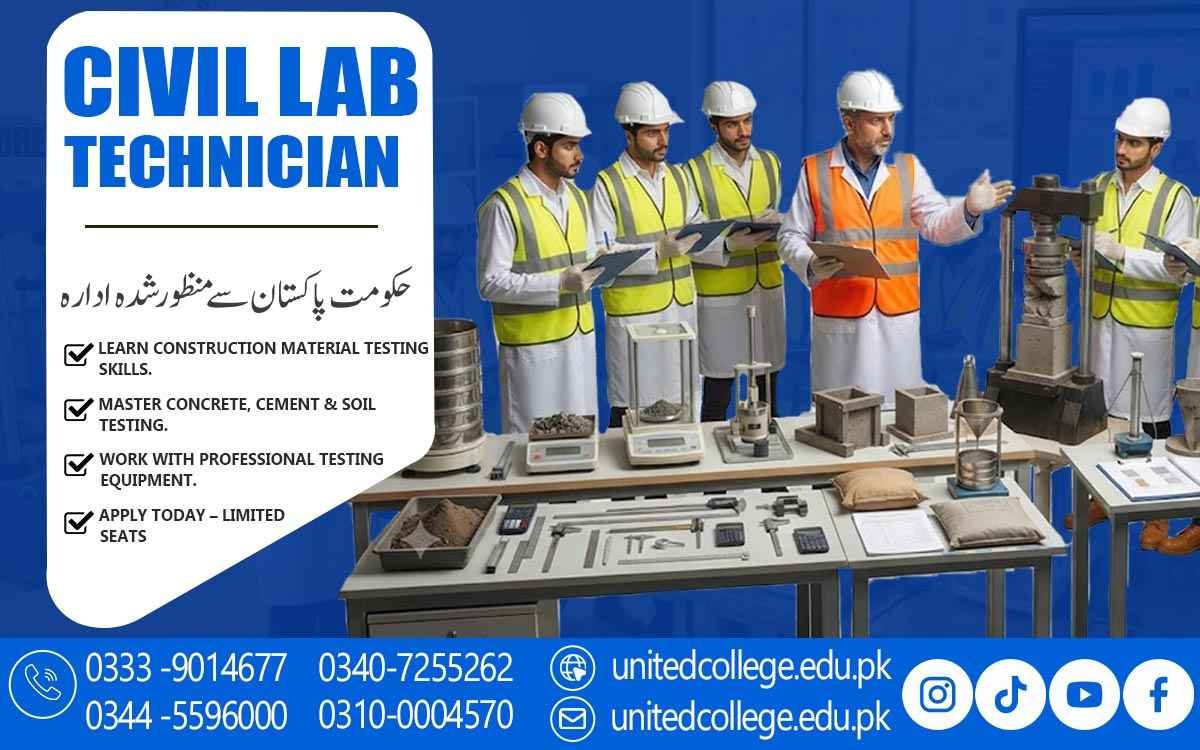

Civil Lab Technician Course in Sukkur – Learn Practical Testing Skills
When Construction Quality Depends on What Testing Reveals
A construction project may involve concrete, steel, bricks, soil, sand, aggregates, asphalt, and many other materials, but how can a team know whether those materials are suitable for the work? Looking at a material is not always enough. Proper testing can reveal properties that cannot be identified simply by appearance, helping construction teams understand how a material behaves under specific conditions. This makes civil laboratory work an important part of construction quality control. A Civil Lab Technician Course in Sukkur can introduce beginners to the practical side of material testing and help them understand how laboratory information supports construction projects.
Sukkur and surrounding areas include different types of buildings, roads, commercial developments, and infrastructure work where construction materials need to be inspected and tested according to project requirements. During training, learners can explore how samples are collected, prepared, tested, measured, and documented. They can also learn why accuracy, careful observation, and following established testing procedures matter when producing laboratory results. United College of Technology offers training that can help students and fresh learners understand civil laboratory practices in a structured learning environment.
Learning What a Civil Lab Technician Actually Does
What happens when a sample of soil, concrete, cement, or aggregate arrives at a civil engineering laboratory? A civil lab technician may be involved in several steps before a final test result is recorded. In a Civil Lab Technician Course in Sukkur, learners can develop an understanding of the responsibilities involved in receiving or collecting samples, identifying materials, preparing specimens, selecting appropriate testing procedures, operating laboratory equipment, taking measurements, observing results, and maintaining records. The exact duties can vary depending on the laboratory, project, material, and testing requirements, but accuracy remains an important part of the work.
Students can learn that laboratory testing is not simply about placing a sample into a machine and writing down a number. The technician needs to follow a suitable method, handle the sample correctly, understand the purpose of the test, and record observations in a clear manner. Training can also introduce learners to the relationship between laboratory staff and other construction professionals, including engineers, quality control teams, supervisors, and site personnel. This helps beginners understand why communication and proper documentation matter alongside technical skills. For someone entering a civil laboratory for the first time, learning these responsibilities can make the field easier to understand and provide a practical foundation for further civil engineering laboratory training.
Testing the Materials That Become Part of a Project
Think about a building or road under construction and consider how many different materials are involved. Cement, concrete, soil, sand, aggregates, bricks, asphalt, and other building materials can all have different properties and testing requirements. A material testing laboratory provides a controlled environment where selected samples can be examined through appropriate procedures. During a Civil Lab Technician Course in Sukkur, learners can explore the basic purpose of testing different construction materials and understand why one testing technique cannot be applied to every material. Cement testing may focus on particular properties of cement, while concrete testing can involve fresh and hardened concrete.
Soil testing helps provide information about ground materials, whereas aggregate testing can examine properties such as particle size and grading. Brick testing can help assess characteristics of masonry units, while asphalt testing can be relevant to road and pavement-related work. Students can also learn that material inspection may take place before laboratory testing, especially when samples need to be identified, collected, or checked for obvious issues. By studying these materials individually, beginners can understand how their properties can influence construction quality.
Understanding What Concrete and Cement Testing Can Tell You
Fresh concrete may look like a simple mixture, but its quality depends on several factors that need careful control and testing. Cement is also more than just a powder added to a mixture; its characteristics can affect how construction materials behave during different stages of work. In practical civil laboratory training, learners can be introduced to cement testing and concrete testing procedures in a simple and understandable way. A Civil Lab Technician Course in Sukkur may cover concepts such as concrete workability, slump testing, compressive strength, cement consistency, setting time, and other laboratory procedures depending on the training curriculum.
Compressive strength testing introduces another important concept by showing how hardened concrete is tested under a controlled load to obtain a measured strength result. Cement testing can involve examining characteristics such as consistency and setting behavior through appropriate procedures. These tests help students understand why construction quality cannot be judged only by whether concrete looks smooth or cement appears normal. Proper sample preparation, equipment handling, measurement, curing where required, and accurate recording all contribute to useful results. Learning these processes practically can make technical concepts easier for beginners to understand and connect with actual construction work.
Soil and Aggregates Reveal the Conditions Behind the Surface
Before a road is paved or a building rises above the ground, the materials beneath and around the construction work can require careful attention. Soil and aggregates are widely used in civil construction, but their properties can vary and therefore need suitable testing. Through a Civil Lab Technician Course in Sukkur, learners can become familiar with soil testing and aggregate testing concepts used to understand material characteristics. Soil analysis may involve examining factors such as moisture content, density, particle size, and compaction, depending on the purpose of the test. Soil compaction testing can help learners understand how controlled compaction changes the density of soil and why compaction information can matter in construction and road work.
Students can learn why sieving, weighing, sample preparation, and accurate measurements are important when carrying out these procedures. They can also understand that a laboratory result represents the sample that was tested, which makes proper collection and identification important. For learners interested in construction site testing around Sukkur, this knowledge can help explain how laboratory work connects with roads, foundations, earthwork, concrete production, and other civil construction activities. Instead of treating soil and aggregates as ordinary materials, students begin to see why their measurable properties matter.
Getting Hands-On With Laboratory Equipment and Testing Procedures
Knowing the name of a laboratory instrument is different from knowing how to use it correctly. Practical civil lab training allows learners to understand the purpose of equipment, how samples are prepared, how measurements are taken, and how testing procedures are followed step by step. In a Civil Lab Technician Course in Sukkur, students can become familiar with laboratory equipment and measuring instruments used for different construction material testing activities. Depending on the training environment, this may include weighing equipment, sieves, molds, measuring tools, sample containers, compression testing machines, moisture-related equipment, and other apparatus.
Sample preparation is another important part of the process because the way a material is prepared can influence how accurately it represents the required testing condition. Students can also develop safe working habits by keeping equipment organized, following operating instructions, handling samples responsibly, and maintaining a clean laboratory environment. Recording measurements while testing can help learners become more attentive to small details rather than rushing toward a final result. These practical habits are useful because civil laboratory work requires patience and consistency. By repeatedly performing testing procedures under guidance, beginners can gradually become more comfortable with equipment and understand how individual measurements contribute to a complete laboratory result.
Turning Measurements Into Records That Construction Teams Can Use
A laboratory result becomes much more useful when it is properly recorded, identified, and explained. Imagine receiving a test value without knowing which sample was tested, when the test was performed, or what procedure was used. Such information would be difficult to review or rely on. This is why documentation is an important part of civil lab technician skills. During a Civil Lab Technician Course in Sukkur, learners can understand how observations, measurements, sample details, test procedures, and results are organized into laboratory records and test reports. Students can learn the importance of checking figures, writing information clearly, and keeping records connected with the correct sample.
Learners can also see how test reports may be reviewed by engineers, site teams, quality control personnel, or project managers when evaluating construction materials. This creates a connection between laboratory work and practical construction decisions. Good documentation can also help when repeated tests are carried out and results need to be compared. By practicing measurements, observations, calculations where appropriate, and report preparation, students can develop a more complete understanding of laboratory work. These skills can be particularly useful for beginners because careful record-keeping is something that improves through practice rather than simply through memorization.
Where Material Testing Supports Construction Quality Control
What happens when a construction team needs to decide whether a material meets a particular project requirement? This is where quality control and material testing can come together. Construction quality control involves checking materials, processes, and completed work against relevant requirements, while laboratory testing can provide measurable information to support those checks. A Civil Lab Technician Course in Sukkur can help learners understand how laboratory results may become part of a wider quality control process. For example, a material sample may be collected from a construction site or supplier, prepared for testing, examined using a suitable procedure, and documented in a test report.
Field testing can complement laboratory work when certain measurements need to be taken at or close to the construction site. Students can therefore begin to understand the difference between simply performing a test and contributing useful information to a construction project. Material inspection, laboratory testing, site observations, documentation, and quality checks can work together to identify issues and support informed decisions. In Sukkur, where construction can involve residential buildings, commercial structures, roads, and infrastructure-related work, knowledge of quality testing in construction can be relevant to learners who want to understand how technical teams monitor materials and construction activities.
Practical Training Connects Classroom Learning With Real Construction Work
Have you ever understood a process in theory but felt uncertain when it was time to perform it yourself? This is common when learning technical skills, especially laboratory procedures that involve equipment, measurements, samples, and several steps. Hands-on practical training can help bridge this gap by giving learners opportunities to perform or observe testing activities under guidance. Through a Civil Lab Technician Course in Sukkur, students can practice areas such as sample collection, sample preparation, material testing, equipment handling, measurements, observations, and recording results. Practical exercises can help learners understand why each step is performed and what can happen when a procedure is not followed carefully.
United College of Technology can provide a structured learning environment where students can build familiarity with civil laboratory procedures and develop confidence through repeated practice. Safety can also be included in practical learning because laboratory work requires responsible handling of equipment, materials, and testing areas. The purpose of this training is to build a technical foundation that learners can continue improving through further education and supervised experience. For beginners in Sukkur, practical exposure can make civil laboratory work feel more understandable and help them recognize the skills they need to keep developing.
Building Civil Lab Skills for Future Technical Learning
Civil laboratory training can be a starting point for learners who want to explore different areas of construction and civil engineering rather than a final destination by itself. Once students become familiar with construction material testing, soil testing, concrete testing, cement testing, aggregate testing, laboratory equipment, sample preparation, documentation, and quality inspection, they can identify areas where they want to develop further. A Civil Lab Technician Course in Sukkur can provide a practical foundation for understanding the work carried out in material testing laboratories and the relationship between laboratory results and construction projects.
Construction companies, engineering organizations, material testing laboratories, and infrastructure projects can involve different technical responsibilities, so the exact skills required may vary from one workplace to another. Continued learning, practical experience, familiarity with relevant testing procedures, and responsible working habits can help learners prepare themselves for these different environments. For students, fresh learners, job seekers, and school or college graduates in Sukkur, understanding this wider pathway can make technical education more purposeful.
Frequently Asked Questions (FAQs)
A Civil Lab Technician Course in Sukkur teaches learners how to test construction materials, handle laboratory equipment, record measurements, and support construction quality control.
Students, beginners, fresh learners, school or college graduates, and people interested in construction material testing can consider joining the course.
Common materials include soil, cement, concrete, aggregates, sand, bricks, asphalt, and other construction materials depending on the project and testing requirements.
Learners can develop practical skills in sample preparation, testing procedures, laboratory equipment handling, measurements, observations, documentation, and test report preparation.
Material testing provides measurable information about construction materials and can help engineers and quality control teams assess materials against relevant project requirements.
Admission Open: Start Your Professional Journey Today!
Join United College of Technology and build a career with practical training, recognized certifications, and Gulf job support. Seats are limited.
Apply Now via WhatsAppContact Information
- Address: Rawalpindi: F-272 Main New Katarian Stop, Old IJP Road | Lahore Campus: Lahore, Pakistan
- Phone/WhatsApp: 0340-7255262 / 0333-9014677 / 0301-5044340 / 0310-0004570 / 051-8770756
- Website: unitedcollege.edu.pk
















Leave a Comment