


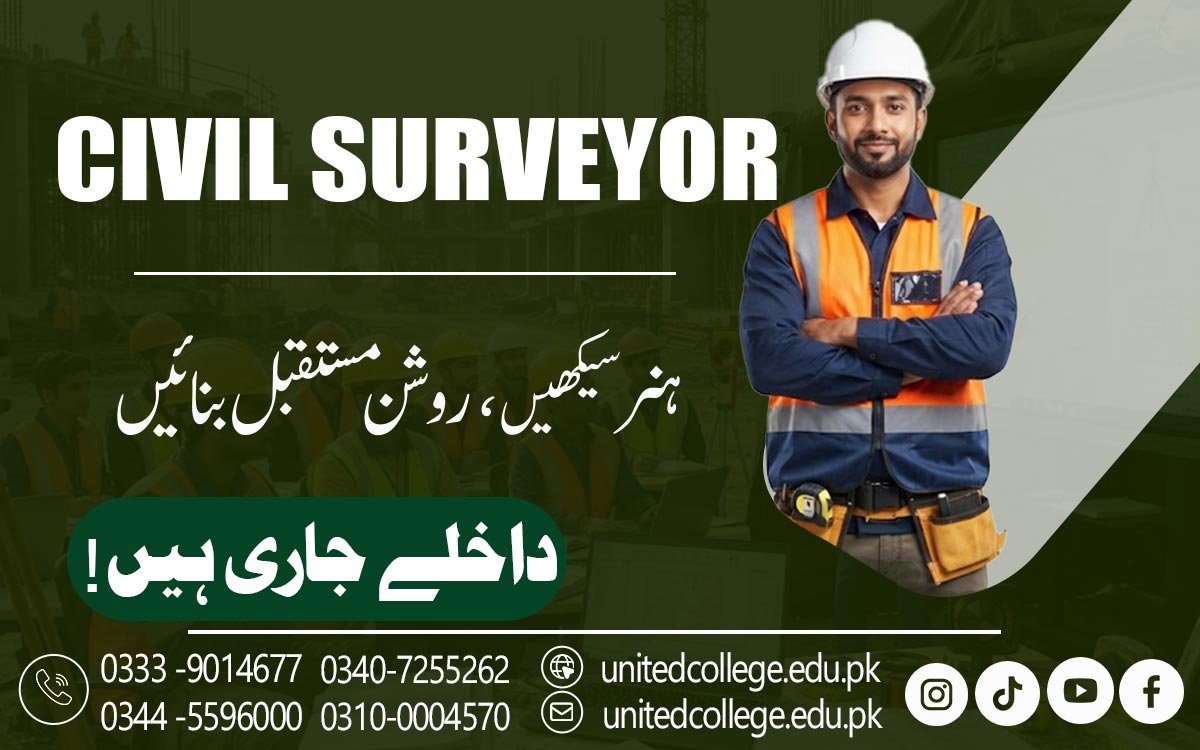

Civil Surveyor Course in Jhang – Gain Skills for Construction Sites
Turn Accurate Measurements Into Practical Construction Skills
A construction project can look simple from a distance, but every successful structure begins with accurate information about the land. A small mistake in distance, level, or angle can affect later stages of construction. This is why surveying plays such an important role before and during building work.
The Civil Surveyor Course in Jhang offers learners a practical way to understand how land is measured, checked, and prepared for construction activities. It can suit students, beginners, fresh learners, and job seekers who want to develop useful technical knowledge. With the right training, learners can understand both basic concepts and the field practices used in civil surveying.
Discover the Real Work Behind a Civil Surveyor’s Measurements
A civil surveyor does much more than simply measure land. The work may involve setting reference points, checking elevations, recording field observations, and providing accurate survey data for construction teams. During site surveying, a surveyor may work around existing structures, open land, roads, or other physical features.
The Civil Surveyor Course in Jhang can help learners understand this working environment from a practical perspective. Students can gradually become familiar with the responsibilities involved in field surveying and learn how accuracy, patience, and attention to detail influence the quality of survey work.
Build Your Understanding of Land, Distance, Angles, and Elevation
Strong surveying skills begin with understanding the measurements used in everyday fieldwork. Land measurement helps determine the size and position of an area, while distance measurement shows how far one point is from another. Angle measurement is also important when establishing directions and positions. Elevation measurement, on the other hand, helps identify differences in height between points.
These concepts are closely connected with leveling and site layout. Another useful area is topographic surveying, which focuses on collecting information about the shape and features of land. When beginners understand these concepts step by step, they can better understand how survey measurements become useful information for construction planning.
Get Familiar With the Instruments Used on Modern Survey Sites
Surveying instruments help professionals collect measurements with greater precision. Beginners may come across equipment such as total stations, theodolites, and leveling instruments while learning the fundamentals of field surveying. A total station can be used for measuring angles and distances and for collecting positional information.
A theodolite is commonly associated with accurate angle measurement, while levels are used to determine differences in elevation. The Civil Surveyor Course in Jhang can introduce learners to the purpose and handling of common survey equipment. Understanding the function of each instrument is important because choosing and using the right tool can make fieldwork more organized and reliable.
Turn Classroom Knowledge Into Confidence Through Field Practice
Surveying is a practical field, so reading about instruments and measurements is only one part of learning. Learners also need opportunities to understand how measurements are taken, recorded, checked, and used in real working situations. Field practice can help students become more comfortable with measuring land, setting points, taking readings, and maintaining proper records.
A Civil Surveyor Course in Jhang can provide learners with an opportunity to build practical surveying skills alongside classroom knowledge. It also teaches them to work carefully instead of depending on assumptions. Practical surveying skills develop gradually. A beginner may first learn simple measurements and then move toward more detailed tasks involving leveling, site layout, and survey data.
Understand How Survey Information Supports the Entire Construction Team
Survey information becomes valuable when different professionals use it to make informed decisions. Engineers may rely on measurements when studying a site, while contractors can use layout information when carrying out planned construction activities. Accurate survey data can also support the positioning of structures, checking levels, and understanding site conditions.
In this way, a surveyor becomes an important part of the communication between the physical site and the technical plans. Construction projects depend on coordination. When measurements are collected and recorded properly, they can provide useful information to people working on different stages of a project. This makes civil surveying an important area within broader civil engineering support.
Develop Practical Skills That Go Beyond Basic Measurement
Learning surveying can help students develop several abilities at the same time. They can improve their understanding of measurement, equipment handling, field observation, basic calculations, record-keeping, and technical communication. A learner also needs to develop accuracy and responsibility. Fieldwork often requires careful checking because a measurement is useful only when it is collected and recorded correctly.
The Civil Surveyor Course in Jhang, offered by United College of Technology, provides an opportunity for learners interested in building this type of practical knowledge. The learning process can give beginners a clearer understanding of surveying techniques and the way these skills connect with construction-related work.
Give Your Interest in Technical Work a Clearer Direction
For people in Jhang who are interested in construction, land measurement, or technical work, civil surveying can be an interesting skill area to explore. It combines outdoor field activity with measurement, equipment, calculations, and practical problem-solving. The field can also appeal to learners who prefer practical tasks rather than studying only from books.
Starting with basic concepts is important. Once learners understand measurements, instruments, leveling, site layout, and field procedures, they can continue improving their knowledge through practice and experience. A strong foundation can make advanced surveying topics easier to understand later.
Take the Next Step Toward Practical Surveying Skills
Good construction starts with good information, and accurate surveying helps provide that information. From measuring land to checking elevations and preparing site layouts, surveying connects technical knowledge with the physical world of construction. For beginners and students, the Civil Surveyor Course in Jhang can be a practical starting point for exploring this technical field.
It allows learners to build their understanding of surveying methods while becoming familiar with the tools and practices used on construction sites. With practical learning, regular practice, and a careful approach to measurements, learners can develop skills that have value across construction-related environments. If civil surveying interests you, taking the first step toward learning these skills can turn a simple interest into useful technical knowledge.
Frequently Asked Questions (FAQs)
Patience, careful observation, responsibility, and attention to detail are useful qualities. A surveyor must also stay focused while working with measurements and technical equipment.
Yes. Surveying can include outdoor field activities as well as indoor tasks such as organizing measurements, reviewing records, and preparing technical information.
Surveyors often work with engineers, supervisors, and other site workers. Clear communication helps them share measurements and explain important observations correctly.
A learner should gradually practice equipment handling, reading measurements, recording observations, and following basic field procedures. Regular practice can improve confidence.
Basic mathematics is useful because surveying involves distances, angles, levels, and calculations. A strong understanding of simple mathematical concepts can make technical tasks easier.
Beginners can start with basic terminology and simple measurement concepts before moving toward equipment and field procedures. The learning process becomes easier through repeated practice.
Admission Open: Start Your Professional Journey Today!
Join United College of Technology and build a career with practical training, recognized certifications, and Gulf job support. Seats are limited.
Apply Now via WhatsAppContact Information
- Address: Rawalpindi: F-272 Main New Katarian Stop, Old IJP Road | Lahore Campus: Lahore, Pakistan
- Phone/WhatsApp: 0340-7255262 / 0333-9014677 / 0301-5044340 / 0310-0004570 / 051-6770756
- Website: unitedcollege.edu.pk
















Leave a Comment