


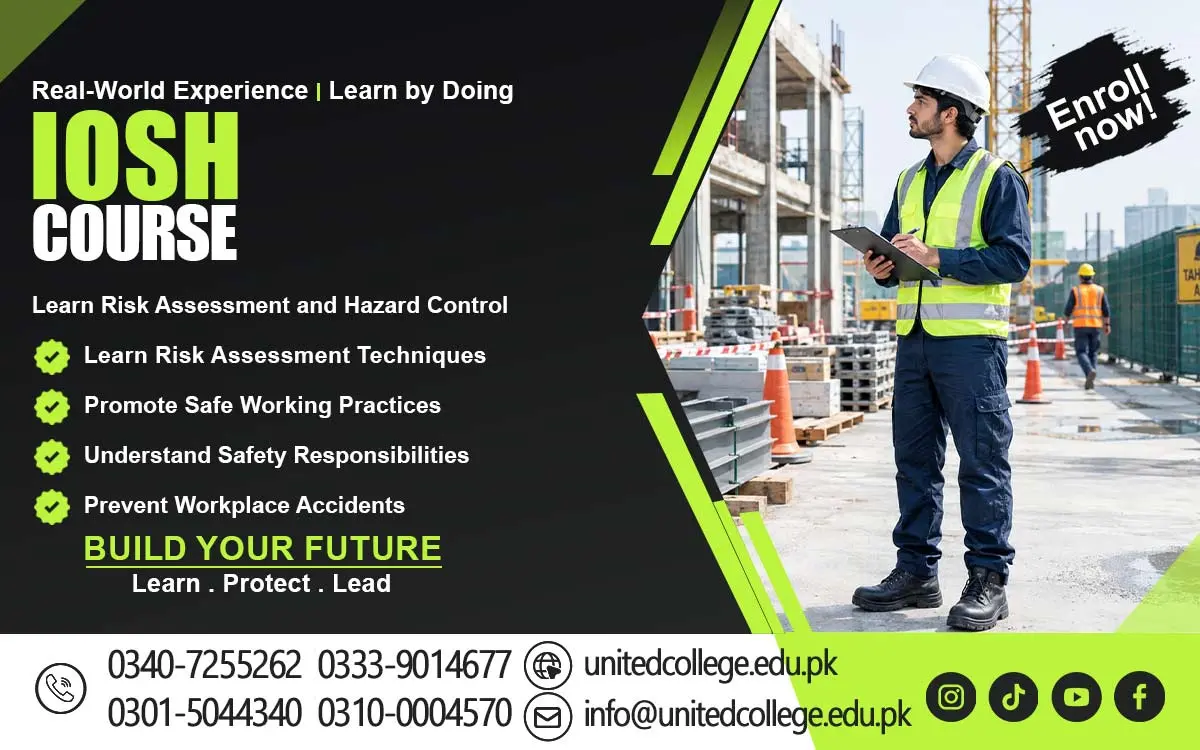

IOSH Course in Balakot: Build Essential Workplace Safety Skills
Developing Workplace Safety Awareness Through IOSH Training
Workplace safety is an important responsibility in every industry, whether employees are working on a construction project, operating machinery, handling materials, or performing everyday office duties. A small safety issue, such as a damaged cable, an unstable ladder, or a blocked emergency exit, can create serious problems if nobody notices it in time. IOSH training introduces learners to the importance of identifying these situations and taking suitable preventive measures. Through the IOSH Course in Balakot, students can develop an understanding of occupational health and safety principles and learn how these practices apply to real working environments.
IOSH stands for the Institution of Occupational Safety and Health, an organisation known for its workplace safety training and professional development programmes. One commonly recognised option is the IOSH Managing Safely Course, which focuses on helping managers and supervisors understand their safety responsibilities. The training covers essential subjects such as workplace hazards, risk control, accident prevention, and safety management. Learners also become familiar with the importance of communication between workers and management. This knowledge can help individuals understand that workplace safety is not only the responsibility of one safety officer but requires cooperation from everyone involved in daily operations.
Recognising Hidden Hazards Across Different Work Environments
Some workplace hazards are easy to notice, while others remain hidden until an accident occurs. A wet floor in a warehouse, an exposed electrical connection in a workshop, or a damaged hand tool on a construction site may appear to be minor issues. However, each situation can put workers at risk when proper precautions are ignored. Hazard identification is an important part of occupational health and safety training because it teaches individuals to observe their surroundings and recognise possible sources of injury or damage. During the IOSH Course in Balakot, learners can understand different categories of workplace hazards, including physical, chemical, electrical, biological, and ergonomic risks.
Physical hazards may include falling objects, excessive noise, or slippery surfaces, while chemical hazards can involve harmful substances, fumes, and cleaning products. Electrical hazards may result from damaged wires, overloaded sockets, or unsafe equipment. Ergonomic problems can develop when workers repeatedly lift heavy objects or maintain uncomfortable working positions. Understanding these risks helps learners become more aware of unsafe conditions before they cause harm. For example, a worker who notices a loose scaffold connection should understand that it needs attention before anyone uses it.
Building Practical Skills in Risk Assessment and Prevention
Finding a workplace hazard is only the first step towards improving safety. The next important task is understanding how serious the risk may be and deciding what action should be taken. Risk assessment is a process used to identify possible dangers, consider who could be affected, and determine suitable control measures. For example, workers carrying heavy materials on a busy construction site may face risks from falling objects, poor lifting techniques, or crowded walking areas. A proper assessment helps supervisors consider these situations and introduce appropriate precautions. The IOSH Course in Balakot introduces learners to the relationship between hazard identification and risk assessment, helping them understand how workplace risks can be managed more effectively.
can become familiar with the importance of checking equipment, maintaining clear walkways, providing suitable protective equipment, and following safe working instructions. They can also understand the difference between a hazard and a risk. A hazard is something that can cause harm, while risk refers to the possibility and seriousness of that harm occurring. These concepts are useful in construction site safety, industrial workplace safety, and everyday business operations. Risk assessment training also encourages a planned approach instead of waiting for accidents to happen. By understanding preventive measures, learners can develop a more responsible attitude towards workplace safety and recognise the importance of reviewing safety arrangements whenever working conditions change.
Preventing Workplace Accidents Through Responsible Safety Practices
A workplace accident can affect more than the person directly involved. It may interrupt business activities, damage equipment, create financial difficulties, and place additional pressure on other employees. For example, if a machine operator suffers an injury because a safety guard has been removed, the incident may affect the entire production process. Accident prevention therefore requires workers and supervisors to follow proper procedures and remain alert to unsafe activities. The IOSH Course helps learners understand the importance of safe behaviour, workplace monitoring, and reporting possible dangers. During training, individuals can learn why equipment should be inspected before use, why warning signs must remain visible, and why workers should never ignore established safety instructions.
Another important area is incident reporting. Even when an incident does not cause an injury, it should not automatically be ignored. A near miss, such as a tool falling close to a worker, can provide an opportunity to identify weaknesses in existing safety arrangements. Reporting such events helps responsible personnel investigate possible causes and take preventive action. Learners can also understand the importance of maintaining accurate safety records and communicating incidents clearly. These practices support accident prevention and improve workplace risk management. Developing this knowledge can be especially useful for people interested in supervisory responsibilities, safety-related duties, or professional development in different industrial environments.
Strengthening Fire Protection and Emergency Response Knowledge
A fire can spread quickly when workers do not know how to respond or when emergency arrangements are poorly maintained. Imagine a small electrical fire starting inside a workshop where flammable materials are stored nearby. If employees panic, block the exit, or attempt unsafe actions, the situation can become much more dangerous. This is why fire safety awareness and emergency response procedures are important parts of workplace safety management. Through the IOSH Course in Balakot, learners can develop an understanding of common fire hazards, basic prevention practices, and the importance of following an established emergency plan.
They can learn why electrical equipment should be maintained properly, why combustible materials must be stored safely, and why emergency exits should never be blocked. Fire extinguishers are another important subject because different types are designed for different classes of fire. Employees should understand that using the wrong extinguisher can create additional danger, and only people with suitable training should attempt firefighting when it is safe to do so. Emergency planning also includes recognising alarm signals, knowing evacuation routes, and understanding designated assembly points. First aid awareness and clear communication can also support an organised response when an incident occurs.
Understanding PPE and Safe Equipment Handling Procedures
Personal protective equipment, commonly known as PPE, plays an important role in reducing exposure to workplace hazards. Depending on the nature of the job, workers may need safety helmets, protective gloves, safety shoes, goggles, face shields, hearing protection, or respiratory equipment. For example, a construction worker may require a helmet and safety footwear to reduce the risk of injury from falling objects, while someone working with chemicals may need suitable gloves and eye protection. However, wearing protective equipment does not automatically make every activity safe. Workers must understand which equipment is appropriate, how it should fit, and when it needs to be replaced.
It also highlights that protective equipment is generally one part of a wider safety system, alongside suitable equipment design, safe procedures, and proper supervision. Another important area is safe equipment handling. Machinery, electrical tools, ladders, and lifting equipment should be used according to instructions and inspected when required. A damaged power tool or a faulty ladder should not be used simply because a worker is in a hurry. Through an IOSH Course in Balakot, learners can develop greater awareness of these responsibilities and understand how proper equipment handling contributes to a safer working environment.
Improving Workplace Inspections and Safety Management Skills
A warehouse may have blocked walkways, improperly stacked materials, or damaged storage racks, while a manufacturing unit may contain faulty machinery or missing warning signs. If these conditions remain unnoticed, workers may face unnecessary risks during their daily activities. Safety inspections provide an organised way to check working conditions, equipment, housekeeping, and compliance with established procedures. Through occupational health and safety training, learners can understand why inspections should be planned and why findings should be recorded accurately. The IOSH Course in Balakot introduces important safety management concepts that can help individuals understand how workplace conditions are monitored and improved.
Learners can become familiar with checking whether fire extinguishers are accessible, emergency routes are clear, protective equipment is available, and machinery is being used correctly. Documentation is another useful part of safety management because inspection records help responsible personnel track problems and monitor corrective actions. Communication also matters. If an employee notices a damaged machine guard, the concern should be reported to the appropriate supervisor instead of being ignored. These practices help create a workplace where safety concerns are taken seriously. Developing safety management skills can also improve an individual's ability to support inspections, communicate risks, and understand the responsibilities involved in maintaining a safe working environment across different industries.
Applying IOSH Knowledge to Construction and Industrial Workplaces
In Balakot and nearby areas, people may be involved in construction activities, workshops, transportation, small businesses, warehouses, and other types of employment. Each environment has its own safety requirements. On a construction site, workers may face risks from working at heights, moving vehicles, electrical connections, and falling materials. In a mechanical workshop, common concerns include rotating machinery, sharp tools, welding activities, and poor ventilation. A warehouse may require careful material handling, safe stacking, and clear movement routes for workers and vehicles. IOSH training helps learners understand how safety principles can be applied across these different settings instead of treating every workplace as if it has identical risks.
The IOSH Course in Balakot gives students an opportunity to build knowledge of hazard identification, risk assessment, accident prevention, and workplace safety procedures that are relevant to various industries. For instance, a supervisor working in a warehouse should understand why heavy materials must be stored securely, while a person responsible for a workshop should recognise the importance of machine guards and suitable protective equipment. This practical understanding can help learners communicate safety concerns more clearly and appreciate the importance of adapting preventive measures to the specific activities, equipment, and working conditions found in each workplace.
Building Professional Confidence Through UCT's IOSH Learning Pathway
Developing workplace safety knowledge can be a useful step for individuals who want to improve their professional understanding and explore responsibilities related to health and safety. Students, fresh learners, supervisors, team leaders, and people already working in different industries may benefit from learning how workplace risks are identified and controlled. The IOSH Course in Balakot, offered by United College of Technology (UCT), provides learners with an opportunity to explore important occupational health and safety concepts in an organised learning environment. Through this training, individuals can develop awareness of risk assessment, hazard identification, fire prevention, emergency procedures, PPE, incident reporting, and workplace inspections.
These subjects can help learners understand the responsibilities involved in maintaining safer working conditions. People interested in safety-related roles may also find this knowledge useful when preparing for further professional development or exploring areas such as safety supervision and workplace risk management. However, career opportunities depend on several factors, including relevant qualifications, practical experience, employer requirements, and the specific nature of a job. An IOSH course should therefore be viewed as a learning opportunity rather than a guarantee of employment. United College of Technology aims to help learners build useful technical and professional knowledge through its training programmes.
Frequently Asked Questions (FAQs)
The IOSH Course in Balakot is workplace health and safety training that helps learners understand hazard identification, risk assessment, accident prevention, and safety management.
Students, fresh learners, supervisors, managers, and working professionals interested in workplace safety can consider this course.
The training covers workplace hazards, risk assessment, fire safety, accident prevention, PPE, emergency procedures, and safety inspections.
IOSH Managing Safely is a training programme designed to help managers and supervisors understand their health and safety responsibilities.
Yes, beginners interested in learning workplace health and safety concepts can consider IOSH training.
Admission Open: Start Your Professional Journey Today!
Join United College of Technology and build a career with practical training, recognized certifications, and Gulf job support. Seats are limited.
Apply Now via WhatsAppContact Information
- Address: Rawalpindi: F-272 Main New Katarian Stop, Old IJP Road | Lahore Campus: Lahore, Pakistan
- Phone/WhatsApp: 0340-7255262 / 0333-9014677 / 0301-5044340 / 0310-0004570 / 051-8770756
- Website: unitedcollege.edu.pk
















Leave a Comment