


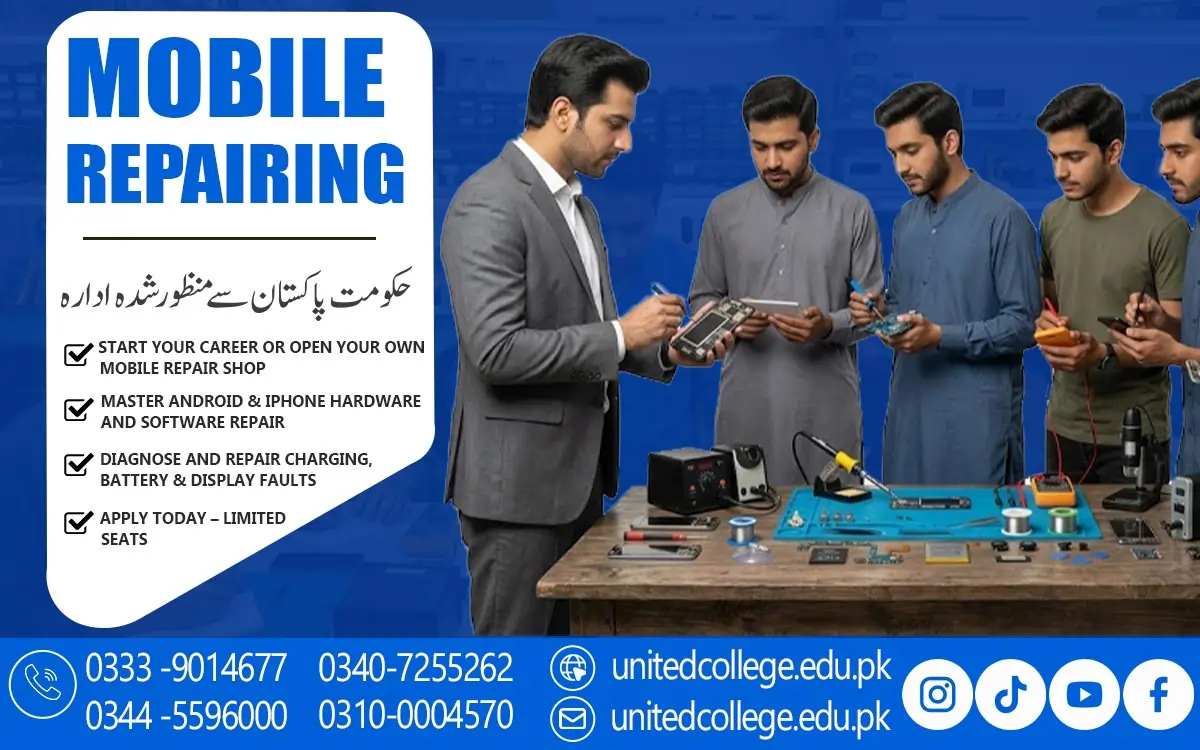

Mobile Repairing Course in Okara – Master Smartphone Repair Skills
Mobile Repairing Course in Okara
A smartphone has become an essential part of everyday life, whether people use it for communication, education, work, banking, shopping, or entertainment. When a phone suddenly stops charging, the display gets damaged, the battery becomes weak, or software starts causing problems, users need a skilled person who can identify the actual fault and provide the right solution. This growing dependence on smartphones has created a continuous need for people with practical mobile repairing skills.
The Mobile Repairing Course in Okara offered by United College of Technology can help beginners understand smartphone hardware, software, troubleshooting, fault diagnosis, and repair techniques. With proper guidance and hands-on practice, students can gradually develop the confidence and technical knowledge needed to work with different types of mobile repair problems.
Why Skilled Mobile Technicians Are Needed in Everyday Life
Think about how much people depend on their smartphones throughout the day. A phone is often used for calls, messages, online classes, office work, social media, photographs, payments, and many other activities, so even a minor technical problem can quickly become a major inconvenience. Common issues such as a phone not charging, a broken screen, weak battery, missing sound, microphone failure, camera problems, or unexpected software errors can make professional repair services necessary.
This is why mobile phone repair has become a practical technical field for people who want to learn a useful skill. For students and beginners in Okara, learning mobile repair can provide an opportunity to develop technical abilities that can be used in mobile shops, repair centers, electronics businesses, or independent work. A mobile repair course in Okara can introduce learners to the practical side of smartphone repair and help them understand how technicians identify and handle different customer problems.
What Students Actually Learn During Mobile Repair Training
A professional mobile technician needs more than the ability to open a smartphone or replace a damaged part. Good repair work begins with understanding the device, identifying symptoms, checking possible causes, and selecting the correct repair approach. During mobile repairing training, students can learn about common mobile hardware components and their functions, including batteries, charging ports, displays, touchscreens, speakers, microphones, cameras, buttons, connectors, and motherboard-related components.
Along with hardware, learners can explore mobile software problems such as system errors, hanging, restarting, application issues, and other common software-related faults. They can also become familiar with basic fault diagnosis, component handling, testing procedures, and safe repair practices. This combination of theory and practical learning helps beginners understand not only what a component does but also how a technician approaches a real repair situation.
Understanding Smartphone Hardware Without Getting Overwhelmed
The inside of a smartphone may appear complicated at first, especially to someone who has never worked with electronic components before. However, students can understand mobile hardware more easily when each component is introduced gradually, and its purpose is explained in simple terms. Learners can study the role of batteries, charging systems, displays, touchscreens, speakers, microphones, cameras, connectors, buttons, and other important parts used in smartphones. They can also learn how different components are connected and how a fault in one area can affect the overall performance of the device.
Through a smartphone repair course, beginners can develop a stronger understanding of mobile hardware components without feeling overloaded with difficult technical information. This basic knowledge becomes important when diagnosing faults because a technician needs to understand the function of a component before deciding whether it needs testing, repair, or replacement.
From Charging Problems to Display Faults: Practical Repair Skills
Many customers visit mobile repair shops because of common hardware problems that affect the basic use of their phones. Through the Mobile Repairing Course in Okara, students can learn how technicians identify and handle these everyday repair issues. A phone may not charge because of a damaged charging port, a faulty connection, a battery problem, or another internal fault, while a damaged display or touchscreen may require careful inspection before deciding on display replacement.
Practical learning also helps beginners understand the importance of handling small and delicate smartphone components carefully. Instead of immediately replacing a part, students can learn to inspect the device, identify possible causes, test relevant components, and then decide on an appropriate repair method. These practical mobile repairing skills can help learners become more careful and systematic when working with customer devices.
Learning Mobile Software Troubleshooting Step by Step
Not every smartphone fault comes from a physical component. A phone may become slow, hang frequently, restart on its own, show system errors, or experience problems with applications and other software functions. This is why mobile software repair is another important area for anyone planning to become a mobile repair technician. During training, learners can develop an understanding of common mobile software problems and learn how technicians approach software troubleshooting in a structured way.
They can become familiar with smartphone troubleshooting concepts and understand why it is important to determine whether a problem is related to hardware or software before starting repair work. Learning both areas can make students more versatile because modern smartphones depend on the proper functioning of both physical components and software. With continued practice, beginners can become more comfortable identifying different symptoms and choosing a suitable troubleshooting approach.
Tools, Testing Methods, and Safe Repair Practices
Having technical knowledge is important, but a technician also needs to know how to handle tools and components properly. During mobile repairing training, students can become familiar with commonly used mobile repair tools and understand their purpose in different repair and testing situations. They can learn why components should be handled carefully, why proper inspection is necessary, and how testing can help identify the actual source of a problem before repair work begins.
Safe working habits are particularly important when dealing with batteries, charging systems, displays, connectors, and motherboard-related components because careless handling can cause additional damage. By practicing with appropriate tools and learning basic testing methods, students can gradually develop a more professional approach to repair work. These habits can also help learners understand that successful mobile repairing depends on patience, accurate diagnosis, careful component handling, and consistent practice rather than guesswork.
How Practical Training Builds Confidence for Real Repair Work
Reading about mobile repair is helpful, but practical experience makes a major difference when someone wants to work as a technician. A beginner may understand the purpose of a charging port or battery from a textbook, but handling the actual component and identifying a real fault requires practice. This is why hands-on learning is an important part of the Mobile Repairing Course in Okara. Students can practice identifying components, using repair tools, checking common faults, handling smartphone parts, and following repair procedures under technical guidance.
Repeated practice can help learners become more comfortable with delicate devices and understand how much care is required during repair work. At United College of Technology, students can develop their knowledge through mobile repairing training and practical activities designed to connect learning with real repair situations. Over time, this practical exposure can help beginners build confidence and improve their ability to approach mobile faults in a logical and careful manner.
Turning Mobile Repairing Skills into a Job or Small Business
After gaining practical knowledge and sufficient experience, learners can explore different ways to use their mobile repairing skills professionally. A beginner may start as a repair shop assistant and work alongside an experienced technician to understand customer handling, device inspection, and everyday repair tasks. With greater experience, a learner may progress toward roles such as Mobile Repair Technician, Smartphone Repair Technician, Mobile Hardware Technician, Mobile Software Technician, or Mobile Service Center Technician. Some people may eventually consider establishing their own small repair setup or providing independent mobile repair services after developing stronger technical and customer-handling skills.
Career growth in this field generally depends on practical ability, accuracy, reliability, communication, and the willingness to keep learning as smartphone technology changes. For students and job seekers in Okara, a career in mobile repairing can therefore begin with structured training and develop gradually through real-world experience and continuous skill improvement.
Career Opportunities for Mobile Repair Technicians in Okara and Beyond
Mobile repairing can provide several practical career directions for learners who develop strong technical skills. After completing training and gaining experience, individuals may look for opportunities in local mobile shops, electronics businesses, repair workshops, service centers, and other places where smartphone repair services are required. A person can begin with basic repair responsibilities and gradually take on more complex tasks as their troubleshooting and fault diagnosis abilities improve. Some technicians may choose to focus more on hardware repair, while others may develop stronger skills in software troubleshooting or advanced areas such as mobile motherboard repair.
With time, experienced technicians may also consider independent repair work or starting a small mobile repair business. United College of Technology can provide a starting point for learners who want structured mobile repairing training, practical exposure, and technical guidance. For someone willing to practice consistently and continue improving, mobile repairing can become a useful technical skill with different possible professional paths in Okara and beyond.
Frequently Asked Questions (FAQs)
A Mobile Repairing Course in Okara teaches students how to identify, troubleshoot, and repair common smartphone hardware and software problems through practical training.
Yes, beginners can join the course and gradually learn about mobile components, repair tools, fault diagnosis, hardware repair, and software troubleshooting.
Students can learn mobile hardware repair, software troubleshooting, charging port repair, display replacement, battery replacement, speaker and microphone repair, and common fault diagnosis.
Yes, practical learning is important for developing mobile repairing skills. Students can practice handling components, using tools, identifying faults, and understanding repair procedures.
After gaining skills and experience, learners can explore roles such as Mobile Repair Technician, Smartphone Repair Technician, Mobile Hardware Technician, or Mobile Service Center Technician.
Admission Open: Start Your Professional Journey Today!
Join United College of Technology and build a career with practical training, recognized certifications, and Gulf job support. Seats are limited.
Apply Now via WhatsAppContact Information
- Address: Rawalpindi: F-272 Main New Katarian Stop, Old IJP Road | Lahore Campus: Lahore, Pakistan
- Phone/WhatsApp: 0340-7255262 / 0333-9014677 / 0301-5044340 / 0310-0004570 / 051-8770756
- Website: unitedcollege.edu.pk
















Leave a Comment