


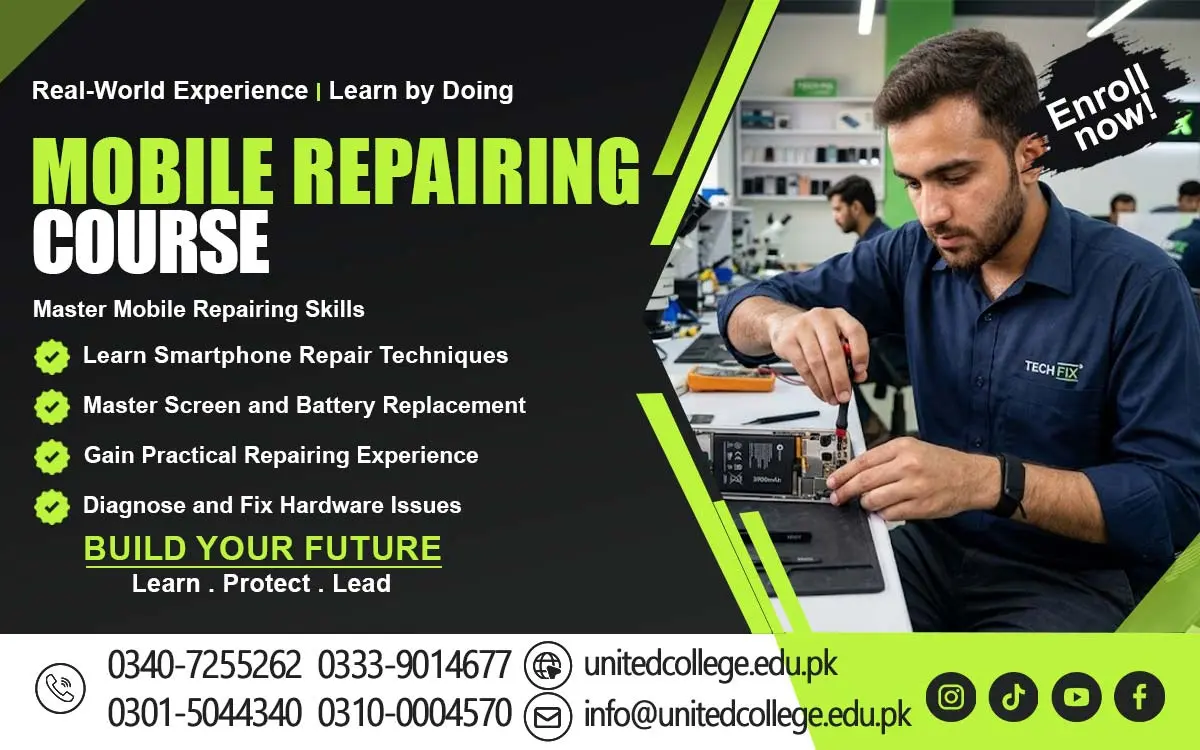

Mobile Repairing Course in Shangla – Learn Practical Phone Repair Skills
When a Broken Mobile Phone Creates a Need for Repair Skills
Imagine a student preparing for an important online class when their mobile phone suddenly stops charging. Another person drops their phone on the floor and finds the screen cracked, while someone else struggles with a battery that loses power within a few hours. These problems are common in everyday life, and they often require someone who understands how mobile phones work and how faults can be identified safely. As smartphones become an important part of communication, education, business, and entertainment, learning repair skills can be a practical way to develop technical knowledge. The Mobile Repairing Course in Shangla is a relevant learning option for people who want to understand mobile phone maintenance and repair.
Offered by United College of Technology (UCT), this course introduces learners to a technical field where patience, careful observation, and regular practice are important. Mobile phone repair is not simply about replacing a broken screen; it also involves identifying the real cause of a problem before attempting a repair. For example, a phone that does not charge may have a damaged charging cable, a faulty port, a weak battery, or another internal issue. Learning how to distinguish between these possibilities helps prevent unnecessary repairs. For students and beginners in Shangla, mobile repairing training can provide a starting point for exploring smartphone hardware, software troubleshooting, and practical electronics repair skills.
How Mobile Repairing Training Can Introduce Learners to Technical Work
Starting a technical skill can feel difficult when a person has never opened a mobile phone or handled repair equipment. However, beginners can develop their knowledge gradually by learning how devices are designed, how their main components work, and how technicians identify common faults. The Mobile Repairing Course in Shangla, offered by United College of Technology, provides a useful subject for learners who want to explore the mobile phone repair field and understand the skills involved. Before attempting complicated repairs, learners need to become familiar with basic mobile phone components, including the battery, display, charging port, speakers, microphone, buttons, and internal circuit board.
A smartphone repair course should help learners recognize that correct diagnosis is often more important than quickly replacing a part. For instance, if a phone screen remains black, the problem may involve the display, battery, charging system, or another component rather than the screen alone. Understanding these possibilities encourages careful inspection instead of guesswork. Mobile repairing training in Shangla may interest school leavers, job seekers, people exploring technical careers, and individuals who want to build a foundation for working with electronic devices. Learners should check the current course details directly with UCT to confirm the available training arrangements.
Practical Repair Skills That Help Identify Mobile Phone Faults
A good repair process begins with understanding the problem rather than immediately opening the device. Suppose a customer brings a phone to a repair shop because it switches off unexpectedly. A technician needs to ask when the issue started, whether the phone was dropped, whether it becomes unusually hot, and whether the battery loses charge quickly. These details help narrow down possible causes before further testing. During mobile phone technician training, learners can develop a systematic approach to fault diagnosis by observing symptoms, checking basic functions, and using suitable diagnostic methods.
Another important skill is learning how to open a smartphone without damaging its delicate internal parts. Modern devices often contain thin cables, tightly fitted components, and adhesive that requires appropriate handling. Incorrect use of opening tools can damage a screen or disconnect an internal cable. Learners also need to understand how to keep screws and small components organized during repair work. Practical mobile repairing skills improve when learners repeat suitable tasks under proper supervision and review mistakes instead of rushing through them.
Common Hardware Problems Every Beginner Should Learn to Recognize
A cracked display, for example, may prevent the user from seeing messages clearly or responding accurately to touch. A damaged charging port can make charging unreliable, while an aging battery may cause unexpected shutdowns. These are common examples of mobile hardware repair problems that technicians need to understand. During the Mobile Repairing Course in Shangla, learners can study how different components contribute to a phone's operation and how their failure affects everyday use. Screen replacement involves more than removing broken glass because the display assembly, connectors, adhesive, and model-specific design must all be considered.
Similarly, mobile charging port repair requires careful diagnosis because the charging cable, power adapter, battery, and internal charging circuit may also contribute to the problem. Speaker and microphone faults can affect calls, voice recordings, and audio playback, while faulty buttons may make it difficult to control the device. Battery replacement and testing also require attention to safety because damaged or swollen lithium-ion batteries can present a fire risk. Learners should never puncture, bend, or apply excessive force to a battery. Water-damaged phones need special care as well, because moisture can cause corrosion and electrical faults even when the device initially appears to work.
Mobile Software Troubleshooting for Everyday Smartphone Issues
Sometimes a phone becomes slow because its storage is almost full, an application repeatedly crashes, or a software update has not completed correctly. In other situations, a device may become stuck during startup or display unexpected error messages. Mobile software troubleshooting focuses on identifying and addressing these problems through appropriate software-related procedures. Beginners learning Android phone troubleshooting can start with simple checks, such as reviewing available storage, restarting the device, checking application permissions, and installing supported updates from trusted sources.
More advanced procedures, including firmware installation and operating system recovery, require careful attention because an incorrect file or interrupted process can make a device unusable. A factory reset may erase personal information, so the technician should explain the risks and obtain the owner's permission before proceeding. When possible, important data should be backed up using an appropriate method before any operation that could erase it. Software repair must also respect security protections and ownership rights; technicians should never attempt to bypass security controls or access private information without authorization.
Essential Mobile Repairing Tools and Their Proper Use
Imagine trying to open a modern smartphone with a large household screwdriver. The tool may slip, damage a screw, scratch the frame, or harm nearby components. This simple example shows why choosing the correct equipment is an important part of mobile repairing training. Different repairs require different tools, and learners should understand their purpose before using them. Precision screwdrivers help remove small screws, while plastic opening tools can help separate phone components with less risk of scratching or damaging the casing. Fine tweezers are useful for handling small parts, and organized trays help prevent screws and connectors from getting lost during disassembly.
A digital multimeter can measure electrical values such as voltage and resistance, helping a trained person investigate certain electrical faults. However, it must be used correctly, with suitable settings and safe testing procedures. Soldering equipment may be needed for some component-level repairs, but soldering requires practice, proper ventilation, temperature control, and an understanding of delicate electronic circuits. Beginners should not attempt advanced board-level work without suitable instruction and supervision. Other useful equipment may include appropriate lighting, magnification tools, cleaning supplies designed for electronics, and model-specific repair information.
Safe Hands-On Practice and Responsible Customer Data Protection
A beginner who opens a phone without understanding its internal layout may tear a flexible cable, damage a connector, or lose important screws. For this reason, hands-on mobile repairing practice should begin with suitable devices, clear instructions, and supervision when needed. During the Mobile Repairing Course in Shangla, learners can develop practical repair skills by studying phone models, using the correct tools, and learning how to handle delicate components carefully. Before starting a repair, a technician should understand the reported fault and check whether the device has visible damage or a potentially dangerous battery condition.
If a battery is swollen, leaking, or unusually hot, the device should not be handled casually; appropriate safety procedures and qualified assistance are necessary. Customer privacy is equally important. Mobile phones contain personal photographs, messages, contacts, banking applications, and other private information. A repair technician should obtain permission for necessary diagnostic operations, avoid opening personal files without authorization, and never copy or share customer data. If software recovery may erase information, the customer should be informed beforehand.
Career Paths That May Follow Mobile Repairing Skills
After developing practical repair knowledge, learners may explore different ways to use their skills. Some people may look for assistant technician roles in mobile repair shops, while others may seek opportunities in electronics service centers or businesses that handle smartphone maintenance. A person with sufficient experience may eventually consider operating a small mobile repair shop, depending on local demand, available resources, business costs, and the ability to provide reliable service. However, these opportunities depend on more than completing a training course. Employers and customers may consider practical ability, troubleshooting experience, communication skills, honesty, and the quality of previous work.
For example, a technician who can explain why a charging problem occurs and describe the available repair options may build greater customer confidence than someone who replaces parts without proper diagnosis. Learners should also understand the difference between basic repairs and specialized work. Replacing certain components may be manageable after appropriate training, while advanced motherboard repairs, complex circuit diagnosis, and severe water-damage cases require additional knowledge and suitable equipment. The Mobile Repairing Course in Shangla offered by United College of Technology can be explored by people who want to learn about this technical field, but prospective students should confirm the actual course content and available practical instruction before enrolling.
Preparing for Mobile Repairing Training and Improving Technical Confidence
One useful step is to understand the basic functions of smartphone components, such as the battery, display, charging port, camera, speaker, microphone, and circuit board. Learners can also become familiar with common terms, including voltage, connector, short circuit, software update, and fault diagnosis. Understanding these words makes it easier to follow technical explanations during training. Another helpful habit is observing everyday phone problems and thinking about possible causes without immediately assuming that a particular part has failed.
For instance, when a phone charges slowly, the issue might involve the cable, adapter, charging port, battery, or software rather than a single obvious fault. This approach encourages logical thinking and careful testing. People interested in mobile repairing training in Shangla should also ask about course content, practical exercises, equipment, fees, duration, and any entry requirements before making a decision. United College of Technology can be contacted for confirmed details about its Mobile Repairing Course in Shangla and the learning arrangements currently available. Once training begins, regular practice, organized notes, and reviewing mistakes can help improve understanding over time.
Frequently Asked Questions (FAQs)
The Mobile Repairing Course in Shangla introduces learners to mobile phone hardware repair, software troubleshooting, fault diagnosis, and the use of basic repairing tools.
Students, beginners, job seekers, and anyone interested in learning smartphone repair skills can explore this course. Contact United College of Technology (UCT) to confirm the current admission requirements.
Learners can study mobile phone fault diagnosis, screen replacement, charging problems, battery testing, software troubleshooting, and safe handling of repair tools.
Yes, beginners can start by learning basic phone components, common faults, and safe repair procedures before moving on to more advanced techniques.
Common tools include precision screwdrivers, tweezers, plastic opening tools, multimeters, and suitable soldering equipment for advanced repairs.
Admission Open: Start Your Professional Journey Today!
Join United College of Technology and build a career with practical training, recognized certifications, and Gulf job support. Seats are limited.
Apply Now via WhatsAppContact Information
- Address: Rawalpindi: F-272 Main New Katarian Stop, Old IJP Road | Lahore Campus: Lahore, Pakistan
- Phone/WhatsApp: 0340-7255262 / 0333-9014677 / 0301-5044340 / 0310-0004570 / 051-8770756
- Website: unitedcollege.edu.pk
















Leave a Comment