


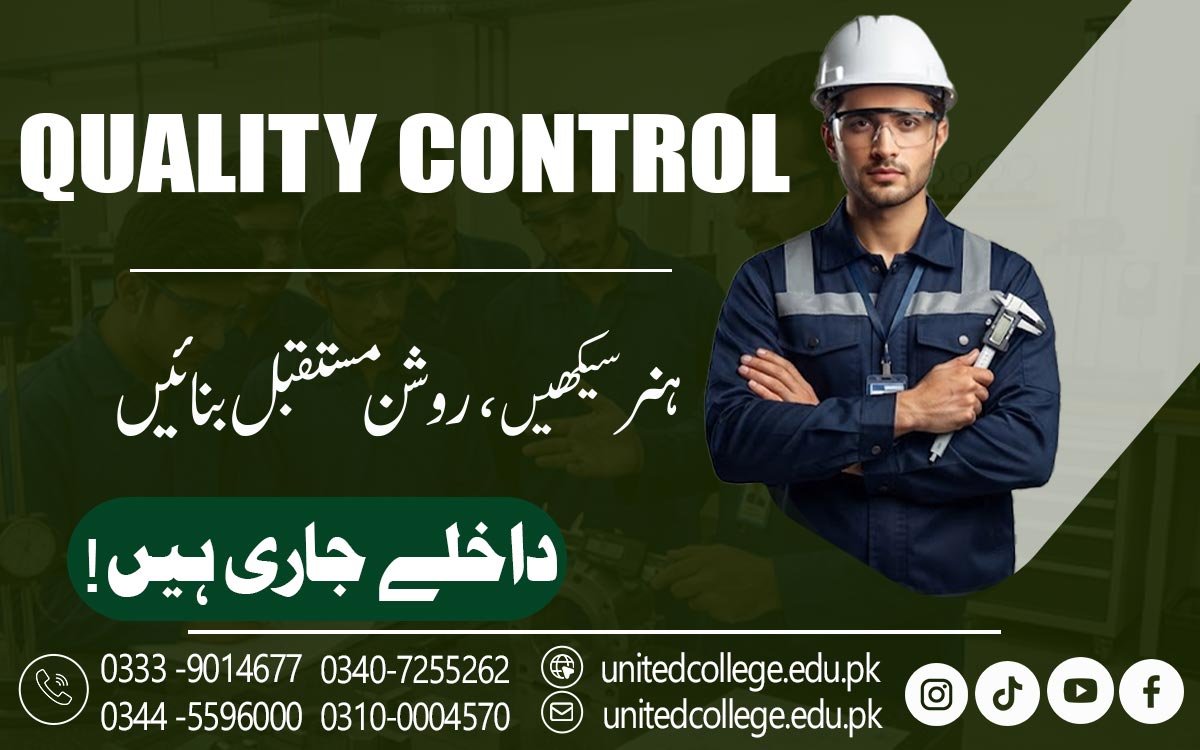

Quality Control Course in Bhimber AJK for Industrial Learning
Good Products Begin With Good Quality Decisions
A product may look perfect from the outside, but its real value depends on how carefully it was made, checked, and prepared for use. This is where quality control becomes important. Quality Control Course in Bhimber AJK offers an opportunity for students, beginners, diploma holders, fresh graduates, and job seekers to understand the work behind reliable products and professional production. Quality control is not simply about finding mistakes.
It involves checking materials, measurements, processes, and finished work against defined requirements. In industries where accuracy matters, a small error can lead to waste, customer complaints, or production delays. Learning how to notice such problems and report them properly can therefore become a useful workplace skill.
Quality Control Is More Than Just Finding Faults
In simple words, quality control means making sure that work meets the expected standard. Imagine a factory producing metal parts for machines. Before those parts are sent forward, someone needs to check their size, shape, surface condition, and other requirements. If one part is incorrectly measured, it may not fit properly when used.
This makes quality inspection an important part of the production process. Learners can also understand the difference between quality control and quality assurance. Quality Control Course in Bhimber AJK focuses mainly on checking actual work and identifying problems, while quality assurance is concerned with systems and processes that help prevent problems from happening.
Turn Observation Into a Useful Technical Skill
A strong quality professional needs a trained eye. During a Quality Control Course in Bhimber AJK, learners can develop the ability to observe work and recognize conditions that may affect product quality. Training can introduce students to inspection techniques, measurement practices, checking methods, and basic quality testing. They can learn how specifications are used to decide whether work is acceptable and how inspection procedures should be followed in an organized way.
Defect identification is another useful area because defects can appear in different forms. A product might have an incorrect dimension, damaged surface, poor finishing, weak connection, missing component, or another issue. Instead of simply saying that something is wrong, a trained learner can learn to identify the nature of the problem and communicate it clearly.
Learn What Happens Between a Check and a Decision
Quality inspection does not end when a worker notices an issue. The next step is understanding what the finding means and recording it correctly. For this reason, students can learn about inspection records, checklists, reports, measurements, and other forms of workplace documentation. Accurate records help teams track recurring problems and understand whether production standards are being maintained.
For example, if the same defect appears several times during a production shift, proper documentation can help supervisors investigate the reason instead of treating every case as an isolated mistake. Learners can also become familiar with basic quality control procedures and the importance of following instructions consistently. This part of training develops a sense of responsibility because quality work requires accuracy and honesty.
Practical Learning Makes Technical Knowledge Easier to Use
Reading definitions from a textbook can introduce a subject, but practical training can make those ideas easier to understand. Learners benefit when they can see examples, perform basic checks, practice measurements, examine sample defects, and discuss workplace situations with an instructor. This type of learning can help beginners become less nervous when they first encounter technical inspection tasks.
United College of Technology offers the Quality Control Course in Bhimber, AJK, as part of its career-oriented technical training approach. The focus on practical understanding can help learners connect classroom concepts with situations they may encounter in professional environments. Instructor guidance is particularly useful for beginners because quality inspection often involves details that are difficult to understand through theory alone.
One Skill Can Connect With Several Industrial Fields
Quality control knowledge can be useful across different industries because many workplaces need consistent standards. Manufacturing companies may require people to inspect products during production, while engineering and fabrication businesses may need checks on components and finished work. Construction-related operations can also involve material and workmanship inspections.
This means learners are not necessarily limited to one type of workplace after studying quality control. Depending on their education, experience, and additional skills, they may explore roles such as quality inspector, quality control inspector, inspection assistant, production quality worker, or related technical positions. Job titles and requirements vary from one employer to another, so training should be viewed as a foundation rather than a promise of employment.
Build Workplace Habits Alongside Technical Knowledge
Successful quality work requires the right attitude as much as technical understanding. A person working around production or inspection activities needs patience because important details can be easy to miss when work is rushed. Accuracy is also essential when taking measurements or entering information into records. Safety should never be ignored, especially in environments involving machinery, tools, chemicals, heavy materials, or active production areas.
Learners can prepare themselves by improving basic mathematics, computer use, communication, observation, and problem-solving abilities. These supporting skills can make technical training more useful in the long term. For students and job seekers in Bhimber, AJK, vocational training in AJK can be a practical way to add a focused skill to their existing education.
Make Quality Your Next Professional Direction
Choosing a technical field often becomes easier when learners understand what kind of work matches their interests. Quality control can suit people who enjoy careful observation, organized tasks, problem-solving, measurements, and checking work against clear requirements. A Quality Control Course in Bhimber, AJK can give students and job seekers a starting point for learning about industrial inspection, product quality, production standards, and quality management.
At United College of Technology, learners interested in practical technical education can explore this field and develop knowledge that may support their future career plans. There is no single path for everyone, and employment depends on factors such as skills, experience, qualifications, and employer requirements. However, building a useful technical foundation can be an important step toward professional growth.
Frequently Asked Questions (FAQs)
A quality control learner should be curious, patient, organized, and willing to examine small details instead of making quick assumptions.
Yes. Knowledge of areas such as engineering, production, welding, construction, or computer applications can complement quality control knowledge.
Quality staff often need to explain findings to supervisors and production teams. Clear communication helps others understand an issue and respond appropriately.
A beginner can strengthen basic mathematics, observation, computer use, and communication. A willingness to practice is also important for learning technical tasks.
No. Quality-related checks can take place at different stages, including before production, during processing, and when work is being prepared for final use.
Careful work, reliable records, responsible behavior, strong observation, continuous learning, and the ability to follow workplace instructions can create a positive professional impression.
Admission Open: Start Your Professional Journey Today!
Join United College of Technology and build a career with practical training, recognized certifications, and Gulf job support. Seats are limited.
Apply Now via WhatsAppContact Information
- Address: Rawalpindi: F-272 Main New Katarian Stop, Old IJP Road | Lahore Campus: Lahore, Pakistan
- Phone/WhatsApp: 0340-7255262 / 0333-9014677 / 0301-5044340 / 0310-0004570 / 051-6770756
- Website: unitedcollege.edu.pk
















Leave a Comment