


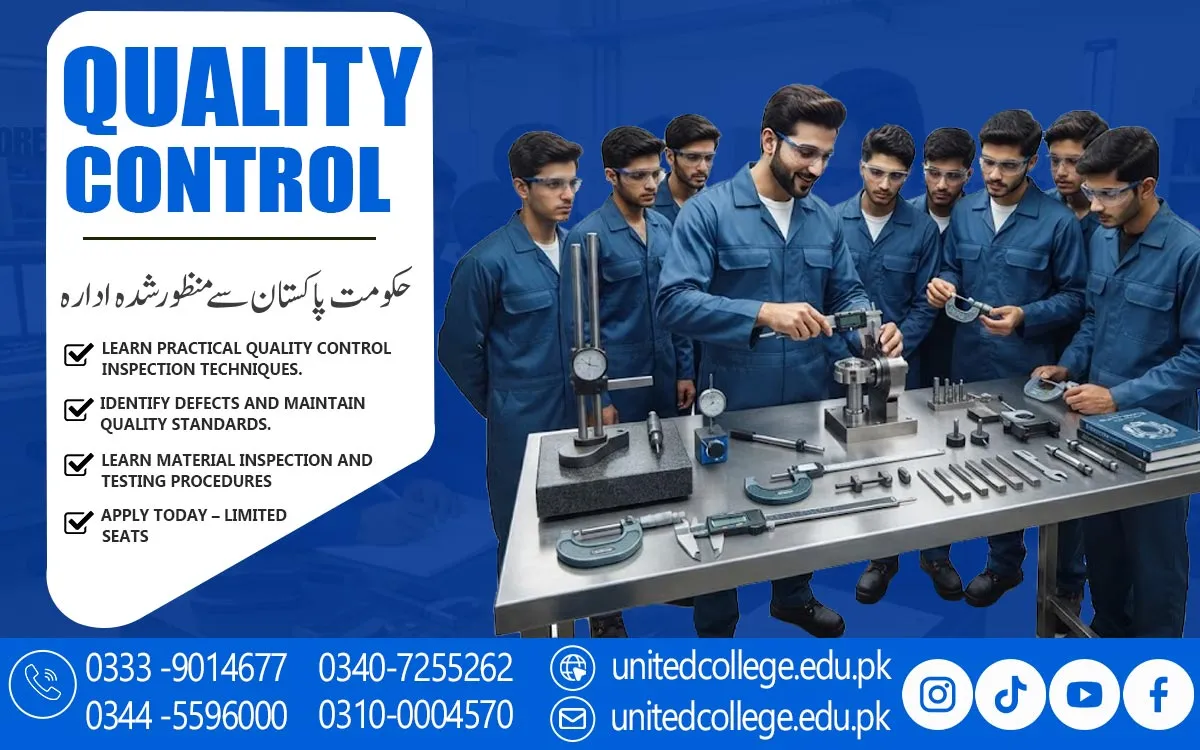

Quality Control Course in Jhang to Improve Production Accuracy
Quality Control Course in Jhang to Turn Precision Into Practical Expertise
A single defect can sometimes create a chain of problems. A wrongly sized part may stop an assembly, poor finishing can lead to rejection, and an unnoticed production error may increase material waste. For this reason, industries need people who understand how to check work before small issues become expensive problems. The Quality Control Course in Jhang provides a practical learning path for students, beginners, fresh learners, workers, and job seekers who want to understand quality inspection and workplace standards.
Quality control involves checking whether materials, products, and processes meet expected requirements. It also involves recording findings, identifying defects, and supporting improvements. For learners who want to develop a technical skill with practical value, quality control can provide a useful foundation for understanding how professional workplaces maintain consistency and reliability.
A Quality Check Can Protect More Than the Final Product
Quality control begins with a simple goal: make sure the work is done according to the required standard. A Quality Control Course in Jhang can help learners understand how quality checks are applied throughout the production process. In a production environment, this may involve checking raw materials before use, monitoring work during manufacturing, and examining finished products. These steps can help organizations reduce avoidable waste and maintain consistent production quality. Consider a workshop making metal components.
If a component is slightly larger than the required size, it may not fit correctly into another part. Detecting that issue early can prevent further work from being performed on a defective item. Through a Quality Control Course in Jhang, learners can understand how planned checking supports production rather than viewing inspection as a final formality. They can also discover why quality standards differ between industries and why workers must follow the specific requirements of their workplace.
Develop the Inspection Skills Behind Reliable Results
Effective inspection depends on knowing what to check and how to check it. Students studying a Quality Control Course in Jhang can learn basic quality inspection techniques, product inspection, process inspection, and quality testing concepts. These may include visual examination, measurement, comparison with specifications, sampling, and other checking methods suitable for different work situations.
For example, a learner may examine whether a product has the correct dimensions, acceptable finishing, proper fitting, or visible signs of damage. Such activities can improve observation and help learners understand how quality inspector skills develop through practice. Instead of depending on guesswork, students learn to use defined requirements as a basis for making inspection decisions.
Learn Why Quality Assurance Works Alongside Inspection
Quality control and quality assurance are closely connected, but they are not identical. Quality control mainly focuses on examining actual products or processes and identifying problems. Quality assurance is broader and involves planned systems, procedures, and practices that support consistent quality. During quality assurance training, learners can understand why organizations create procedures and standards before problems occur.
These practices form part of a wider quality management approach. Students can therefore learn that good quality is not created by one inspection at the end of production. It develops through consistent procedures, responsible workers, suitable checks, and continuous attention to standards. This understanding can help beginners see how different parts of a quality management system work together.
Accurate Records Give Quality Work a Professional Foundation
Imagine identifying an important problem but failing to record what happened. The same issue could appear again without anyone having useful information to compare. Quality documentation helps prevent this gap. A Quality Control Course in Jhang can introduce learners to the purpose of inspection reports, checklists, measurement records, quality reports, and other workplace documents. Good records can show what was checked, what result was found, and what action followed.
They can also help supervisors recognize repeated issues and monitor whether corrective measures are working. This makes communication an important part of quality control. A quality professional may need to explain a finding clearly to production staff or supervisors without creating confusion. Through a structured Quality Control Course in Jhang, learners can develop better habits for recording information, maintaining accurate documentation, and communicating observations effectively.
Practical Learning Makes Workplace Tasks Feel More Familiar
Technical knowledge becomes more useful when learners know how to apply it. Practical quality control training can expose students to realistic examples of inspection, measurement, defect identification, documentation, and workplace decision-making. Instead of memorizing terms, learners can understand how a quality check may take place from beginning to end.
United College of Technology offers the Quality Control Course in Jhang for learners interested in practical and career-focused technical education. A learning approach that combines explanation with practice can help students build confidence while developing accuracy and professional discipline. It can also help them recognize areas where they need more practice before entering a workplace.
Quality Skills Can Connect With Many Technical Workplaces
Quality control knowledge can be applied in several areas because businesses across different sectors need reliable processes and products. Manufacturing units may inspect materials, components, and finished goods. Engineering and fabrication workplaces may check dimensions, assembly, and workmanship.
Depending on their education and experience, learners may explore roles such as quality inspector, quality control inspector, inspection assistant, or other quality-related positions. However, employers can set different requirements, and completing training does not guarantee a particular job.
Make Careful Work Part of Your Professional Identity
Quality control can be a suitable direction for people who enjoy detail-oriented tasks, organized procedures, technical problem-solving, and careful decision-making. Students, fresh learners, workers, diploma holders, and job seekers in Jhang can explore this field as a way to add a practical technical skill to their existing knowledge. The Quality Control Course in Jhang can introduce learners to inspection procedures, quality standards, testing, documentation, corrective action, preventive action, and quality improvement.
With guidance from United College of Technology, learners can build a foundation that connects classroom knowledge with practical workplace expectations. Professional growth still depends on experience, continued learning, qualifications, and the requirements of individual employers. However, developing strong quality habits can give learners a valuable starting point.
Frequently Asked Questions (FAQs)
The first step depends on the workplace, but an inspector may begin by reviewing the required specifications and then checking the relevant material, product, or process.
Yes. Workers can use quality knowledge to better understand production requirements and recognize issues that may affect the final result.
Yes. Quality staff may need to compare findings with workplace requirements and decide whether an item needs approval, correction, or further examination.
Consistent quality can reduce avoidable defects and help businesses provide products that better match customer expectations.
It can be useful as part of broader technical experience because understanding quality processes may help workers communicate inspection concerns and monitor work more effectively.
It connects technical knowledge with real workplace tasks such as checking, measuring, recording, evaluating, and improving work.
Admission Open: Start Your Professional Journey Today!
Join United College of Technology and build a career with practical training, recognized certifications, and Gulf job support. Seats are limited.
Apply Now via WhatsAppContact Information
- Address: Rawalpindi: F-272 Main New Katarian Stop, Old IJP Road | Lahore Campus: Lahore, Pakistan
- Phone/WhatsApp: 0340-7255262 / 0333-9014677 / 0301-5044340 / 0310-0004570 / 051-8770756
- Website: unitedcollege.edu.pk
















Leave a Comment