


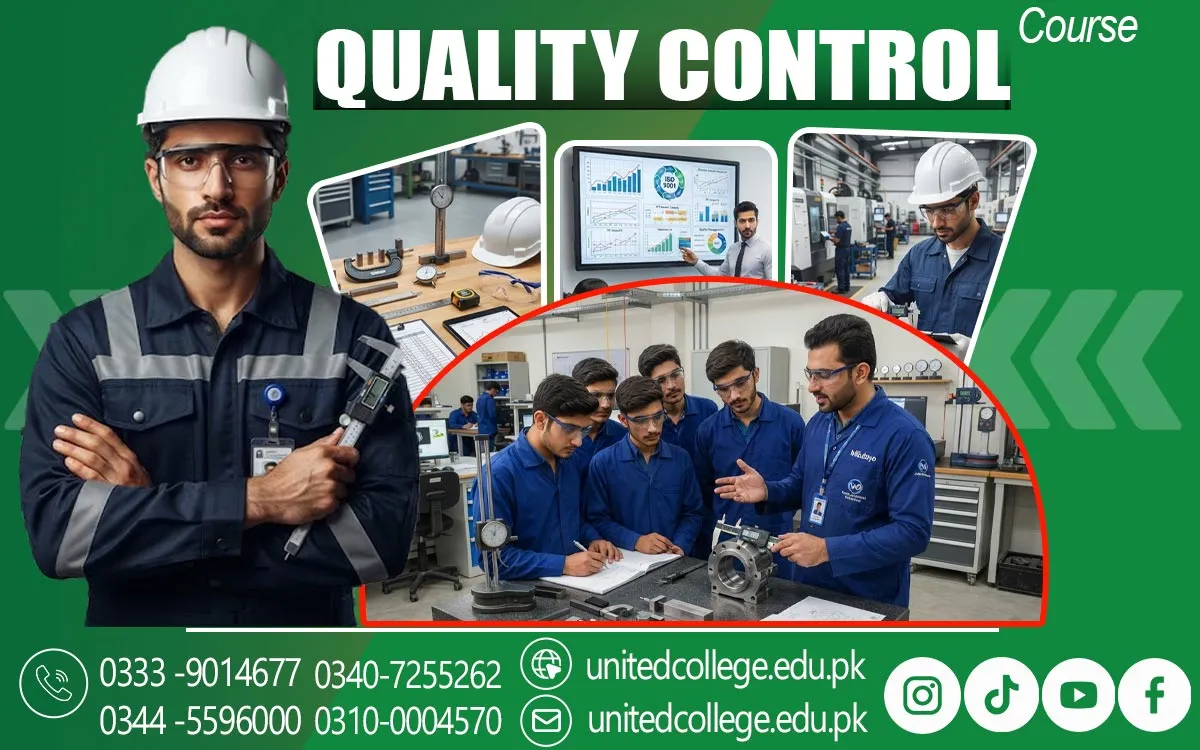

Quality Control Course in Khushab to Strengthen Quality Expertise
Where Careful Skills Can Shape Your Professional Future
A product can lose its value because of one small mistake. A wrong measurement, damaged material, weak finishing, or missed defect can create waste, increase costs, and affect customer trust. That is why quality has become an important part of modern technical and industrial work. Quality control helps businesses keep their work within required standards. It involves checking materials, products, processes, and results to find problems before they become bigger. It also supports consistency, better production, and continuous improvement.
For students, beginners, fresh graduates, workers, and job seekers in Khushab, learning quality control can provide useful knowledge for technical environments. The Quality Control Course in Khushab offered by United College of Technology can help learners understand practical quality concepts and develop skills related to inspection, testing, documentation, and workplace standards.
A Small Error Can Become a Major Workplace Problem
Quality control begins with understanding what can go wrong. Every workplace has requirements that its products, materials, or processes need to meet. A Quality Control Course in Khushab can help learners understand these requirements and recognize how quality issues can affect production. When these requirements are not followed, the result may include defective products, wasted materials, delayed work, or customer complaints. Early quality checks can help identify such issues before they create larger problems.
For example, a manufacturing unit may discover that a batch of material does not meet the required specification. Finding this issue before production continues can prevent additional work on unsuitable material. This shows why quality inspection is more than simply checking a finished product. It can be part of the complete production process and help maintain consistent workplace quality.
Understand What Quality Control Looks Like in Real Work
Quality control involves systematic checking. Workers follow inspection procedures to compare actual results with expected requirements. The process can include examining materials, checking product conditions, taking measurements, performing basic tests, and recording findings. The exact method depends on the industry and type of work.
For beginners, the main idea is simple: check the work, compare it with the requirement, identify differences, and report the findings clearly. Through quality control training, learners can develop an understanding of how these steps connect. This foundation can make technical quality tasks easier to understand.
Quality Assurance Builds Strength Before Problems Appear
Quality control focuses heavily on checking actual work, while quality assurance focuses on processes that support consistent quality. Imagine a workplace where workers follow a clear procedure from the beginning. That procedure can help prevent mistakes. Quality control can then check the resulting work to see whether the expected requirements were achieved.
Both areas support quality assurance practices and workplace quality control. Learning the difference can give beginners a broader understanding of how organizations manage quality. It also shows that quality is not only about finding mistakes. Good quality practices aim to reduce the chance of those mistakes happening in the first place.
Strong Quality Work Depends on Strong Personal Skills
Technical knowledge is only one part of quality control. The way a person approaches work also matters. Observation helps workers notice unusual details. Accuracy supports reliable measurements and records. Documentation keeps important information organized. Communication helps workers explain quality issues to others.
Problem-solving skills are equally valuable. When a problem appears repeatedly, a quality worker may need to look beyond the immediate defect and consider what part of the process could be causing it. These habits can help learners become more organized and responsible in technical workplaces.
Process Monitoring Keeps Quality Connected to Production
Quality should not always be checked only after production has finished. Monitoring work during different stages can help identify problems earlier. A Quality Control Course in Khushab can help learners understand how process monitoring works and why it is important for maintaining production quality. Process monitoring allows teams to observe whether activities are following expected procedures.
This is especially relevant to manufacturing quality and production quality checks. A small process problem can sometimes create repeated defects if nobody notices it early. Learners can therefore understand how quality control supports production instead of working separately from it. They can also develop practical awareness of how regular monitoring contributes to consistent and reliable results.
Quality Knowledge Can Travel Across Different Workplaces
Quality control is useful in many industries because different workplaces all need reliable results. The exact inspection methods may change, but the basic principles remain relevant. Manufacturing units may inspect raw materials and finished goods. Construction-related workplaces may check materials, dimensions, and completed tasks.
Food production, warehousing, industrial operations, and engineering-related workplaces can also involve quality checks. For learners in Khushab, this wider connection can make quality control a useful technical area to explore. It can also complement other skills and provide a better understanding of industrial quality management.
Practical Learning Gives Quality Skills a Real-World Meaning
Quality concepts become easier to understand when learners connect them with practical situations. Instead of only learning definitions, students can explore how inspection methods, standards, testing, and documentation work together. The Quality Control Course in Khushab offered by United College of Technology can support this learning process.
With instructor guidance, learners can become familiar with important areas such as quality inspection, defect identification, quality testing, documentation, process monitoring, and quality improvement. This type of training can be useful for beginners who want to build a foundation before entering a technical or industrial environment.
Turn Careful Working Into a Professional Strength
Quality control can shape the way a person thinks about technical work. Instead of completing a task and moving on, a quality-focused worker learns to check whether the result meets the expected requirements. This approach encourages accuracy, patience, responsibility, and attention to detail.
For fresh graduates and job seekers, these quality control career skills can complement their existing education or technical interests. Workers can also use quality knowledge to better understand the standards connected with their daily responsibilities. The Quality Control Course in Khushab can provide a starting point for learners who want to develop this professional approach.
Make Quality Knowledge Part of Your Next Step
A strong technical career can begin with learning how professional work is checked and improved. Quality control provides practical knowledge about standards, inspection, testing, process monitoring, and problem identification. For students, beginners, workers, and job seekers in Khushab, developing these skills can strengthen their understanding of modern workplace requirements.
It can also build useful habits that apply to different technical and industrial settings. The Quality Control Course in Khushab offered by United College of Technology gives interested learners a path to explore these areas in a structured learning environment. Building knowledge today can help you approach future technical responsibilities with greater accuracy, awareness, and confidence.
Frequently Asked Questions (FAQs)
Yes. Quality awareness can help workers examine incoming goods, storage conditions, packaging, and outgoing items more carefully.
In some workplaces, quality teams inspect supplied materials to determine whether they match the required specifications before production begins.
Consistent results help businesses maintain the same expected level of quality across repeated production instead of producing items with major differences.
Yes. Learners can develop a habit of reviewing evidence, comparing requirements, and considering findings before making quality-related decisions.
Depending on the workplace procedure, it may be separated, reviewed, corrected, retested, or handled according to the organization’s quality process.
No. Small production units and other workplaces can also use quality practices to maintain reliable work and reduce avoidable errors.
Admission Open: Start Your Professional Journey Today!
Join United College of Technology and build a career with practical training, recognized certifications, and Gulf job support. Seats are limited.
Apply Now via WhatsAppContact Information
- Address: Rawalpindi: F-272 Main New Katarian Stop, Old IJP Road | Lahore Campus: Lahore, Pakistan
- Phone/WhatsApp: 0340-7255262 / 0333-9014677 / 0301-5044340 / 0310-0004570 / 051-8770756
- Website: unitedcollege.edu.pk
















Leave a Comment