


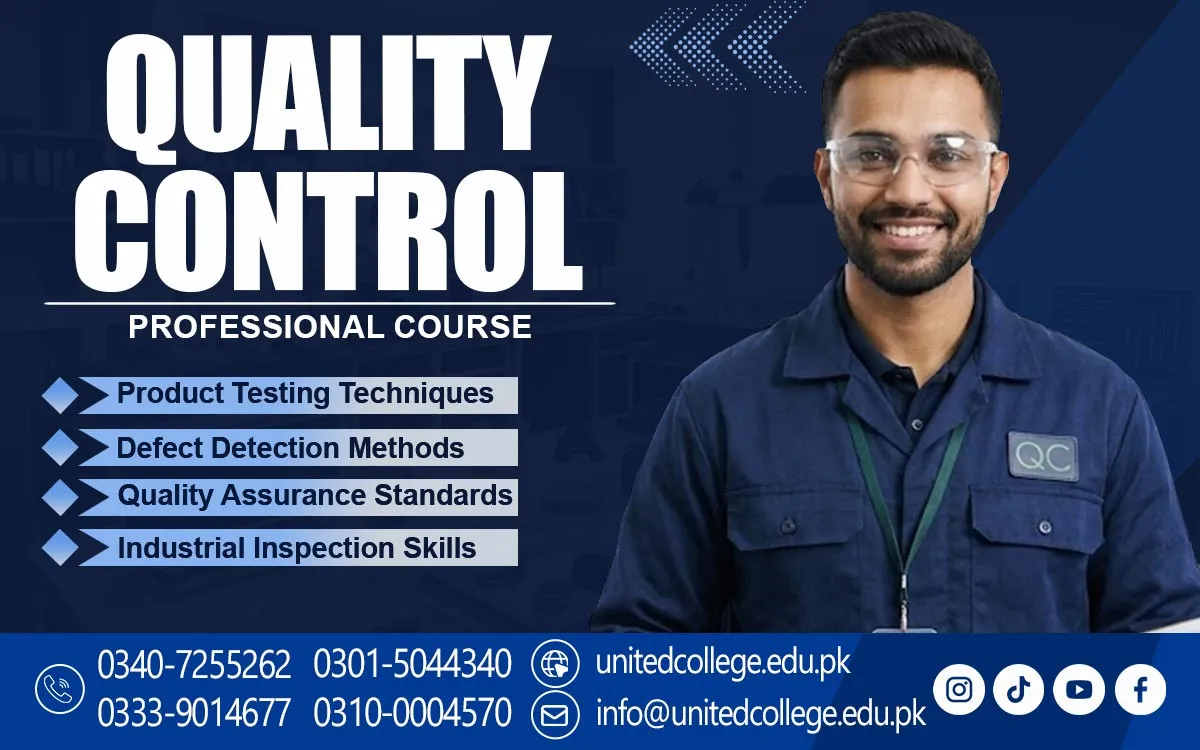

Quality Control Course in Nowshehra for Skill Growth
Maintaining Product Quality in Modern Industrial Workplaces
A product may look perfect when it leaves a factory, but a small manufacturing mistake can affect its performance, safety, and reliability. Similarly, an incorrect measurement on a construction site or the use of poor-quality material can create serious problems during a project. These situations show why quality control is an important part of modern industries. Businesses need trained people who can inspect materials, check finished products, identify defects, and make sure that work follows the required standards. A Quality Control Course in Nowshehra, offered by United College of Technology (UCT), provides learners with an opportunity to understand these important responsibilities and develop relevant technical knowledge.
Quality control is not limited to large factories; it is also used in construction companies, production units, engineering workshops, warehouses, and many other workplaces. Students can learn the importance of checking work carefully instead of depending only on its appearance. They can also become familiar with product quality standards, inspection procedures, and basic testing methods. For beginners, understanding these processes creates a useful foundation for learning about industrial quality management. The course is relevant to students and fresh learners who want to explore technical training and understand the role of quality inspection in different working environments.
Essential Responsibilities of a Quality Control Inspector
Imagine a factory producing hundreds of metal components every day. If even a few pieces have incorrect measurements or damaged surfaces, they may not fit properly into the final product. A quality control inspector helps identify such problems before defective items move to the next production stage. The main responsibility of this professional is to examine materials, products, and work processes according to established quality requirements. During quality control training, students can understand how inspectors check product dimensions, appearance, weight, finishing, and other important features. They also learn the importance of comparing actual results with the required specifications.
A quality inspector may examine incoming raw materials, monitor production activities, and inspect finished products before approval. If a defect is discovered, it must be recorded and reported to the responsible team. This process helps businesses understand the source of a problem and take suitable corrective action. Quality control responsibilities can vary depending on the industry, but accuracy and attention to detail remain important in every workplace. Through a Quality Control Course in Nowshehra, learners can develop an understanding of these duties and the professional behaviour expected from people working in quality inspection and industrial quality control.
Practical Skills Developed Through Quality Control Training
A worker may know how to operate a machine, but producing an item correctly also requires an understanding of quality requirements. For example, a manufactured part must have the correct dimensions, smooth finishing, and suitable material strength to perform its intended function. Quality control training introduces students to the practical skills used to examine these requirements. Learners can develop knowledge of inspection methods, defect identification, measurement techniques, and basic testing procedures. They can also understand the difference between acceptable and unacceptable products by comparing samples with given specifications. Another important skill is reading simple technical drawings and understanding measurement details.
These drawings provide information about the required shape, size, and dimensions of a component. Students can also learn the importance of maintaining inspection records and communicating findings clearly. Quality control work requires patience because even a small defect can affect the final result. At United College of Technology (UCT), the Quality Control Course in Nowshehra is relevant to learners who want to build a foundation in these technical areas. Understanding these skills can help beginners become more familiar with industrial inspection activities and the standards followed in different production environments.
Product Inspection and Defect Identification Techniques
A product can have a hidden problem even when its outer appearance seems completely normal. A metal component may contain a crack, a plastic item may have an uneven shape, or a finished product may not match its required measurements. This is why product inspection involves more than simply looking at an item. During quality control training, students can learn about visual inspection, dimensional checking, surface examination, and basic testing methods. Visual inspection helps identify visible problems such as scratches, cracks, dents, colour differences, and poor finishing. Dimensional inspection involves checking the length, width, thickness, or diameter of an item using suitable measuring instruments.
In some workplaces, products also require functional testing to confirm that they work according to their intended purpose. Defect identification is an important part of quality inspection techniques because it helps prevent unsuitable products from reaching customers. Students should also understand that not every defect has the same level of seriousness. Some issues may affect appearance, while others can influence product safety or performance. A Quality Control Course in Nowshehra can introduce beginners to these inspection concepts and explain the importance of following proper procedures when examining different materials and finished products.
Quality Assurance and Industrial Management Practices
A manufacturing company may inspect its products at the end of production, but finding mistakes at that stage can lead to unnecessary waste and delays. Quality assurance focuses on improving the processes that help prevent these problems from happening in the first place. Although quality assurance and quality control are closely connected, they have different responsibilities. Quality assurance is mainly concerned with maintaining suitable procedures throughout the work process, while quality control focuses on checking products and identifying defects. Together, quality assurance and quality control help businesses maintain consistent standards.
They can also develop an understanding of manufacturing quality standards and the importance of following instructions during production. For example, if a factory repeatedly produces items with incorrect dimensions, the quality team may investigate machine settings, raw materials, or operating procedures to identify the reason. This approach helps address the actual source of the problem instead of correcting only individual defective products. Through Quality Control Training in Nowshehra, learners can understand these basic industrial management practices and their role in maintaining product quality, improving work processes, and reducing avoidable mistakes.
Inspection Tools and Material Testing Procedures
Using the wrong measuring tool can produce an incorrect result, even when an inspector is working carefully. For example, checking the thickness of a metal sheet with an unsuitable instrument may lead to inaccurate measurements and incorrect quality decisions. Quality control professionals therefore need to understand common inspection tools and their correct use. Students can become familiar with instruments such as measuring tapes, steel rulers, vernier calipers, micrometers, weighing scales, and other basic measuring equipment. Each tool has a specific purpose, and selecting the right one depends on the material and measurement requirements.
Depending on the workplace, testing may involve checking hardness, strength, thickness, weight, or other characteristics. Students can also learn the importance of recording measurements correctly and following safety instructions during inspection activities. Quality control documentation provides written evidence of inspection results, test observations, and identified defects. These records help supervisors review work and make informed decisions. The Quality Control Course in Nowshehra offered by United College of Technology can help beginners develop an understanding of these tools, measurement practices, and testing procedures used in different technical environments.
Quality Control Applications in Construction and Manufacturing
A construction project may face serious difficulties if the cement, steel, concrete, or other materials do not meet the required specifications. Similarly, a manufacturing unit can experience customer complaints if finished products contain repeated defects. Quality control helps reduce these risks by checking materials and work at different stages. In construction, quality inspection may involve examining building materials, checking measurements, observing concrete work, and reviewing construction activities against project specifications. Material testing is also important because the strength and condition of construction materials can affect the durability of a structure. In manufacturing, quality control focuses on raw materials, machine operations, production samples, and finished goods.
Inspectors may check whether products have the correct dimensions, shape, weight, and finishing. Quality checks are also useful in engineering workshops, packaging units, warehouses, and production facilities. Each workplace follows different quality requirements depending on the products or services it provides. Students enrolled in a Quality Control Course in Nowshehra can explore these industrial applications and understand the connection between inspection methods and workplace standards. This knowledge can help learners recognise the importance of quality management in different sectors rather than viewing inspection as a task limited to factory production.
Professional Skills for Quality Inspection Careers
A quality inspector needs more than technical knowledge to perform workplace responsibilities properly. Consider a situation where an inspector discovers that a batch of products does not meet the required measurements. The inspector must record the issue accurately, explain the findings to the supervisor, and communicate with the production team without creating confusion. This situation highlights the importance of communication, teamwork, and problem-solving skills. Attention to detail is equally important because small mistakes in measurement or documentation can affect inspection results. Time management also helps inspectors complete their assigned checks without unnecessary delays.
Professional responsibility matters as well because inspection decisions should be based on actual measurements and established standards rather than personal assumptions. Students interested in quality inspector training should understand the importance of honesty, patience, accuracy, and workplace safety. A Quality Control Course in Nowshehra can help learners become familiar with these professional expectations while developing their technical understanding. These skills are relevant to different entry-level roles related to inspection assistance, production monitoring, quality checking, and documentation, depending on an individual's practical experience and the requirements of an employer.
Technical Training Opportunities at United College of Technology
Learning quality control becomes more meaningful when students can connect technical information with real workplace situations. A person who understands the definition of inspection may still need guidance to recognise defects, use measuring instruments, or prepare an accurate inspection record. This is why structured technical education can provide a useful starting point for beginners. United College of Technology (UCT) offers the Quality Control Course in Nowshehra for learners interested in developing knowledge related to industrial inspection, product standards, measurement, testing, and quality management. The training can help students understand the responsibilities of quality control professionals and the importance of maintaining consistent workplace standards.
Learners should focus on understanding each inspection method, following instructions, and developing the habit of checking details carefully. They can also improve their awareness of quality assurance procedures and the documentation used in industrial environments. People with an interest in construction, manufacturing, engineering, or production can find these subjects relevant to their learning goals. Before choosing a training programme, students should understand its course content, practical learning arrangements, and assessment requirements. With a clear interest in technical learning and regular practice, beginners can build useful foundational knowledge and become better prepared to understand the quality requirements followed in different industrial workplaces.
Frequently Asked Questions (FAQs)
A Quality Control Course teaches students how to inspect products, identify defects, check measurements, and maintain quality standards in different industries.
Students, fresh learners, job seekers, and individuals interested in manufacturing, construction, production, and industrial inspection can consider this course.
Students can learn product inspection, defect identification, measurement techniques, material testing, quality documentation, and basic quality management.
Quality control focuses on inspecting products and identifying defects, while quality assurance focuses on improving processes to prevent quality problems.
Common tools include measuring tapes, vernier calipers, micrometers, steel rulers, weighing scales, and other inspection instruments.
Admission Open: Start Your Professional Journey Today!
Join United College of Technology and build a career with practical training, recognized certifications, and Gulf job support. Seats are limited.
Apply Now via WhatsAppContact Information
- Address: Rawalpindi: F-272 Main New Katarian Stop, Old IJP Road | Lahore Campus: Lahore, Pakistan
- Phone/WhatsApp: 0340-7255262 / 0333-9014677 / 0301-5044340 / 0310-0004570 / 051-8770756
- Website: unitedcollege.edu.pk
















Leave a Comment