


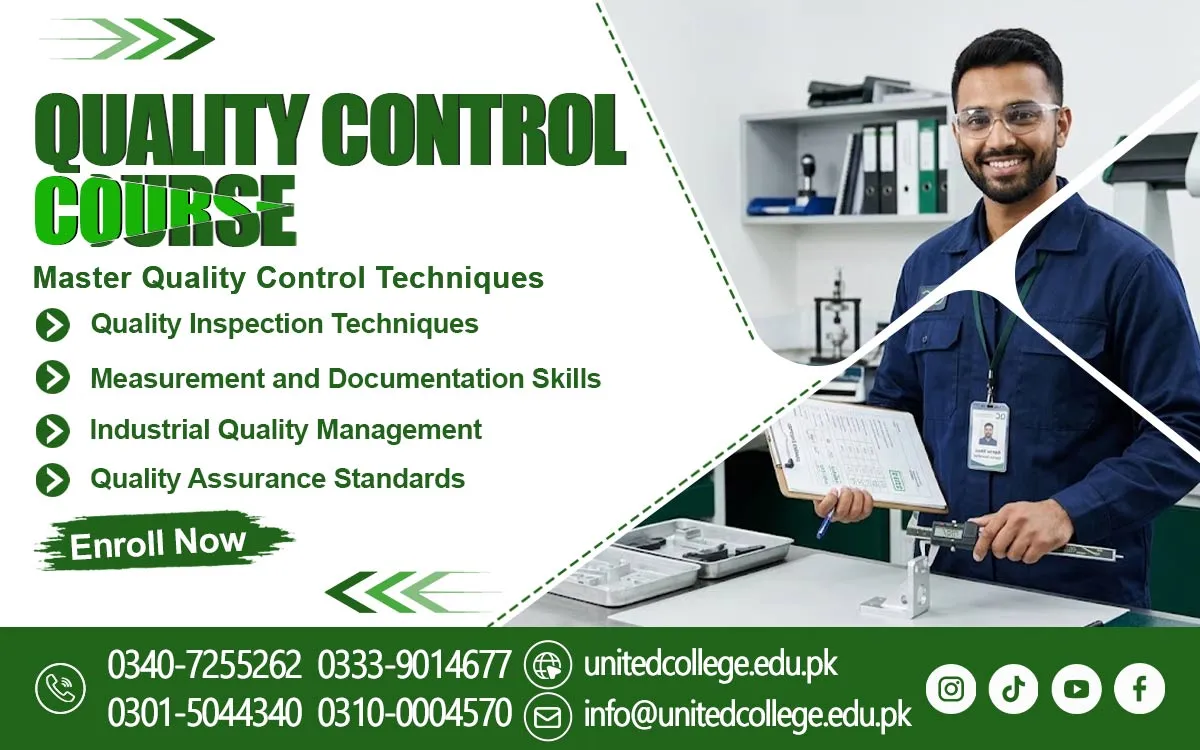

Quality Control Course in Shangla to Build Inspection Skills
Industrial Quality Challenges and the Need for Proper Inspection
A manufacturing unit may complete hundreds of products in a day, but a single mistake in material selection, measurements, or finishing can affect the entire production batch. Similarly, a construction project can face unexpected delays when cement, steel, or other building materials fail to meet the required specifications. Such problems can increase expenses, waste valuable resources, and reduce customer confidence. Proper inspection helps businesses identify these issues before they become more serious. Quality control professionals examine raw materials, monitor production activities, check finished products, and compare results with approved standards.
For example, a small difference in the thickness of a metal component may affect its fitting or performance, while poor-quality construction materials can create problems during building work. These situations show why industries need individuals who understand inspection procedures and product requirements. The Quality Control Course in Shangla offered by United College of Technology (UCT) introduces students to important concepts related to quality inspection, defect identification, material checking, and workplace standards. For beginners, learning these subjects can provide a useful foundation for understanding industrial requirements and developing technical knowledge.
Quality Standards and Their Importance in Modern Industries
Quality standards help businesses avoid these problems by setting clear requirements for materials, production processes, and finished products. Every industry follows certain specifications to make sure its products or services meet the expected level of quality. In construction, for example, the strength and condition of cement, steel bars, bricks, and other materials must be checked before use. In manufacturing, products may need to meet specific requirements for size, weight, appearance, and performance. A Quality Control Course helps learners understand these requirements and develop knowledge of inspection methods, product testing, and defect identification used to maintain quality standards in different industries.
Quality control professionals help maintain these standards through regular inspections and testing. They compare actual results with approved specifications and report any differences that require attention. Students studying quality control learn why consistency matters and how small errors can affect an entire production process. They also become familiar with workplace quality standards and the importance of following inspection procedures. Understanding these requirements is useful for anyone interested in industrial quality control because it develops awareness of product reliability, customer satisfaction, and responsible workplace practices. Strong quality standards also help organizations reduce unnecessary waste and improve their daily operations.
Essential Responsibilities of a Quality Control Professional
A quality control professional has an important responsibility in making sure that products, materials, and processes meet the required specifications. Their duties can vary depending on the industry, but the main purpose remains the same: identifying quality problems before they create bigger issues. For example, a quality inspector working at a construction site may check the dimensions of building materials, examine steel bars for visible damage, and review material delivery records. In a manufacturing factory, the same professional may inspect finished products, measure their sizes, and identify scratches, cracks, or other defects. Quality inspectors also compare test results with approved standards and communicate problems to supervisors or production teams.
Proper record-keeping is another important part of their work because inspection reports help businesses understand recurring issues and take corrective action. During Quality Control Training, beginners can learn about these responsibilities through simple workplace examples and technical explanations. They can understand the importance of accuracy, attention to detail, observation, and clear communication. A good inspector should never ignore a small defect simply because it appears harmless. Even a minor issue can become serious when products are used in large quantities or in important applications. Learning these responsibilities gives students a clearer understanding of professional quality inspection work.
Practical Skills Developed Through Quality Control Training
Checking a product carefully requires more than simply looking at its appearance. A quality inspector must understand measurements, product specifications, inspection methods, and basic testing procedures. Quality Control Course introduces learners to these practical skills step by step. One important skill is measurement checking, which helps inspectors compare the actual size of a product with its required dimensions. For example, a metal component may need to match a particular length and thickness before it can be used in a machine. Another important skill is defect identification. Students learn to recognize visible problems such as cracks, scratches, uneven surfaces, damaged edges, and incorrect finishing.
They can also develop an understanding of sampling, where selected items from a larger batch are checked to evaluate overall product quality. Basic inspection checklists help learners understand which points should be examined during a quality assessment. Communication and reporting are also important because inspectors need to explain their findings clearly. The Quality Control Course in Shangla at United College of Technology provides an educational starting point for students who want to understand these techniques. Through technical explanations and relevant examples, learners can become familiar with the type of knowledge used in industrial environments.
Product Inspection and Defect Identification Techniques
A product may appear perfect from a distance but still contain defects that affect its performance or safety. For example, a metal pipe may have an uneven surface, a manufactured component may have incorrect dimensions, or a construction material may contain visible damage. This is why product inspection is an important part of quality control. Inspectors use different techniques depending on the material, product type, and industry requirements. Visual inspection is one of the simplest methods. It involves examining a product for visible damage, cracks, scratches, poor finishing, or other noticeable problems. Dimensional inspection focuses on checking length, width, thickness, diameter, and other measurements.
In some industries, testing equipment is also used to evaluate specific properties such as strength, weight, temperature, or performance. Sampling is another common method in which selected products are inspected instead of checking every item individually. Students learn that testing procedures must follow suitable instructions so that results remain reliable. They also become familiar with inspection criteria and the importance of separating acceptable products from items that need further examination. Quality Testing Methods are not identical in every industry, so inspectors must understand the requirements of the product they are checking.
Quality Assurance and Industrial Management Standards
For example, if a factory discovers that several products have incorrect measurements, quality control helps identify the affected items. Quality assurance looks at the production process to find out why the problem happened and how it can be prevented in future batches. Both activities are important for maintaining consistent results. Students also need to understand the role of Quality Management Systems (QMS), which provide organized procedures for managing and improving quality within an organization. Through a Quality Control Course, learners can develop a better understanding of QC, QA, quality management procedures, and the importance of maintaining consistent standards in industrial environments.
ISO 9001, for example, provides requirements for a quality management system and helps organizations establish consistent processes. It does not mean that every product is automatically perfect, but it provides a framework for managing quality effectively. During quality assurance training, learners can become familiar with procedures, corrective actions, documentation, and continuous improvement. They can also understand why businesses review their processes instead of focusing only on finished products. These concepts are useful in manufacturing, construction, engineering, and other industries where consistent standards are necessary.
Inspection Equipment and Technical Documentation
Accurate inspection depends on using suitable tools and recording results properly. A quality inspector may need different measuring instruments depending on the product being examined. A measuring tape is commonly used to check larger dimensions, while a vernier caliper can measure internal and external dimensions as well as depth. A micrometer is used when more precise measurements of small components are required. Weighing scales help check the weight of materials or finished products, and specialized testing equipment may be used for strength, pressure, or other technical assessments. However, using a tool is only one part of the inspection process.
Technical documentation is equally important because businesses need clear records of inspection activities. Quality control documentation may include inspection reports, checklists, measurement records, test results, and details of identified defects. For example, if a warehouse receives a delivery of metal sheets, an inspector may record their dimensions, quantity, and visible condition. If a problem is found, the report provides information that supervisors can use to investigate it. Students learning quality inspection skills should understand that clear documentation supports accountability and better decision-making. These practices help maintain organized inspection procedures and provide useful information for future quality reviews.
Quality Control Applications Across Different Industries
Quality control is not limited to manufacturing factories. It is used in many industries where materials, products, or services must meet specific requirements. In construction, inspectors examine cement, steel, concrete, bricks, and other building materials to check whether they meet project specifications. They may also review measurements and observe construction activities for quality-related issues. In manufacturing, quality professionals inspect raw materials, monitor production processes, and examine finished products before packaging or delivery. Engineering workshops also depend on quality inspection because machine parts and metal components must meet accurate measurements to function correctly.
Warehouses use inspection procedures to check incoming goods, identify damaged packaging, and maintain proper storage records. Food processing industries have their own quality requirements, including cleanliness, product handling, packaging, and storage conditions. These activities help businesses maintain product consistency and follow relevant safety and quality requirements. The methods used in each industry may be different, but the basic principles of inspection, testing, documentation, and defect identification remain important. Through the Quality Control Course in Shangla, students can explore these industry applications and understand the different responsibilities involved in maintaining standards.
Professional Skills and Career Development in Quality Control
Technical knowledge becomes more useful when learners understand how to apply it in a professional environment. Quality control work requires accuracy, patience, problem-solving ability, observation, and clear communication. An inspector may need to identify a defect, explain the issue to a supervisor, and complete an inspection report without missing important details. Time management is also important because inspections often take place during busy production schedules. Students interested in this field can develop these professional qualities alongside their technical understanding. Quality control knowledge may be relevant to several entry-level and support roles, depending on an individual's training, practical experience, and employer requirements.
Possible career paths include Quality Control Inspector, Quality Inspector, Quality Assurance Assistant, Quality Control Technician, and Inspection Assistant. Responsibilities differ between organizations, and some positions may require additional education, industry-specific experience, or specialized training. For example, a person working in construction quality control may need a stronger understanding of building materials and construction specifications, while someone in manufacturing may need knowledge of production processes and measurement techniques. The course can help beginners understand the basic requirements of this profession, but employment depends on several factors, including skills, experience, and available opportunities.
Quality Control Course in Shangla at United College of Technology
For students in Shangla who want to develop technical knowledge without beginning with complicated industrial concepts, structured training can provide a useful learning opportunity. The Quality Control Course in Shangla offered by United College of Technology (UCT) is intended for learners interested in understanding inspection methods, quality standards, product testing, and workplace requirements. Beginners can explore the responsibilities of quality control professionals and become familiar with the basic concepts used in different industries. Important learning areas include material inspection, measurement techniques, defect identification, quality assurance, inspection procedures, and technical documentation.
For example, checking the dimensions of a metal component or identifying damaged construction material may seem like a small task, but both activities can influence the quality of a larger project. UCT provides a training environment where learners can build their understanding of these subjects and explore the technical knowledge associated with quality inspection. Students should also develop the habit of asking questions, following instructions, and paying attention to small details because these qualities are important in professional inspection work. Anyone interested in manufacturing, construction, engineering, or industrial quality management can consider this course a starting point for further technical learning.
Frequently Asked Questions (FAQs)
The Quality Control Course in Shangla teaches students how to inspect products, identify defects, check materials, and maintain quality standards in different industries.
Students, fresh learners, job seekers, and individuals interested in manufacturing, construction, engineering, and industrial quality management can consider this course.
Students learn quality inspection, measurement techniques, defect identification, product testing, inspection procedures, and quality control documentation.
Quality Control focuses on identifying defects in products, while Quality Assurance focuses on improving processes to prevent quality problems.
Common tools include measuring tapes, vernier calipers, micrometers, weighing scales, and specialized testing equipment.
Admission Open: Start Your Professional Journey Today!
Join United College of Technology and build a career with practical training, recognized certifications, and Gulf job support. Seats are limited.
Apply Now via WhatsAppContact Information
- Address: Rawalpindi: F-272 Main New Katarian Stop, Old IJP Road | Lahore Campus: Lahore, Pakistan
- Phone/WhatsApp: 0340-7255262 / 0333-9014677 / 0301-5044340 / 0310-0004570 / 051-8770756
- Website: unitedcollege.edu.pk
















Leave a Comment