


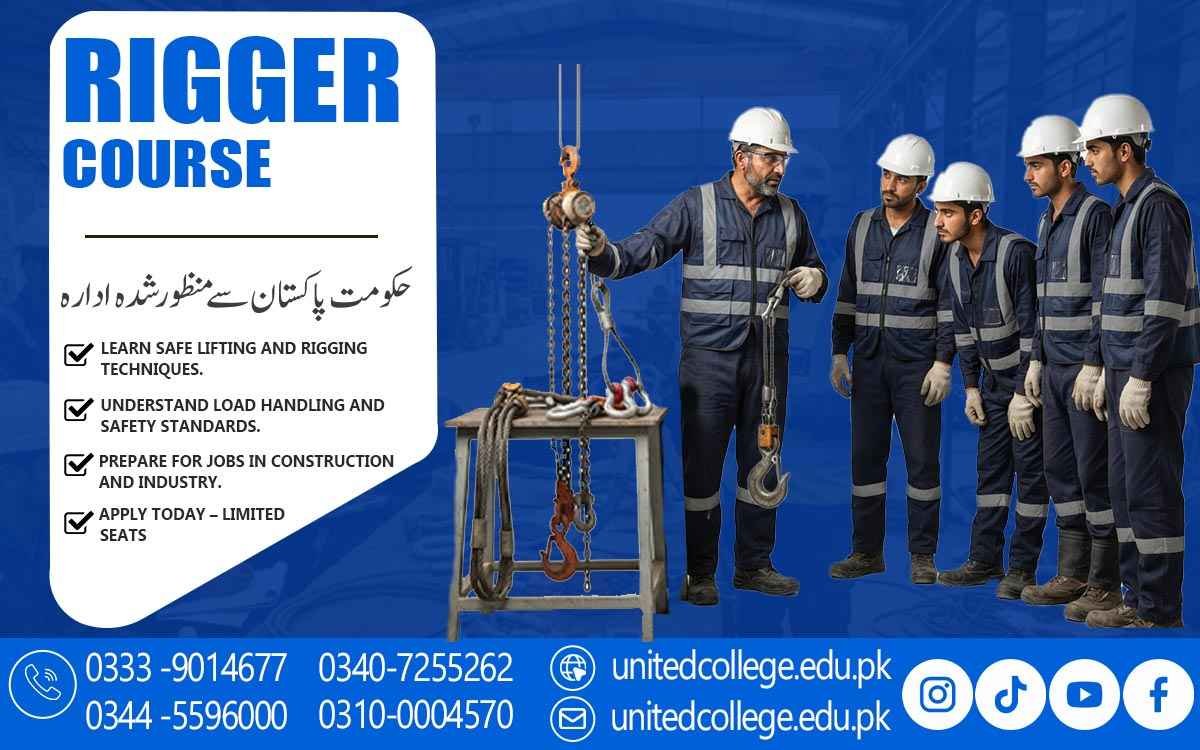

Rigger Course in Okara for Safe Crane and Load Handling
When Every Lift Depends on the Right Rigging Decision
A heavy load may look simple when it is sitting on the ground, but moving it safely requires careful planning, suitable equipment, clear communication, and trained people who understand how lifting operations work. On construction sites, industrial workplaces, warehouses, workshops, and infrastructure projects, materials such as steel sections, machinery, pipes, equipment, and other heavy objects may need to be lifted or moved from one location to another. This is where a rigger plays an important role. A rigger helps prepare loads for lifting, selects suitable rigging equipment, checks lifting accessories, secures the load, and communicates with the crane operator during movement.
A small mistake in sling selection, load balance, or communication can create serious hazards, which is why practical knowledge matters. A Rigger Course in Okara can introduce beginners and workers to the basic principles behind safe lifting and material handling. Instead of treating rigging as simply attaching a load to a crane, learners can understand how different parts of a lifting operation work together. Through rigger training in Okara, students can become familiar with safe working practices, equipment handling, workplace coordination, and the importance of following established lifting procedures.
Understanding the Equipment Behind a Safe Lifting Operation
Before a load is moved, a rigger needs to know which equipment is suitable for the task and how each item is intended to be used. Rigging equipment can include wire ropes, chain slings, web slings, shackles, hooks, lifting points, clamps, and other lifting accessories. Slings are used to connect the load with the lifting system, while shackles provide a secure connection between different components. Hooks are designed to engage with suitable lifting points or rigging arrangements, while other accessories may be selected according to the shape, weight, and condition of the load.
During a rigging course, learners can study the purpose of common equipment and understand why choosing the right accessory is important. They can also learn that equipment should not simply be selected because it appears strong enough; its condition, capacity, configuration, and suitability for the task must be considered. This equipment familiarity forms an important part of practical rigging training because a rigger needs to recognize tools before using them and understand how they contribute to a controlled lifting operation.
Inspecting Slings, Shackles, Hooks, and Lifting Accessories
A lifting accessory should not be treated as ready for use simply because it is available in the workplace. Before a lifting operation begins, equipment needs to be inspected according to workplace procedures to identify visible damage, excessive wear, deformation, corrosion, cuts, broken wires, damaged stitching, or other conditions that may make an item unsuitable. For example, a web sling may need attention if its material has been badly cut or damaged, while a wire rope requires careful examination for signs of wear or broken wires.
Rigging inspection is therefore an important part of rigger safety training because equipment condition can directly affect the reliability of a lifting arrangement. Learners in a Rigger Course in Okara can study inspection procedures and learn why damaged equipment should not simply be ignored or used because the lifting task appears urgent. They can also understand the importance of following manufacturer information, workplace inspection systems, and authorized procedures rather than making unsafe assumptions.
Reading the Load Before Choosing a Lifting Method
How can a load be lifted safely if its weight, shape, balance, and lifting points are not properly understood? Load assessment is one of the important parts of rigging because different materials require different approaches. A rigger needs to consider the approximate load weight, available lifting points, dimensions, shape, center of gravity, and the way the load may behave when it leaves the ground. The center of gravity is the point around which the weight of an object is balanced. If the lifting arrangement does not account for this balance point, the load may tilt, rotate, or move unexpectedly.
Basic rigging calculations may involve understanding load weight, sling arrangement, lifting angles, and available equipment capacity. These calculations should be carried out using appropriate information and established workplace procedures rather than guesswork. In rigger training in Okara, learners can develop an understanding of how load assessment connects with sling selection and safe lifting techniques. This helps them see that a successful lift is not simply about lifting a heavy object, but about planning how the load will remain controlled throughout the operation.
Securing Heavy Loads Before They Leave the Ground
Once the load has been assessed and suitable equipment has been selected, the next challenge is securing it properly. A load must be connected in a way that supports its weight and helps prevent unwanted movement during lifting. Sling selection can depend on factors such as load shape, weight, lifting points, material type, and the lifting arrangement being used. Learners can study different rigging techniques and understand how slings and shackles may be arranged for particular lifting situations under proper supervision. Tag lines can also be used where appropriate to help control the movement of a suspended load from a safe position, reducing the need for people to place themselves unnecessarily close to the load.
During practical rigging training, students can learn why the load should be checked before lifting and why a controlled initial lift can help confirm that the rigging arrangement is behaving as expected. Load securing also requires attention to loose materials, unstable components, and possible snagging points. A rigger must understand that the objective is not only to attach the load but to maintain control while it is lifted, moved, positioned, and lowered. These practices are particularly relevant to construction safety, warehouse material handling, and industrial lifting operations where heavy materials may need to be moved through active work areas.
Using Clear Signals Between Riggers and Crane Operators
A crane operator may control the lifting machine, but the rigger often plays an important role in guiding the operation and communicating what needs to happen. Clear communication becomes especially important when the operator cannot see the load or the complete lifting area from the crane position. Standard lifting signals can help the rigger communicate instructions such as raising, lowering, stopping, or moving in a particular direction. Learners can also study the importance of maintaining an agreed communication method and ensuring that signals are clear and understood before the lifting operation begins. If radios are used, workers need to understand how to communicate instructions clearly and avoid unnecessary confusion.
During a Rigger Course in Okara, communication and coordination can be included alongside practical rigging procedures so learners understand that technical equipment alone cannot make a lifting operation safe. Crane rigging involves cooperation between the rigger, crane operator, supervisors, and other workers who may be involved in the task. Good communication helps everyone understand the lifting plan, movement path, restricted areas, and responsibilities before the load begins to move.
Identifying Hazards Before Starting a Lifting Operation
Every lifting area can contain different hazards, so a rigger needs to look beyond the load itself. Before an operation starts, workers may need to identify overhead obstructions, electrical hazards, unstable ground, nearby structures, moving vehicles, other workers, restricted spaces, poor visibility, weather conditions, and potential pinch or crush points. Risk assessment helps the team consider what could go wrong and what controls should be applied before work begins. Learners can be introduced to hazard identification and workplace safety procedures so they understand why lifting areas may need to be controlled or restricted to authorized personnel.
Personal protective equipment, commonly called PPE, may include items such as safety helmets, protective footwear, gloves, high-visibility clothing, and other equipment required by the workplace and task. However, PPE is only one part of construction safety and industrial safety; it does not replace proper planning, equipment inspection, communication, and safe lifting procedures. Through rigger safety training, learners can develop the habit of identifying hazards before starting work rather than waiting for a problem to appear during the lifting operation.
Practicing Lifting and Lowering Procedures Through Hands-On Learning
Rigging knowledge becomes easier to understand when learners can connect classroom explanations with practical situations. A practical training environment can allow students to become familiar with rigging equipment, lifting accessories, load securing methods, inspection routines, communication signals, and basic lifting procedures under appropriate supervision. Learners may study how a lifting task is prepared, how equipment is checked, how a load is connected, how the lifting area is controlled, and how communication is maintained during movement. They can also explore the importance of controlled lifting and lowering rather than treating the process as a single action.
United College of Technology can provide a learning environment where students studying the Rigger Course in Okara can build familiarity with practical rigging skills while learning the safety principles behind them. The purpose of hands-on learning is not to encourage beginners to carry out unsupervised lifting operations, but to help them understand proper procedures, equipment use, workplace coordination, and the responsibilities involved in professional rigging work. This practical approach can make technical concepts easier to remember because learners can connect each step with a realistic lifting situation.
Building Professional Rigger Skills for Workplaces in Okara
Rigging skills can be relevant wherever heavy materials, machinery, structural components, or industrial equipment need to be lifted and positioned safely. In Okara, construction projects, warehouses, workshops, industrial workplaces, infrastructure activities, and machinery-handling environments may involve different forms of material movement. A learner who joins a Rigger Course in Okara can begin to see how equipment inspection, load assessment, sling selection, load securing, lifting signals, hazard identification, and workplace coordination connect with one another.
The most important lesson is that professional rigger skills depend on careful preparation and respect for established safety procedures. Whether the work involves construction rigging, industrial material handling, warehouse operations, or machinery movement, every lifting task should be planned and performed according to applicable workplace rules, equipment requirements, and proper supervision. This approach gives learners a useful foundation for understanding how safe and controlled lifting contributes to organized work environments.
Frequently Asked Questions (FAQs)
A Rigger Course in Okara teaches learners about rigging equipment, load handling, lifting procedures, crane communication, equipment inspection, and workplace safety.
Yes, beginners can study basic rigging concepts, equipment identification, safe lifting practices, load securing, and workplace safety procedures.
Training may cover slings, shackles, hooks, wire ropes, lifting points, tag lines, and other commonly used lifting accessories.
Load assessment helps a rigger understand weight, balance, center of gravity, lifting points, and equipment capacity before a lifting operation begins.
Learners can develop skills related to equipment inspection, hazard identification, risk assessment, PPE, crane signals, load securing, and safe lifting procedures.
Admission Open: Start Your Professional Journey Today!
Join United College of Technology and build a career with practical training, recognized certifications, and Gulf job support. Seats are limited.
Apply Now via WhatsAppContact Information
- Address: Rawalpindi: F-272 Main New Katarian Stop, Old IJP Road | Lahore Campus: Lahore, Pakistan
- Phone/WhatsApp: 0340-7255262 / 0333-9014677 / 0301-5044340 / 0310-0004570 / 051-8770756
- Website: unitedcollege.edu.pk
















Leave a Comment