


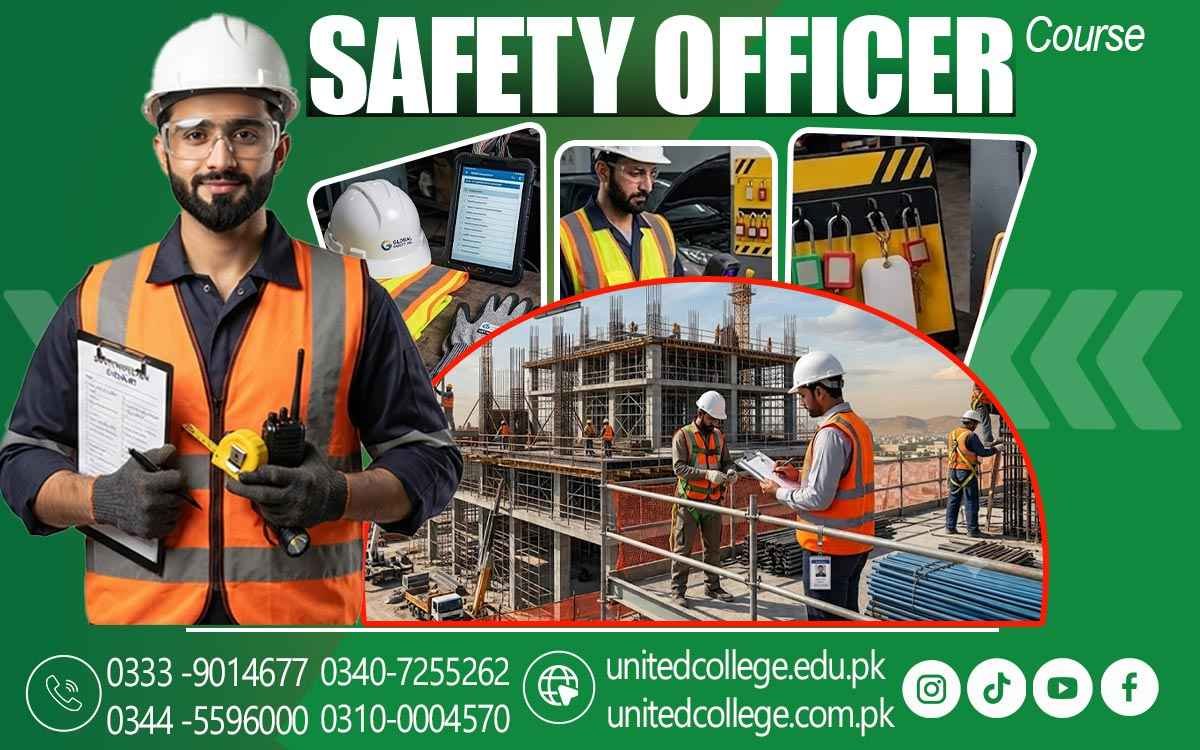

Safety Officer Course in Kohat – Practical Skills for Your Future
How Workplace Accidents Show the Need for Safety Training
Imagine a construction worker walking through a busy site when a loose electrical cable lies across the floor. Nearby, another worker is lifting heavy materials without wearing protective equipment. These situations may look ordinary, but they can quickly lead to serious injuries if nobody recognizes the danger. Workplace accidents often happen because hazards are ignored, safety procedures are misunderstood, or workers have not received proper guidance. This is why occupational health and safety is important in construction projects, factories, workshops, warehouses, and other working environments.
Safety training helps learners understand why accidents happen and how they can be prevented through careful planning, regular inspections, and responsible working practices. A safety officer helps identify unsafe conditions, communicate risks to workers, and encourage compliance with established safety procedures. Even a small action, such as reporting a damaged cable or keeping an emergency exit clear, can reduce the risk of an accident. Learning these practices is useful for beginners who have little knowledge of workplace safety as well as individuals who want to improve their existing skills.
What Students Learn in a Safety Officer Course in Kohat
A safety officer course introduces learners to the principles and practices used to maintain a safer workplace. The Safety Officer Course in Kohat, offered by United College of Technology (UCT), is relevant to individuals who want to build their understanding of occupational safety and workplace risk prevention. Students can explore important concepts such as hazard identification, risk assessment, personal protective equipment, fire prevention, emergency procedures, and safety reporting. Hazard identification means recognizing something that could cause injury or illness, while risk assessment involves considering how likely harm is to occur and how serious its consequences might be.
Learners also need to understand the responsibilities of a safety officer, including observing working conditions, reporting unsafe practices, supporting safety inspections, and communicating preventive measures to workers and supervisors. These responsibilities require more than memorizing safety rules. A safety officer must also pay attention to details, ask relevant questions, and explain potential dangers in a way that workers can understand. Depending on the course content, learners may study examples of workplace incidents and discuss how suitable precautions could have reduced the risks. Beginners should also understand that safety requirements differ between industries and workplaces.
Recognizing Workplace Hazards Before They Cause Harm
A dangerous workplace does not always look unsafe at first glance. Sometimes, the biggest risks are hidden in everyday activities, such as operating machinery, moving heavy objects, handling cleaning chemicals, or repairing electrical equipment. Workplace hazard identification is the process of noticing these dangers before they cause an accident or health problem. During safety officer training, learners can develop an understanding of common hazards and the precautions used to control them. Physical hazards may include slippery floors, excessive noise, falling objects, unguarded machines, and poorly arranged materials.
Chemical hazards may arise when workers handle substances without understanding their effects or following the correct storage and handling procedures. There are also ergonomic hazards, which can develop when workers repeatedly lift heavy items, maintain uncomfortable positions, or perform the same movement for long periods. In a construction environment, a safety officer may need to notice missing edge protection, unstable ladders, or workers entering restricted areas. In a workshop, the focus may be on moving machine parts, poor ventilation, or unsuitable protective equipment. Recognizing these problems requires observation and an understanding of how work is performed.
Learning Risk Assessment and Practical Hazard Control
Recognizing a hazard is important, but understanding the level of risk helps determine what action should be taken first. Risk assessment is a structured process for identifying hazards, considering the likelihood of an incident, evaluating the possible consequences, and deciding how to control the danger. For example, a loose cable in a busy walkway may cause someone to trip, particularly if the area is crowded or poorly lit. A suitable response could involve restricting access to the affected area, arranging a safe repair, and checking that the cable is secured correctly. The Safety Officer Course in Kohat can help learners understand the basic principles behind these decisions and the importance of selecting suitable preventive measures.
For instance, installing a machine guard can provide more reliable protection than simply reminding workers to keep their hands away from moving parts. Risk assessment should also consider who might be harmed, including new employees, contractors, visitors, and workers performing maintenance tasks. Safety officers may support this process by observing activities, reviewing workplace procedures, documenting findings, and communicating recommendations to supervisors. Risks should be reassessed when equipment changes, new materials are introduced, or working conditions become different. By learning risk assessment and hazard control, students can develop a more organized approach to workplace safety instead of waiting for an accident to reveal a problem.
Using Personal Protective Equipment and Fire Safety Measures
Personal protective equipment, commonly called PPE, helps protect workers from specific workplace hazards when it is selected and used correctly. Examples include safety helmets, protective gloves, safety shoes, goggles, face shields, hearing protection, and suitable protective clothing. However, wearing equipment does not automatically make every activity safe. A helmet may protect against certain falling-object hazards, but it cannot prevent every possible head injury. Similarly, gloves must be appropriate for the task because some types may create additional risks around rotating machinery. Through workplace safety training, learners can understand why PPE must fit properly, remain in good condition, and be used according to workplace requirements.
They can also learn about fire safety, which is an important part of industrial safety and construction site safety. Fires may begin because of electrical faults, flammable materials, unsafe welding practices, or the incorrect storage of chemicals. Preventive measures include maintaining electrical equipment, keeping combustible materials away from ignition sources, ensuring that escape routes remain clear, and following established procedures for hot work. Learners should understand that different fires require different extinguishing methods and that an extinguisher must only be used when the person is trained, the equipment is appropriate, and a safe escape route remains available. If a fire becomes dangerous, raising the alarm and evacuating according to the emergency plan should take priority.
Emergency Response, First Aid Awareness, and Accident Prevention
When an emergency happens, confusion and delayed action can make a dangerous situation worse. A worker may suffer an injury, smoke may spread through a building, or a chemical spill may expose nearby employees to harmful substances. Clear emergency response procedures help workers understand what to do, whom to inform, and how to move away from danger. During safety training, learners can study the importance of emergency planning, evacuation routes, alarm systems, assembly points, and communication with responsible personnel. They can also develop an understanding of first aid awareness, including the importance of seeking qualified assistance and avoiding actions that could cause further harm.
The power must be isolated safely by someone capable of doing so, and emergency assistance should be requested. Similarly, workers should not enter an area affected by dangerous fumes without appropriate training and protective equipment. Accident prevention also involves learning from incidents and near misses. Reporting these events helps organizations investigate underlying problems and introduce better controls. Safety officers may support incident reporting, review relevant information, and help communicate lessons to prevent similar situations. For learners taking the Safety Officer Course in Kohat, understanding emergency procedures and accident prevention can build a foundation for responsible safety practices.
Developing Practical Safety Inspection and Reporting Skills
A workplace can become unsafe gradually as equipment wears out, materials accumulate, or workers begin ignoring established procedures. The Safety Officer Course in Kohat helps learners understand the importance of regular safety inspections and how they can identify problems before they lead to injuries or operational disruptions. A safety inspection involves checking the workplace, equipment, work practices, and emergency arrangements against relevant safety requirements. For example, an inspection at a construction site might examine access routes, ladders, scaffolding, electrical connections, warning signs, and the availability of suitable protective equipment. In a workshop, the inspection may focus on machine guards, ventilation, housekeeping, and the safe storage of tools and materials.
Safety checklists can help inspectors record what needs attention, while written reports provide a clear record of hazards and recommended actions. Accurate reporting is important because vague statements may make it difficult for supervisors to understand the problem or decide how urgently it needs to be addressed. A useful report should identify the unsafe condition, describe its location, explain the potential risk, and communicate the action required through the appropriate workplace process. Safety officers also need good communication skills because workers may be more willing to follow precautions when the reasons are explained respectfully and clearly.
How Safety Officer Skills Apply Across Different Industries
Safety knowledge is useful in many industries because every workplace has activities that can expose people to risks. Construction sites may involve working at heights, moving vehicles, electrical equipment, lifting operations, and heavy materials. Manufacturing facilities may have rotating machinery, high temperatures, chemical substances, and repetitive production tasks. Warehouses require attention to forklift movements, storage arrangements, manual handling, and emergency exits. Workshops may present risks associated with power tools, welding, electrical repairs, and poor housekeeping. Although these environments differ, the basic principles of occupational health and safety remain important: recognize hazards, assess risks, apply suitable controls, communicate clearly, and review whether precautions are effective.
The Safety Officer Course in Kohat can help learners begin understanding these principles and how they relate to different workplace situations. For example, someone learning about risk assessment may consider how workers can be protected when moving heavy materials, while another lesson may examine safe access to electrical equipment. Safety responsibilities can also include supporting toolbox talks, helping communicate workplace rules, maintaining records, and encouraging employees to report unsafe conditions. People interested in safety-related work should understand that employers may require particular educational qualifications, recognized certifications, industry experience, or specialized training.
Preparing for Safety Responsibilities Through Training at United College of Technology
Choosing a training course is an important step for anyone who wants to learn how workplace safety is managed. For students and job seekers in Kohat, the Safety Officer Course in Kohat, offered by United College of Technology (UCT), provides a relevant topic to explore when considering education in occupational health and safety. Before enrolling, prospective students should review the course outline, entry requirements, duration, practical learning arrangements, fees, and details of any certificate provided directly by the institute. They should also check whether the course meets the requirements of the industry or employer they have in mind.
Learners can strengthen their understanding by asking questions, studying real workplace examples, practising hazard identification, and reviewing applicable safety rules. Developing professional skills is equally important. A safety officer needs to explain concerns clearly, listen to workers, maintain accurate records, and communicate potential risks without creating unnecessary confusion. Completing training does not automatically guarantee employment or qualify someone for every safety position, as employers may consider experience, further qualifications, and industry-specific requirements. However, structured learning can provide a foundation for continued development and help learners identify areas where additional preparation is needed.
Frequently Asked Questions (FAQs)
The Safety Officer Course in Kohat is a training program that introduces students to workplace safety, hazard identification, risk assessment, fire prevention, and accident prevention.
United College of Technology (UCT) offers the Safety Officer Course for individuals interested in learning about occupational health and safety.
Students can learn about workplace hazards, personal protective equipment (PPE), fire safety, emergency procedures, safety inspections, and risk management.
Students, beginners, fresh learners, and job seekers interested in workplace safety may consider this course. Specific admission requirements should be confirmed with the institute.
A safety officer helps identify workplace hazards, report unsafe conditions, support safety inspections, communicate safety procedures, and encourage accident prevention.
Admission Open: Start Your Professional Journey Today!
Join United College of Technology and build a career with practical training, recognized certifications, and Gulf job support. Seats are limited.
Apply Now via WhatsAppContact Information
- Address: Rawalpindi: F-272 Main New Katarian Stop, Old IJP Road | Lahore Campus: Lahore, Pakistan
- Phone/WhatsApp: 0340-7255262 / 0333-9014677 / 0301-5044340 / 0310-0004570 / 051-8770756
- Website: unitedcollege.edu.pk
















Leave a Comment