


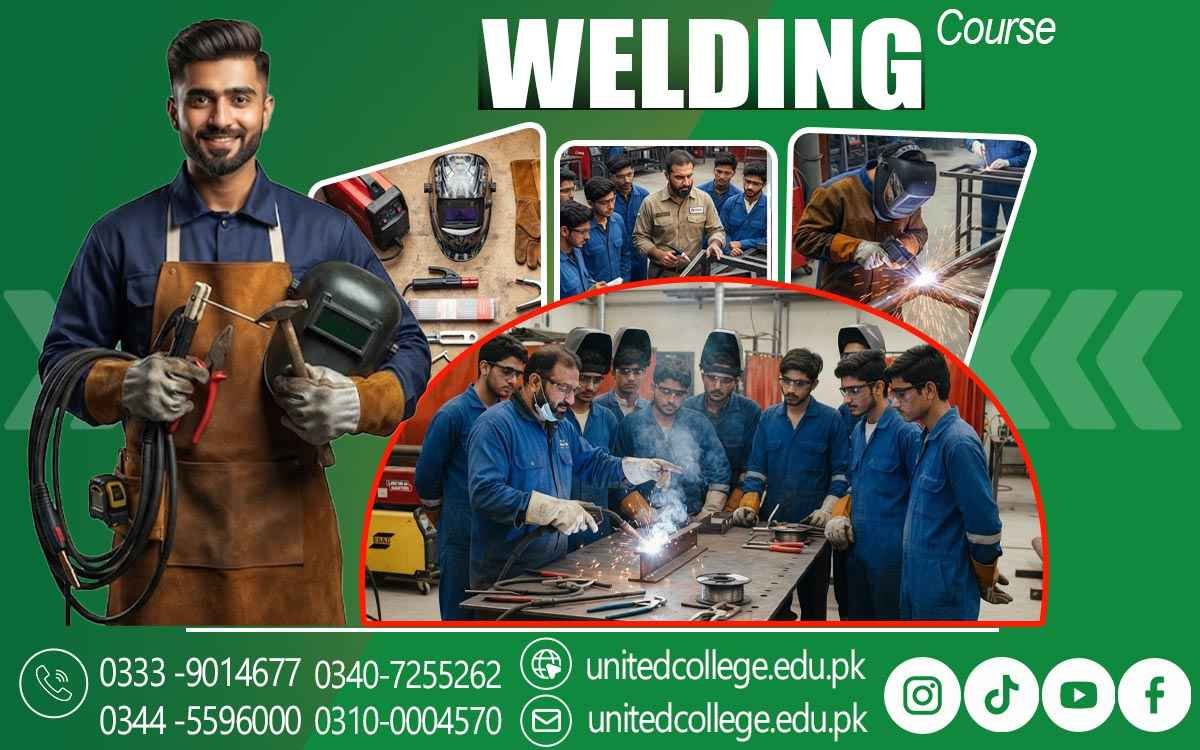

Welding Course in Toba Tek Singh for Practical Skills Training
Where Welding Skills Are Used in Real Work
Imagine a metal gate that needs a strong joint, an agricultural machine that needs repair, or a workshop frame that has to be assembled accurately. In each of these situations, welding plays an important role in joining metal parts and creating structures that can handle practical use. Welding is not simply about producing heat and joining two pieces together; it involves correct preparation, suitable equipment, controlled movement, accurate measurements, safety awareness, and careful inspection.
A welding course in Toba Tek Singh can introduce beginners to these practical areas in a structured learning environment where they can understand how welding is performed and why different techniques are selected for different jobs. Students, fresh learners, and people interested in developing a practical trade skill can gradually become familiar with welding equipment, welding tools, metal preparation, welding joints, welding positions, inspection methods, and workshop safety. Instead of trying to learn everything at once, structured welding training allows learners to build their understanding step by step.
Starting Welding Training with the Right Practical Foundation
For beginners, welding can seem difficult because several things must be controlled at once. The learner has to understand the welding machine, prepare the metal correctly, select and handle the suitable electrode or welding material, maintain an appropriate position, and control hand movement while creating the joint. A structured welding course helps make this process easier by introducing important concepts gradually instead of expecting a beginner to perform complicated tasks immediately. Learners can start by understanding how welding generates heat and uses it to join metal.
They can then become familiar with basic workshop arrangements, machine controls, cables, clamps, electrodes, protective equipment, and safe working procedures. As their understanding develops, they can move toward practical exercises involving simple metal pieces and basic joints. This type of learning is useful because welding ability comes from practice, observation, correction, and repetition rather than from reading instructions alone. A learner in Toba Tek Singh may also find this practical skill relevant because welding is connected with many forms of local metalwork, including fabrication, construction support work, machinery repair, workshop maintenance, and agricultural equipment-related tasks.
Exploring Arc Welding, MIG Welding, and TIG Welding
Welding includes several processes, and understanding their basic differences helps learners develop a broader view of the trade. Arc welding is one of the common processes taught in welding because it uses an electric arc to generate heat and join metal. In basic arc welding, an electrode is used during the welding process, and learners need to understand factors such as electrode angle, current, travel speed, and movement. MIG welding works differently because it normally uses a continuously supplied wire electrode along with shielding gas, making it useful for applications where a continuous welding process is required.
Beginners do not have to become experts in every process immediately, but learning what these methods are and where they can be used gives them a better understanding of welding technology. Different metals, thicknesses, joint designs, and workshop requirements can influence which welding process is appropriate for a particular task. For example, a fabrication workshop producing metal frames may have different requirements from a repair workshop working on machinery components. During welding training, learners can therefore explore how welding techniques differ instead of assuming that one method works for every situation.
Learning to Handle Welding Equipment and Workshop Tools
Good welding depends heavily on the correct use of equipment, so learners need to become familiar with more than just the welding machine. A typical welding setup can involve a welding machine, welding cables, electrode holder, earth clamp, electrodes, measuring tools, clamps, wire equipment where applicable, cleaning tools, cutting equipment, grinders, hammers, and other workshop tools. Each item has a specific purpose, and understanding that purpose can make practical work more organized and controlled. Welding electrodes, for example, are an important part of many arc welding tasks and need to be handled and used correctly. Cables and clamps also require attention because poor connections or damaged equipment can create problems during welding.
They can also learn why the welding machine should be operated according to proper instructions rather than adjusted randomly. Familiarity with welding equipment can make a beginner more comfortable in the workshop because the learner begins to understand which tool is needed for a particular task and how different tools work together. In Toba Tek Singh, where metal fabrication, agricultural machinery repair, construction-related activities, and general workshop work may involve welding, knowledge of common welding tools can provide a useful practical foundation.
Preparing Metal Before Starting the Welding Process
The quality of a weld can be affected by what happens before the welding arc is started. Metal surfaces may contain rust, oil, dirt, paint, moisture, or other unwanted material, and these contaminants can interfere with the welding process. This makes metal preparation an important part of welding course training and hands-on welding practice. Learners can be taught to measure the material carefully, mark cutting points, cut metal to the required dimensions, remove rough edges, clean the surfaces, and prepare the joint before welding. Different types of welding joints are used for different purposes, including butt joints, lap joints, T-joints, corner joints, and edge joints.
For example, a person fabricating a metal frame may need several pieces to meet at specific lengths and angles, while someone performing repair and maintenance work may need a replacement piece to fit an existing component. Clamps can help keep materials in place, while cleaning and edge preparation can support a more controlled welding process. These steps show beginners that welding does not start with the machine; it starts with planning and preparing the material.
Developing Control Through Welding Positions and Techniques
Once the metal has been prepared properly, the welder's movement and control become important factors in producing a suitable joint. Welding may be performed in different positions, including flat, horizontal, vertical, and overhead positions, and each position can present different challenges. Beginners often start with easier positions before gradually working with more demanding situations as their control improves. Welding positions affect how molten metal behaves and can require changes in electrode angle, movement, travel speed, and body position. Learners can practice keeping their hand steady, maintaining a suitable distance, following the joint line, and moving at a controlled speed.
This is why welding techniques require patience and repeated practice. A beginner may produce uneven welds during the first few attempts, but those results can become useful learning opportunities when the learner examines what went wrong and tries again. Practical training allows students to see the effect of small changes in movement and technique instead of only hearing about them in theory. Over time, repeated exercises can help develop better hand control and consistency. For learners in Toba Tek Singh, this type of practice can provide a foundation for understanding how welding techniques may change according to the position, material, joint, and practical requirements of a task.
Recognizing Welding Defects Through Inspection and Quality Checking
Completing a weld is only one part of the job; checking the finished work is equally important. A weld may look acceptable from a distance but still contain visible problems that can affect the quality of the joint. During welding inspection, learners can become familiar with common welding defects such as cracks, porosity, undercut, excessive spatter, incomplete fusion, poor penetration, and irregular weld appearance. These terms may sound technical at first, but their basic meaning can be explained simply.
Learning to recognize such problems helps students understand why welding technique, heat control, surface preparation, and movement matter. Quality checking may involve visually examining the weld, checking whether the joint is continuous, looking for cracks or unusual gaps, and confirming that the metal pieces remain correctly aligned. Learners can also compare their work with the requirements of the task and identify areas that need improvement. This habit of inspection is valuable in fabrication work, construction welding, repair and maintenance, and other workshop environments because it encourages workers to check their work instead of assuming that every completed weld is automatically satisfactory.
Making Safety a Daily Part of Welding Workshop Practice
Welding involves intense heat, sparks, bright light, electrical equipment, fumes, hot metal, and other hazards, which makes safety one of the most important parts of welding training. Learners need to understand that welding safety should be followed during every task, not only when a dangerous situation appears. Personal protective equipment, commonly called PPE, can include a suitable welding helmet, protective gloves, appropriate clothing, safety footwear, and other protective items depending on the work being performed. A welding helmet helps protect the eyes and face from the intense light and sparks produced during welding, while gloves and suitable clothing help protect the skin from heat and hot particles.
They should also learn to treat recently welded metal as hot until it has cooled properly rather than touching it without checking. These habits are particularly important in workshops, construction-related settings, fabrication areas, and machinery repair environments. A structured welding training program can help learners develop safe working habits alongside technical skills, so safety becomes a natural part of the process rather than an afterthought. Understanding workshop safety can also help beginners approach practical welding tasks with greater responsibility and awareness.
Applying Welding Skills to Fabrication, Construction, and Repair Work
The practical value of welding becomes easier to understand when learners connect their training with the types of metalwork found around Toba Tek Singh and nearby areas. Welding can be involved in fabrication work, construction-related metal structures, agricultural machinery repair, workshop maintenance, gates, frames, supports, railings, equipment components, and many other metalworking tasks. A fabrication job may require a worker to measure raw material, mark it, cut it, clean the surfaces, prepare the joints, align the pieces, weld them, and finally inspect the completed structure. A repair task may be different because the worker may first need to identify the damaged area, remove or prepare the affected component, fit a replacement piece, and then create a suitable joint.
Agricultural machinery can also involve metal components that may require repair or maintenance, although the exact work depends on the equipment and the nature of the damage. These examples show why welding is closely connected with practical problem-solving rather than being limited to one type of workshop. A welding course in Toba Tek Singh can help learners understand these applications while introducing them to the procedures and techniques needed for different tasks. United College of Technology can serve as a place where learners become familiar with practical welding concepts, workshop tools, equipment, safety procedures, and hands-on exercises.
Building Accuracy and Confidence Through Continuous Welding Practice
Welding skills develop gradually, and consistent practice is one of the most important parts of becoming comfortable with the work. A learner may understand welding terms and know the names of equipment, but practical ability grows when that knowledge is repeatedly applied through actual exercises. During welding course training and hands-on welding practice, learners can work on improving electrode control, movement, welding positions, measurements, joint preparation, alignment, and inspection habits. Every practice attempt can teach something new, especially when the finished weld is examined carefully and the learner considers what could be improved.
Patience is particularly important because developing a steady hand and consistent technique can take time. Accuracy also matters because even a small measurement or alignment error can influence the final result of fabrication work. These habits can be useful for students, fresh learners, job seekers, and others who want to develop practical welding skills for workshop environments. In Toba Tek Singh, learning welding can provide an introduction to a skill connected with metal fabrication, construction, repair, agricultural machinery, maintenance, and general workshop activities.
Frequently Asked Questions (FAQs)
A welding course can cover welding techniques, arc welding, MIG and TIG concepts, welding equipment, electrodes, metal preparation, welding joints, welding positions, inspection, defects, and workshop safety.
Yes. Beginners can learn welding step by step, starting with basic equipment handling, safety procedures, metal preparation, and simple welding exercises before moving toward more practical techniques.
Training may introduce learners to welding machines, cables, electrode holders, earth clamps, welding electrodes, measuring tools, clamps, grinders, cutting tools, and other workshop equipment.
Welding involves heat, sparks, bright light, fumes, and electrical equipment. Proper PPE, ventilation, fire prevention, equipment checks, and safe workshop practices help reduce workplace hazards.
Welding skills can be relevant to metal fabrication, construction-related work, agricultural machinery repair, maintenance, workshops, gates, frames, and other metalworking activities.
Admission Open: Start Your Professional Journey Today!
Join United College of Technology and build a career with practical training, recognized certifications, and Gulf job support. Seats are limited.
Apply Now via WhatsAppContact Information
- Address: Rawalpindi: F-272 Main New Katarian Stop, Old IJP Road | Lahore Campus: Lahore, Pakistan
- Phone/WhatsApp: 0340-7255262 / 0333-9014677 / 0301-5044340 / 0310-0004570 / 051-8770756
- Website: unitedcollege.edu.pk
















Leave a Comment