


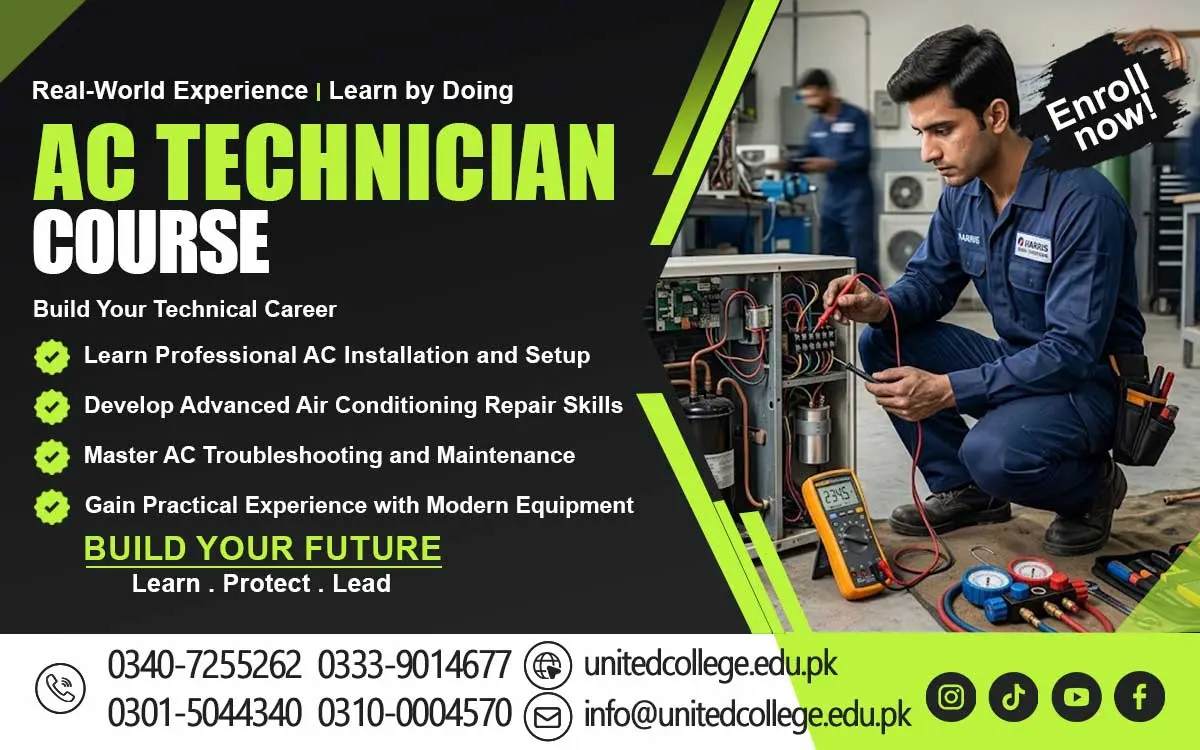

AC Technician Course in Charsadda for Modern HVAC Skills
AC Technician Course in Charsadda to Develop Real-World Cooling and Repair Skills
An air conditioner that stops cooling, makes unusual noises, or leaks water can quickly become a problem in any home, shop, or workplace. Finding the cause requires more than basic knowledge of the machine; it takes careful inspection and an understanding of how cooling systems operate. The AC Technician Course in Charsadda is a useful training option to explore for beginners, students, and job seekers who want to learn about air conditioning repair and maintenance.
It introduces the technical knowledge behind everyday cooling equipment and helps learners understand the tasks involved in keeping these systems in working condition. By studying basic components, maintenance procedures, installation principles, and fault detection, learners can begin developing practical skills that may support further technical education and hands-on experience.
Understand the Working Parts That Make Indoor Cooling Possible
An air conditioner uses several connected components to transfer heat from an indoor space to the outside. The compressor circulates refrigerant through the system, while the condenser releases heat. The evaporator absorbs heat from indoor air, and filters help remove dust and other particles from the passing air. A thermostat measures temperature and helps control the cooling cycle. Fans support airflow, while electrical controls manage the operation of different parts.
During AC Technician Training in Charsadda, beginners can explore the purpose of these components and learn how they work together. Understanding the system as a whole makes it easier to recognize possible faults and follow maintenance procedures. This knowledge also introduces learners to HVAC Basic Skills, which form a foundation for studying different types of air conditioning equipment and understanding how cooling performance can be affected by dirty filters, poor airflow, incorrect settings, or component problems.
Transform Technical Interest Into Useful Air Conditioning Skills
Learning air conditioning repair involves observation, logical thinking, and the ability to follow a clear process. An Air Conditioning Course can introduce learners to routine inspection, cleaning methods, basic servicing, and common cooling problems. For example, an air conditioner may run continuously without cooling a room properly. A technician needs to consider several possible causes, including restricted airflow, incorrect temperature settings, dirty coils, or a technical fault.
An AC Repairing Course helps learners understand why symptoms should be checked carefully before any repair is attempted. Students may also study how to inspect accessible drainage parts, recognize damaged connections, and identify signs that require further testing. These Air Conditioning Repair Skills are developed through clear instruction and repeated practice.
Explore Installation Methods That Support Reliable Cooling Performance
Proper installation helps an air conditioner operate safely and distribute cool air effectively. AC Technician Course in Charsadda may cover unit positioning, airflow requirements, drainage arrangements, mounting principles, and the relationship between indoor and outdoor units. Learners can study why the indoor unit needs a suitable location and why the outdoor unit requires enough space for heat to escape.
Installation procedures vary according to the type and model of equipment, so learners must understand the specific requirements before carrying out any task. Refrigerant pipe connections, pressure testing, electrical wiring, and system commissioning require suitable tools and appropriate training. Beginners should practise only approved tasks under supervision.
Build a Maintenance Routine That Helps Prevent Avoidable Faults
Regular servicing allows technicians to examine an air conditioner and identify problems that may affect its performance. Air Conditioner Technician Training can introduce learners to cleaning accessible filters, checking drainage, inspecting visible components, and observing airflow. Students can also learn to recognize signs of dirt buildup, damaged insulation, unusual vibration, and water leakage.
A blocked filter, for instance, may reduce airflow and make cooling less effective. A drainage problem may cause water to collect in an unwanted place. These issues require different inspection methods, which is why a technician must understand the purpose of each check. Good maintenance is not simply about cleaning equipment; it also involves recording observations, following a suitable sequence, and recognizing when a problem requires more advanced diagnosis.
Learn Safe Tool Handling Before Attempting Complex Repairs
Technical knowledge is only useful when it is applied safely. Air conditioners contain electrical parts, moving components, and pressurized refrigerant systems that require careful handling. Before inspecting electrical equipment, the power supply must be isolated, and the technician must verify that the system is safe to work on. Some capacitors can retain an electrical charge even after power has been disconnected.
Refrigerants also need responsible handling because direct contact can cause cold burns, while uncontrolled releases can create health and environmental risks. Refrigerant recovery, leak detection, and charging require suitable equipment and properly trained personnel. During HVAC Technician Training, safety awareness should remain part of every practical task.
Connect Classroom Knowledge With Practical Fault Finding
Practical learning helps beginners understand how technical information applies to real equipment. The AC Technician Course in Charsadda, offered by United College of Technology, is an option learners can explore when considering training in air conditioning technology. Interested students should contact the institution to verify the current syllabus, practical activities, fees, duration, admission requirements, and certificate details rather than relying on assumptions.
A useful learning process should help students move from identifying components to understanding maintenance steps and basic fault diagnosis. For example, when an AC unit fails to start, learners can study how a technician checks the settings, power supply, and visible condition before moving to more advanced tests. Practical exercises can also teach them to record symptoms and compare possible causes.
Prepare for Different Ways to Use Your AC Technician Skills
Knowledge of air conditioning systems can support several future learning and work paths. Some learners may want to assist experienced technicians, while others may explore repair shops, building maintenance services, or further training in refrigeration and cooling systems. The skills may also help individuals understand basic equipment care in their own surroundings and recognize when a problem needs professional attention.
Independent work requires suitable experience, safe working methods, appropriate tools, and the ability to handle different equipment correctly. Learners should focus on developing dependable habits alongside technical knowledge. Patience, punctuality, clear communication, and attention to detail are valuable qualities when inspecting equipment or explaining a problem to a customer.
Take the Next Step Toward Practical Technical Development
Learning AC technology can be a meaningful step for anyone who enjoys understanding machines and solving practical problems. The AC Technician Course in Charsadda provides a subject to consider for beginners who want to explore installation principles, routine maintenance, cooling performance, and repair methods. A strong foundation begins with understanding the major components, following safety procedures, and learning how to identify faults through careful inspection.
Rather than focusing only on completing lessons, learners should aim to understand why each procedure matters and how it affects equipment performance. By developing a responsible attitude, practising approved tasks, and continuing to improve their technical knowledge, learners can prepare themselves for more advanced training and practical experience. These steady steps can help turn an interest in cooling technology into a useful set of technical skills.
Frequently Asked Questions (FAQs)
Servicing usually involves routine cleaning, inspection, and minor maintenance, while overhauling involves a more detailed examination and repair of major components when necessary.
Comparing air temperatures at the inlet and outlet can provide useful clues about cooling performance. The readings must be interpreted according to the system type and operating conditions.
Sensors monitor conditions such as temperature and provide information that helps the control system regulate operation. Learning their purpose helps beginners understand modern AC functions.
Possible causes include restricted airflow, certain refrigerant problems, or control faults. The underlying issue should be identified before the system is restarted.
A properly arranged drain allows condensed water to leave the indoor unit. Poor drainage can cause leakage, damp surfaces, and possible damage around the installation.
They can review technical manuals, study different AC models, practise approved inspection tasks under supervision, and learn from experienced technicians.
Admission Open: Start Your Professional Journey Today!
Join United College of Technology and build a career with practical training, recognized certifications, and Gulf job support. Seats are limited.
Apply Now via WhatsAppContact Information
- Address: Rawalpindi: F-272 Main New Katarian Stop, Old IJP Road | Lahore Campus: Lahore, Pakistan
- Phone/WhatsApp: 0340-7255262 / 0333-9014677 / 0301-5044340 / 0310-0004570 / 051-8770756
- Website: unitedcollege.edu.pk
















Leave a Comment