


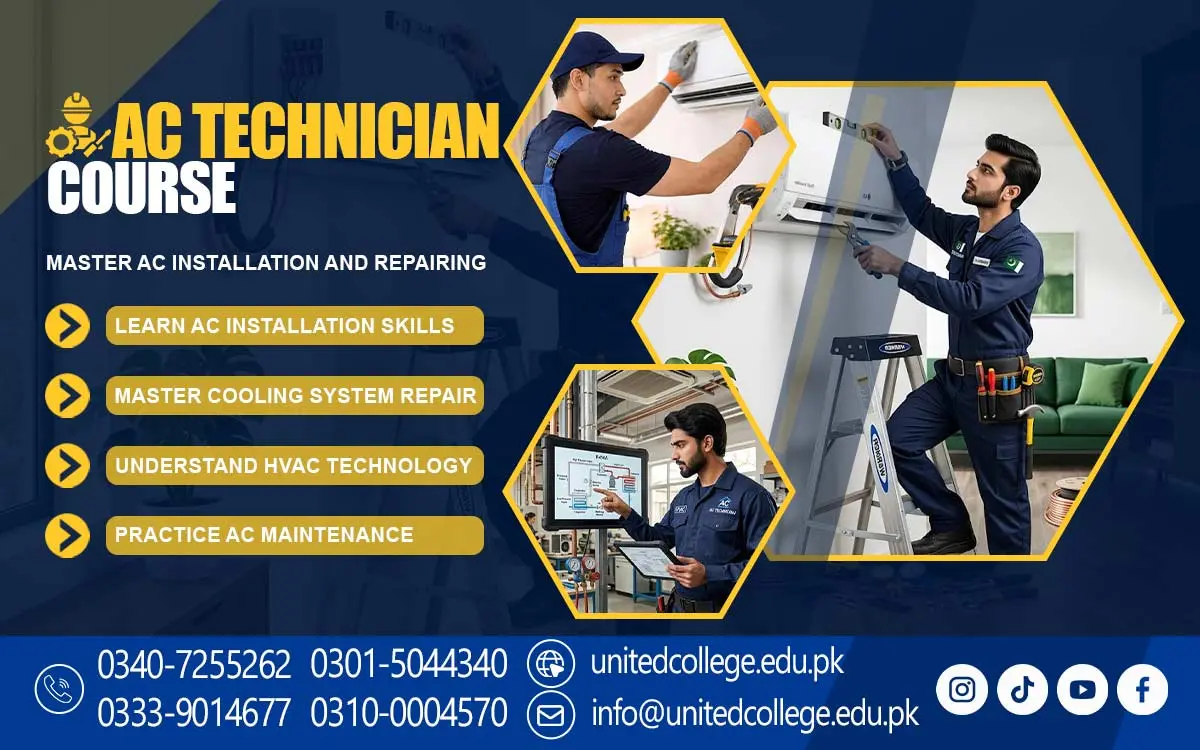

AC Technician Course in Waziristan to Develop Servicing Skills
AC Technician Course in Waziristan to Build Hands-On Skills for Modern Cooling Systems
Air conditioning systems play an important role in homes, offices, shops, and other indoor spaces. When an AC stops cooling properly or develops a fault, technicians need the right knowledge to identify the problem and choose a safe solution. The AC Technician Course in Waziristan can help beginners, students, and fresh learners explore this technical field and understand how air conditioners work.
Through practical learning, students can become familiar with installation procedures, routine maintenance, common faults, and essential safety rules. This knowledge provides a starting point for developing useful technical abilities. Anyone interested in mechanical and electrical work can explore an Air Conditioning Course to learn the basics before progressing towards more advanced servicing and repair tasks.
Understand the Components That Keep Cooling Systems Running
An air conditioner contains several connected components that work together to transfer heat. In a typical split AC, the indoor unit contains the evaporator coil and fan, while the outdoor unit houses the compressor and condenser coil. Refrigerant moves through the system, absorbing heat indoors and releasing it outside. The compressor helps circulate the refrigerant, while the condenser allows heat to escape.
A thermostat or temperature sensor helps the system respond to indoor temperature changes. Learning the purpose of these components helps students understand why an AC may lose cooling, stop unexpectedly, or produce unusual sounds. Through the AC Technician Course in Waziristan, learners can develop HVAC Basic Skills by studying component functions, understanding the cooling cycle, and recognizing how different parts affect system performance.
Turn Basic Installation Knowledge Into Practical Technical Ability
Correct installation is essential for reliable air conditioner operation. Learners need to understand how technicians assess the installation location, position indoor and outdoor units, plan drainage, and follow manufacturer instructions. Incorrect positioning or poor drainage can contribute to water leakage, while unsuitable pipe arrangements may affect system performance. Students should also learn why electrical supply requirements and secure mounting matter before an AC is switched on.
AC Installation and Repair Skills develop gradually through clear demonstrations and supervised practice. An AC Repairing Course can introduce the difference between installing a new unit and working on an existing system. Tasks involving refrigerant piping, vacuum procedures, leak testing, and refrigerant charging require appropriate training and specialist equipment. Beginners should learn these procedures under qualified supervision rather than attempting them independently.
Recognize Early Warning Signs Before a Fault Gets Worse
Air conditioners often show warning signs when a component or operating condition needs attention. Weak airflow may result from a dirty filter, an obstructed air inlet, or a problem with the fan. Water leakage can indicate a blocked drain or another issue that needs inspection. Unusual noises, frequent shutdowns, and poor cooling may also point to faults. Cooling System Troubleshooting teaches learners to examine symptoms carefully instead of replacing parts without evidence.
Students can practise recording the reported problem, checking accessible areas safely, and comparing observations with the manufacturer's guidance. They should also understand that one symptom can have several possible causes. A careful inspection helps narrow down the possibilities and identifies when advanced testing is necessary. Developing this habit can reduce guesswork and improve the quality of technical work.
Handle Servicing Tools With Purpose and Precision
AC technicians use a range of tools to inspect, clean, measure, and maintain cooling equipment. Common tools include screwdrivers, spanners, pliers, cleaning brushes, and suitable measuring instruments. A multimeter can help trained technicians assess electrical values, while manifold gauges support specific refrigerant-system pressure checks. Vacuum pumps and leak detectors are used for particular installation and servicing procedures.
Learners need to understand what each tool does, how to inspect it before use, and which precautions apply. During the AC Technician Course in Waziristan, beginners should become familiar with tool selection and the importance of following equipment instructions. They should never assume that a tool is safe simply because it looks familiar. Correct handling protects the technician, prevents avoidable equipment damage, and supports accurate servicing. Specialist instruments should only be used after suitable instruction.
Make Safety the First Step in Every Repair Procedure
Electrical systems and refrigerant circuits require careful handling. Before cleaning or inspecting an air conditioner, technicians must follow the correct power-isolation procedure and confirm that the equipment is safe to work on. Some electrical components, including capacitors, can retain a dangerous charge after the power supply has been disconnected. Learners should never open electrical sections or perform live testing without suitable training and protective equipment.
Refrigerant also requires special precautions because escaping liquid can cause cold burns, and certain refrigerants may present additional hazards. Technicians must follow approved procedures for leak detection, recovery, and handling instead of releasing refrigerant into the atmosphere. Good AC Technician Skills include recognizing personal limits, keeping the work area safe, and asking a qualified professional to handle tasks beyond a beginner's competence.
Build Strong Maintenance Habits That Support Better AC Performance
Regular Air Conditioning Maintenance helps keep equipment clean and makes some developing problems easier to notice. Depending on the manufacturer's instructions, routine work may include cleaning or replacing accessible air filters, inspecting airflow, checking drain outlets, and looking for visible damage. Dirty coils can interfere with heat transfer, so technicians need to understand suitable cleaning methods for the specific unit. Outdoor equipment also needs enough clear space for air to move freely.
Through AC Technician Training, learners can practise following a maintenance checklist, recording observations, and identifying issues that require further inspection. They should understand that cleaning alone cannot fix every cooling problem. For example, poor performance may also involve electrical faults, sensor problems, or refrigerant-circuit issues. A systematic approach helps technicians distinguish routine maintenance from repairs that need advanced knowledge.
Develop Technical Confidence Through Observation and Guided Practice
Beginners learn more effectively when they build knowledge in stages. First, they can study AC components and the cooling cycle, then learn tool identification, safety procedures, and routine maintenance. With guidance, they can observe experienced technicians, practise approved tasks, and compare their findings with equipment manuals. Keeping notes about different unit types, common symptoms, and maintenance procedures can also improve understanding.
Learners exploring structured training may consider the AC Technician Course offered by United College of Technology and confirm the current course content and practical arrangements directly with the institution. The aim should be to understand why a procedure is necessary rather than simply copy another person's actions. Regular practice, patience, and useful feedback can help students develop a more careful approach to technical problems.
Turn Your Learning Into a Foundation for Future Technical Work
Air conditioning knowledge can support several paths for further skill development. After gaining suitable training and experience, learners may assist experienced technicians, contribute to basic maintenance work within their abilities, or continue developing installation and diagnostic skills. Some may later consider independent repair services once they have the required competence, tools, experience, and understanding of applicable safety requirements.
Training does not guarantee employment or income, so learners should focus on building reliable skills and understanding the needs of customers and equipment. The AC Technician Course in Waziristan offers a starting point for people interested in learning how modern cooling systems operate and how technicians maintain them. By choosing training carefully, following safety procedures, and practising consistently, beginners can turn an interest in air conditioning into a stronger foundation for continued technical growth.
Frequently Asked Questions (FAQs)
A faulty sensor may send incorrect temperature readings, causing the AC to cool poorly, run longer than expected, or stop at the wrong time.
Proper drainage allows condensed water to flow away from the indoor unit and helps prevent water spills, damp surfaces, and related damage.
A relay acts as an electrically controlled switch that helps control power to particular components, depending on the system's design.
Dust, moisture, and debris can collect around outdoor equipment and affect its condition. Technicians should inspect units according to their surroundings and manufacturer guidance.
A symptom shows that something may be wrong, while the root cause explains why the problem occurred. Identifying the cause helps prevent ineffective repairs.
A checklist helps technicians follow a consistent inspection process, record completed tasks, and reduce the chance of overlooking important maintenance points.
Admission Open: Start Your Professional Journey Today!
Join United College of Technology and build a career with practical training, recognized certifications, and Gulf job support. Seats are limited.
Apply Now via WhatsAppContact Information
- Address: Rawalpindi: F-272 Main New Katarian Stop, Old IJP Road | Lahore Campus: Lahore, Pakistan
- Phone/WhatsApp: 0340-7255262 / 0333-9014677 / 0301-5044340 / 0310-0004570 / 051-8770756
- Website: unitedcollege.edu.pk
















Leave a Comment